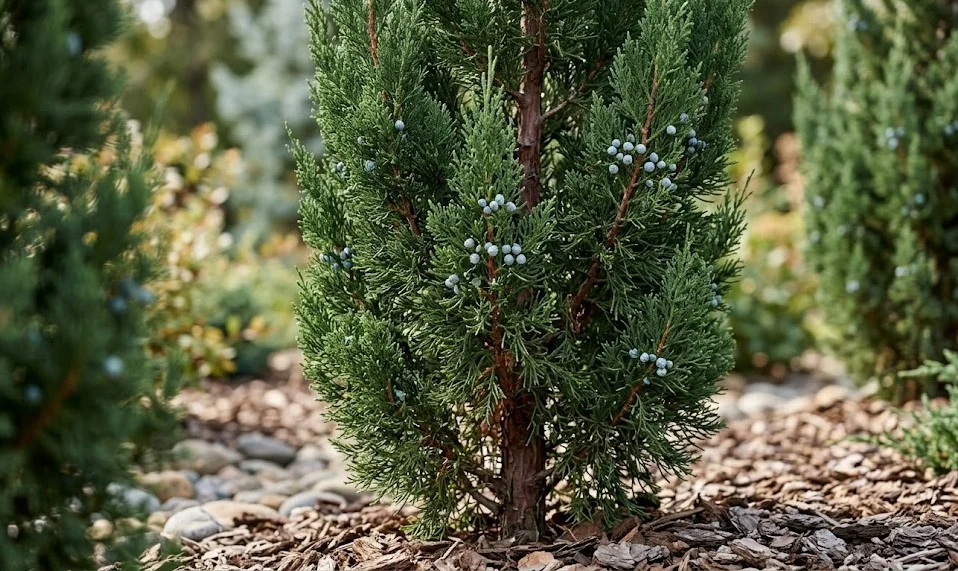

Eastern red cedar is a dependable evergreen for gardens, farms, windbreaks, wildlife corridors, and large landscape designs. Successful planting begins with understanding its mature size, root behavior, light needs, and tolerance for lean soils. Propagation is possible from seed, cuttings, and selected nursery material, but each method has different results. A thoughtful start gives this long-lived conifer the best chance to become stable, attractive, and resilient.
Planning the planting location
The best planting site is sunny, open, and well drained. Eastern red cedar can survive in partial shade, but it becomes denser and more visually balanced in full sun. If the aim is screening, a bright location helps plants fill out from top to bottom. Shaded lower branches often thin over time and may not recover.
Spacing depends on the final purpose of the planting. For a natural specimen tree, allow enough room for the canopy to expand without constant pruning. For a windbreak or privacy row, plants are usually spaced closer, but not so close that air circulation disappears. Overcrowding creates competition and encourages interior browning.
Soil testing is useful when planting large numbers of trees or establishing a professional landscape. Eastern red cedar tolerates a wide pH range, but extreme conditions may slow growth. Drainage should be evaluated before planting because wet soil is more damaging than low fertility. A simple test hole filled with water can reveal whether water drains away at a reasonable pace.
The surrounding landscape should also be considered. This species can host rust fungi that affect apples, hawthorns, serviceberries, and related plants. In regions where cedar-apple rust is common, avoid placing large numbers of Eastern red cedars immediately beside susceptible fruit trees. Where both are already present, resistant fruit cultivars and good sanitation become important.
More articles on this topic
Planting container-grown and balled trees
Container-grown Eastern red cedar can be planted in spring or autumn in many regions. Spring planting allows roots to establish before winter, while autumn planting reduces heat stress if soil remains warm enough for root growth. Summer planting is possible but requires careful watering. Avoid planting during frozen ground, extreme drought, or periods of intense heat.
The planting hole should be two to three times wider than the root ball. It should not be deeper than the root ball because settling can bury the trunk flare. The top of the root system should sit level with or slightly above the surrounding soil. Planting too deeply is one of the most common causes of slow decline in conifers.
When removing a container plant, inspect the roots carefully. Dense circling roots should be loosened, teased outward, or cut where necessary. If the root mass is very tight, vertical scoring around the sides can encourage new roots to grow into the surrounding soil. A plant that remains trapped in its original root pattern may struggle for years.
Balled-and-burlapped trees require similar attention. Natural burlap can be cut away from the upper part of the root ball after the tree is positioned. Wire baskets should be removed or at least cut down from the top and sides where practical. Any twine around the trunk must be removed because it can girdle the tree as it grows.
More articles on this topic
Propagating from seed
Seed propagation is useful for wildlife plantings, restoration projects, and large informal landscapes. It produces genetic variation, which can be beneficial for ecological resilience. However, seedlings may differ in growth habit, color, density, and berry production. Seed propagation is less suitable when uniform ornamental form is required.
Eastern red cedar seeds are enclosed in berry-like cones that mature on female plants. These cones are usually collected when they are fully colored and ripe. The fleshy coating can inhibit germination, so cleaning the seed improves results. In nature, birds help this process by eating the cones and dispersing the seeds.
Germination can be slow and uneven because the seeds often have dormancy mechanisms. Warm and cold stratification may be needed to encourage germination. Many growers use a period of warm moist storage followed by cold moist storage to imitate seasonal conditions. Even with proper treatment, germination may take patience.
Seedlings should be grown in well-drained media and bright light. They are vulnerable to damping-off if kept too wet or crowded. Once they develop a strong root system, they can be potted on or planted into prepared nursery rows. Young seedlings should be protected from heavy weed competition during establishment.
Propagating selected forms from cuttings
Cuttings are used when the goal is to reproduce a specific cultivar or desirable individual. Unlike seedlings, cuttings preserve the parent plant’s characteristics. This is important for narrow, blue-toned, compact, or especially dense forms. Professional nurseries commonly rely on vegetative propagation for uniform plants.
Semi-hardwood or hardwood cuttings can be taken from healthy, vigorous shoots. Material from younger plants or juvenile growth often roots more readily than old, mature wood. Cuttings should be taken with clean tools and kept from drying before sticking. A heel of older wood may improve rooting in some junipers.
A well-drained propagation medium is essential. Excess moisture around cuttings encourages rot before roots form. Bottom heat, humidity control, and rooting hormone can improve success. Even so, rooting may be slow, and not every cutting will succeed.
After rooting, young plants should be acclimated gradually to lower humidity and brighter conditions. Sudden exposure can dry tender new roots and foliage. Once the plant has filled its container with roots, it can be shifted into a larger pot. Strong young plants should be grown on before being placed into demanding landscape sites.