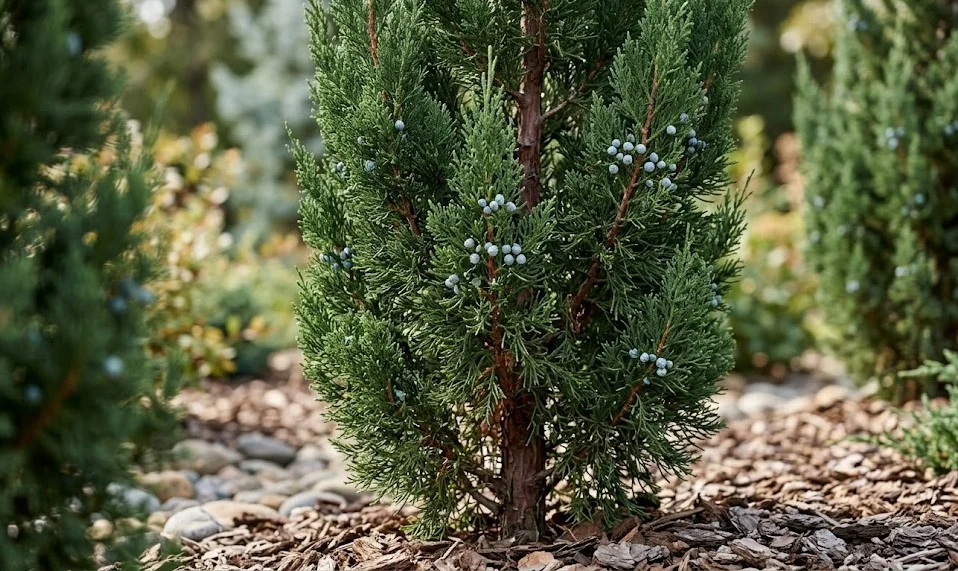

Eastern red cedar is widely valued because it remains attractive under dry, exposed, and low-fertility conditions. Even so, watering and fertilizing are important during establishment and can influence long-term density, color, and stress tolerance. The key is moderation, because this evergreen suffers more often from excess moisture and overfeeding than from mild neglect. A professional approach respects the plant’s natural adaptation to lean, well-drained environments.
Watering newly planted trees
Newly planted Eastern red cedar needs consistent moisture while it forms new roots beyond the original root ball. This does not mean the soil should stay saturated. The goal is to water deeply, then allow the upper soil to dry slightly before the next irrigation. That rhythm encourages roots to expand and breathe.
During the first several weeks after planting, the root ball should be checked frequently. Container media can dry faster than surrounding garden soil, especially in warm weather. A plant may appear well watered at the surface while the original root ball is dry inside. Hand-checking soil moisture is more reliable than watering by habit.
Deep watering should wet the root zone rather than only the surface. Slow irrigation from a hose, drip line, or watering basin is usually effective. Fast runoff wastes water and may leave the lower roots dry. Mulch helps keep the moisture pattern more stable between waterings.
Young trees planted in spring may need extra attention during their first summer. Heat, wind, and competition from grass increase water demand. If rainfall is irregular, a weekly deep watering may be needed on many soils. Sandy sites may require more frequent monitoring, while clay soils may require longer intervals.
More articles on this topic
Watering established plants
Established Eastern red cedar is drought tolerant and usually does not need routine irrigation. Its roots can explore a relatively broad area once the plant is settled. In average climates, natural rainfall is often enough for mature trees. Supplemental watering becomes useful mainly during prolonged dry periods.
Drought stress may appear as dull foliage color, browning branch tips, or premature interior shedding. Some interior browning is normal on evergreens, especially in autumn. The concern increases when outer growth also becomes dry, brittle, or faded. A careful check of soil moisture helps distinguish drought from disease or pest injury.
When watering established plants, deep and infrequent irrigation is best. A slow soak across the root zone supports deeper roots and reduces surface dependency. Sprinkling the foliage is usually unnecessary and can increase humidity around dense canopies. Water should be applied to the soil, not used as a cosmetic rinse.
Avoid irrigating established Eastern red cedar on the same schedule as lawns or moisture-loving perennials. Lawn irrigation is often too frequent and too shallow for conifers adapted to dry soil. Constant moisture near the trunk can weaken roots and promote disease. Separate irrigation zones are ideal in professionally designed landscapes.
More articles on this topic
Avoiding overwatering and drainage stress
Overwatering is one of the most serious cultural problems for Eastern red cedar. The plant needs oxygen around its roots, and saturated soil limits that oxygen. Roots under chronic water stress become less efficient and more vulnerable to decay. The foliage may turn pale or brown even though water is abundant.
Symptoms of overwatering can resemble drought, which often leads gardeners to add even more water. This is why soil inspection is essential before irrigation decisions are made. If the soil smells sour, feels sticky, or remains wet for days, watering should be reduced. Improving drainage may be more important than adjusting the watering schedule.
Mulch should be used carefully in wet sites. A thin mulch layer is beneficial, but deep mulch can keep the root collar too moist. Mulch must be pulled back from the trunk to prevent bark problems. The best mulch arrangement is broad, shallow, and open around the stem.
If the site is naturally wet, Eastern red cedar may not be the right species. Raised berms can sometimes solve moderate drainage problems. However, planting into a consistently waterlogged area is risky. Long-term success depends on matching the plant to the soil rather than forcing it into unsuitable conditions.
Fertilizing for balanced growth
Eastern red cedar generally needs little fertilizer in ordinary garden soil. Its natural tolerance of poor soils means it can remain healthy where many ornamental plants struggle. Excess fertilizer can push weak, loose growth and reduce the plant’s compact appearance. In most cases, fertilization should be light and occasional.
Before feeding, observe the plant’s annual growth, color, and density. A healthy plant with steady growth does not need extra nutrients simply because the season has changed. Yellowing or poor growth may result from shade, water stress, root damage, or pest activity rather than nutrient deficiency. Fertilizer should not be used as a guesswork remedy.
When fertilizer is appropriate, spring is the best time. A slow-release product formulated for trees, shrubs, or evergreens can be used at a conservative rate. It should be distributed evenly over the root zone rather than concentrated near the trunk. Watering after application helps prevent localized salt injury.
Organic matter can support soil health without forcing rapid growth. Compost should be used sparingly and not piled against the trunk. Decomposing mulch slowly releases nutrients and improves soil structure over time. This gradual approach suits the growth pattern of Eastern red cedar.
Reading the plant’s response
A well-watered and properly nourished Eastern red cedar has firm foliage, steady shoot extension, and good color for its type. Some cultivars naturally appear bluish, gray-green, or darker green, so color should be judged against the specific plant. Seasonal bronzing may occur in cold weather and is not always a problem. New growth in spring is often the best indicator of vigor.
Weak growth at the top may indicate root stress, drought, or planting depth problems. Thinning from the inside can be natural if the outer canopy is healthy, but heavy interior loss may suggest shade or stress. Browning on one side can point to winter wind, reflected heat, root disturbance, or pest concentration. Observing patterns is more useful than reacting to a single symptom.
Soil moisture should be checked at several points around the plant. A wet area on one side and dry soil on another can create uneven growth. Drip irrigation lines should be inspected to ensure emitters are not blocked or misplaced. In large plantings, a few stressed trees may reveal irrigation or soil differences across the site.
The best watering and fertilizing program is flexible. It changes with soil type, weather, plant age, and exposure. Eastern red cedar rewards careful observation more than rigid scheduling. Once established, it usually performs best when supported lightly and not overmanaged.