
Eastern red cedar grows best in bright, open conditions where direct sunlight supports dense foliage, strong branching, and reliable long-term health. Although the plant can tolerate some shade, it is not a true shade evergreen. Light level directly affects crown density, color, disease pressure, and the success of hedges or screens. Choosing the right exposure is therefore one of the most important decisions in cultivation.
Full sun and plant performance
Full sun is the ideal exposure for Eastern red cedar. In practical garden terms, this means at least six hours of direct sunlight each day. Plants grown in full sun usually develop a denser canopy and stronger overall structure. The foliage also tends to hold better color and remain more evenly distributed.
Open light encourages growth from the lower branches. This is especially important when the plant is used as a privacy screen, windbreak, or wildlife shelter. If the base becomes shaded, lower foliage may thin and expose the trunk. Once old interior branches become bare, they rarely refill completely.
Full sun also helps keep foliage dry after rain or dew. Faster drying reduces the conditions that favor some fungal diseases. This does not eliminate disease risk, but it improves the plant’s natural resilience. Good light and airflow often work together.
Young plants in very hot climates may show temporary stress after planting in intense sun. This is usually a root establishment issue rather than a sign that the species prefers shade. Adequate watering during establishment helps the plant adjust. Once established, Eastern red cedar handles heat and sun well.
More articles on this topic
Partial shade and its limitations
Eastern red cedar can survive in partial shade, especially where it receives morning sun or broken light. However, survival is not the same as best performance. In reduced light, growth often becomes more open and less symmetrical. The plant may look acceptable for years but gradually lose density.
Shade from buildings can be more challenging than filtered shade from high trees. Building shade may create long periods with little direct light and poor air movement. In such sites, foliage can remain damp longer after rainfall. That combination increases the risk of thinning and disease problems.
Competition from nearby trees also matters. Large trees reduce both light and soil moisture. Eastern red cedar is drought tolerant when established, but young plants can struggle against established tree roots. A partially shaded site with heavy root competition is much harder than a bright, open site.
Cultivar choice may slightly influence shade tolerance, but it does not change the plant’s basic needs. Narrow or dense ornamental forms still need strong light to maintain their shape. Planting them in shade often leads to disappointing results. Site correction is more effective than relying on cultivar toughness.
More articles on this topic
Using light wisely in landscape design
When designing with Eastern red cedar, consider how light will change over time. A sunny young garden may become shaded as nearby trees mature. A small screen may cast shade on itself if plants are spaced too tightly. Long-term planning prevents future thinning and maintenance problems.
Rows used for screening should be arranged so each plant receives light on all sides during establishment. If planted against a fence, wall, or building, the shaded side may become sparse. A little extra spacing from structures can preserve better form. This is especially important for formal or semi-formal designs.
In mixed plantings, Eastern red cedar works well as a vertical evergreen accent. It should be paired with plants that do not smother its lower branches. Low perennials, grasses, and open shrubs are usually better companions than aggressive tall shrubs. The goal is to preserve light around the base.
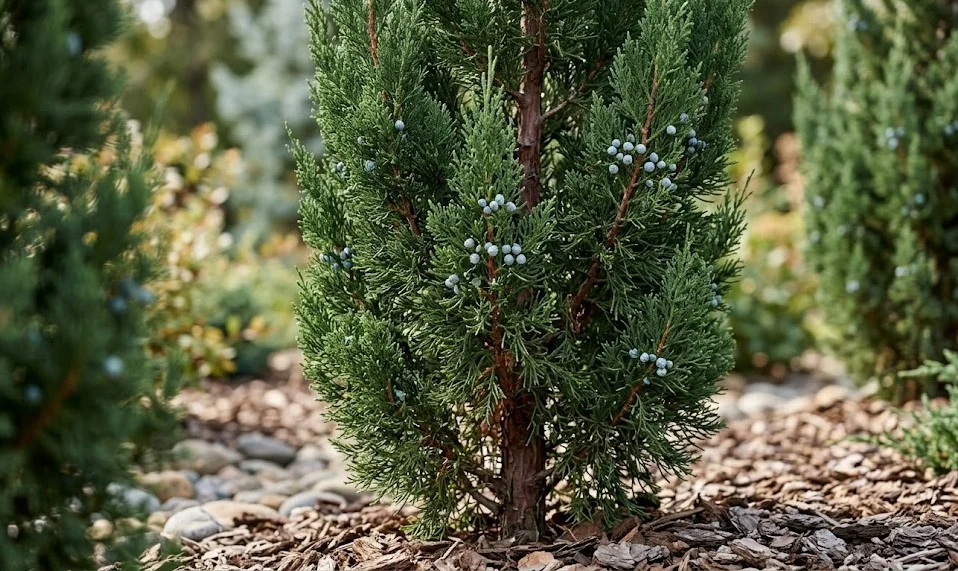
Light also affects berry production on female plants. Good sun generally supports stronger flowering and fruiting. The bluish berry-like cones are valuable for wildlife and add ornamental interest. For ecological plantings, open sunny placement improves both plant health and habitat function.