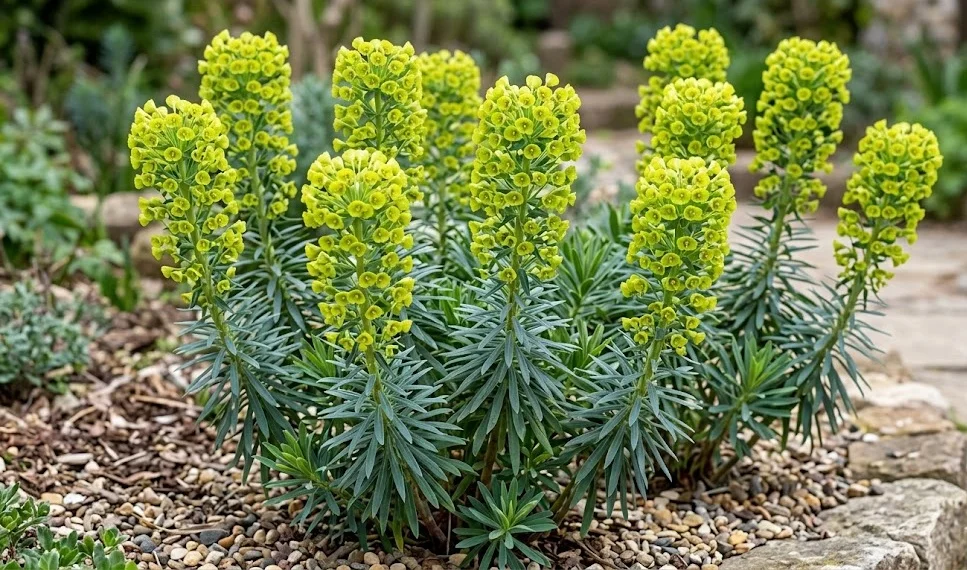

Planting Mediterranean spurge successfully begins with understanding that it is a dry-garden plant with a strong preference for drainage and light. It can be remarkably resilient once established, but young plants still need careful settling-in during their first season. The best results come from preparing the planting area broadly, spacing the plant generously and avoiding the temptation to enrich the soil too heavily. Propagation is also straightforward when timed correctly, especially by basal cuttings or division in spring. RHS+1
Preparing the planting site
Choose a site that receives plenty of direct light and does not remain wet after rain. Mediterranean spurge dislikes stagnant moisture at the crown, especially during cool weather. A raised border, gravel bed or gentle slope is often ideal. Flat, compacted ground should be loosened deeply before planting.
Preparation should focus on structure rather than richness. If the soil is heavy, incorporate gritty material and organic matter over a wide area to open the texture. If the soil is sandy and very poor, a small amount of mature compost can help young roots establish. The aim is a firm, free-draining soil that holds some moisture but never becomes sour or waterlogged.
Remove perennial weeds before planting. Once Mediterranean spurge forms a woody base, it is awkward to weed around without breaking stems. Clean ground also reduces competition during establishment. This matters because the plant’s drought tolerance develops after roots have spread, not immediately after planting.
Consider the final size from the beginning. A small nursery plant can become a broad, architectural clump within a few seasons. Crowded planting causes leaning, poor air movement and difficult maintenance. Good spacing also allows the bracts to be seen properly in spring.
More articles on this topic
Planting technique and establishment
Planting in spring is often the safest option in cooler or wetter climates. The soil is warming, roots can grow actively and the plant has months to establish before winter. Autumn planting can work in mild regions with excellent drainage. In cold, wet gardens, autumn planting carries more risk because young roots may sit in wet soil before they are fully active.
The planting hole should be slightly wider than the root ball and no deeper than necessary. The top of the root ball should sit level with the surrounding soil, or just slightly proud in heavy ground. Planting too deeply can bury the crown and encourage rot. Firm the soil gently without compacting it into a hard pan.
Water thoroughly after planting to settle soil around the roots. This first watering is not a sign that the plant wants constant moisture. It simply removes air pockets and helps the root system make contact with the surrounding soil. After that, watering should be guided by weather, soil type and the plant’s stage of establishment.
During the first growing season, check the plant regularly. Young plants may need occasional deep watering during prolonged dry spells. Frequent shallow watering is less useful because it encourages roots to remain near the surface. A well-established plant should gradually become much more independent.
More articles on this topic
Propagation by cuttings
Basal cuttings are one of the most reliable ways to propagate Mediterranean spurge. They are usually taken in spring or early summer when young shoots are firm but not woody. A basal cutting should include a short section from near the base, where the shoot has enough energy to root. Clean tools and careful handling are essential because the cut surfaces release irritant sap.
After taking cuttings, many growers briefly stop the sap flow before inserting the material. Traditional advice includes dipping cut surfaces in lukewarm water or charcoal to reduce bleeding. The cutting should then be placed into a sharply drained propagation mix. Excess moisture around unrooted cuttings is one of the main causes of failure. RHS
The propagation environment should be bright but not scorching. Strong direct sun can wilt cuttings before roots form. Gentle warmth and steady, moderate moisture are usually more useful than heavy watering. Ventilation is also important because stagnant humidity encourages fungal decay.
Rooted cuttings should be hardened off gradually. A young plant moved too quickly from sheltered propagation conditions to a dry, windy border can stall or scorch. Once roots fill a small pot, the plant can be potted on into a gritty, free-draining mix. It should be planted out only when growth is firm and the weather is suitable.
Division and seedling management
Division can be used on suitable plants, although Mediterranean spurge is not always as easy to divide as soft clump-forming perennials. The best candidates are healthy plants with several distinct growing points. Early spring is the most sensible time because the plant can recover as the growing season begins. Each division needs roots, shoots and a clean cut surface.
Large, woody plants may resent rough division. If the crown is old and brittle, cuttings or seedlings may be a better renewal method. Forcing apart an aged clump can leave damaged pieces that fail to establish. A professional approach is to assess the plant first rather than dividing automatically.
Seedlings may appear around established plants. They can be useful because they are often well adapted to the exact garden conditions. However, they may not always appear where they are wanted. Unwanted seedlings should be removed while small, before the root system becomes persistent.
Selected seedlings can be transplanted when young. Move them with as much root as possible and water them in carefully. They should be placed in open, well-drained ground, not tucked into damp shade. In this way, natural self-sowing can become a practical and economical propagation method.