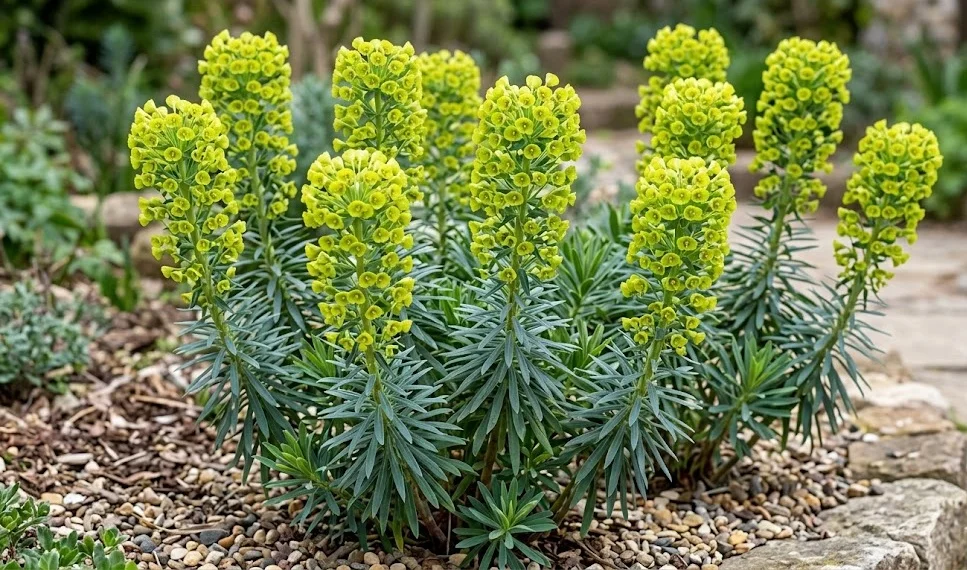

Mediterranean spurge is one of those architectural perennials that earns its place long before the flowers open. Its blue-green foliage, upright stems and lime-yellow spring bracts give structure to borders when many softer plants are still waking up. It is generally grown as an evergreen or semi-evergreen sub-shrub, reaching around 1–1.2 metres in good conditions, with a naturally bold outline that suits gravel gardens, dry borders and Mediterranean-style planting. Its milky sap is irritating to skin and eyes, so good gloves and careful handling are part of responsible cultivation. RHS+2missouribotanicalgarden.org+2
Understanding the plant’s natural character
Mediterranean spurge has a woody-based habit, which means it behaves differently from many soft herbaceous perennials. The stems persist for more than one season, and the plant gradually forms a rounded clump with a strong vertical rhythm. Its leaves are usually narrow, leathery and grey-green, helping the plant tolerate bright light and relatively dry air. This foliage is not just decorative, because it also tells a gardener that the plant dislikes heavy, constantly wet soil.
The flowering display is made of conspicuous bracts rather than showy petals in the usual sense. These bracts create large heads of greenish yellow colour from late winter or early spring into early summer, depending on climate and exposure. The effect is valuable because it bridges the gap between winter structure and the first flush of warm-season perennials. In mixed borders, this makes the plant especially useful as a seasonal anchor.
A mature plant can look almost shrub-like, but it should not be treated exactly like a conventional shrub. Old flowering stems eventually lose quality and are best removed after they have finished their display. New shoots usually arise from the base and become the next generation of flowering stems. The grower’s task is to preserve this renewal cycle without cutting the plant back so hard that its structure is weakened.
The plant’s Mediterranean background explains much of its behaviour in cultivation. It prefers open air, sharp drainage and a position where the crown does not remain wet through winter. It is not a plant for rich, damp ground that stays cold and compacted for long periods. When its natural preferences are respected, it is usually vigorous, long-lasting and relatively undemanding.
More articles on this topic
Choosing the right garden position
The best position is sunny, open and well drained. Full sun encourages compact growth, firm stems and strong colouring in the foliage. In very hot inland gardens, a little afternoon shade can reduce stress, but deep shade usually makes the plant loose and less convincing. The ideal site lets light reach the crown while allowing air to move freely through the planting.
Mediterranean spurge works beautifully in gravel gardens, dry banks, courtyard beds and the warm edge of mixed borders. It also suits coastal-style schemes where wind and lean soil favour tough, waxy-leaved plants. Its architectural form looks especially good beside ornamental grasses, rosemary, lavender, cistus and silver-leaved perennials. These companions share similar requirements, so the whole planting can be managed with the same dry-garden logic.
Avoid planting it where roof runoff, paving drainage or irrigation overspray keeps the soil wet. The plant may tolerate short wet spells, but persistent winter moisture around the roots increases the risk of decline. Heavy clay can be improved, but only if drainage is genuinely changed rather than merely covered with a thin layer of compost. Raised beds, slopes and gravel-amended planting pockets are often better than flat, compacted ground.
The position should also take safety and access into account. Because the sap is irritant, it is not ideal where children, pets or frequent passers-by will brush against broken stems. A place set slightly back from a narrow path is usually wiser than the front edge of a walkway. In professional planting, this practical detail matters as much as colour and texture.
More articles on this topic
Soil conditions and drainage
Mediterranean spurge grows best in soil that is light to moderately fertile and drains freely. It does not need heavily enriched ground, and excessive fertility can produce soft, floppy growth. A leaner soil often results in better stem strength and a cleaner outline. This is one reason the plant is so effective in gravel-based and Mediterranean-style designs. RHS+1
Good drainage begins below the surface, not just at the top. If water sits in the planting hole after rain, the site should be corrected before planting. Coarse mineral material can help improve structure, but it should be mixed through a broad area rather than dropped into the bottom of a hole. A sump-like hole in clay can trap water and create worse conditions for roots.
Soil pH is rarely the main concern unless conditions are extreme. The plant is more sensitive to waterlogging than to small variations in acidity or alkalinity. In many gardens, it performs well in neutral to alkaline soils, especially where drainage is sharp. Where soil is acidic but open and gritty, growth can still be satisfactory if the plant is not overfed or overwatered.
Mulching should be handled with restraint. A mineral mulch such as gravel helps keep the crown dry, suppresses weeds and reflects light around the plant. Thick organic mulch packed against the base can hold moisture and encourage rot. If organic matter is used, it should be kept away from the crown and applied lightly to improve soil life rather than to force lush growth.
Seasonal care through the year
In late winter and early spring, the plant becomes one of the most noticeable features in the border. Check for damaged stems, loosen any debris trapped around the crown and make sure neighbouring plants are not smothering new basal shoots. This is also the moment when flower heads begin to develop their strongest colour. Care should be gentle, because rough handling can snap stems and release sap.
During the main flowering period, the plant needs little active intervention. It should be observed for stem firmness, soil moisture and signs of crowding. If the clump is leaning because it is growing in shade, pruning alone will not correct the underlying problem. Improving light and reducing competition are usually more effective than staking a plant that has become too soft.
After flowering, spent stems should be removed selectively. Cut them low enough to clear old material, but do not damage the new shoots forming at the base. This keeps the plant fresh and prevents a tired, hollow centre from developing. Gloves, long sleeves and eye protection are sensible because the cut stems release milky latex.
In autumn, avoid heavy feeding or late cutting that stimulates tender growth. The plant should enter winter with firm stems and an open, dry crown. Remove fallen leaves from nearby trees if they collect around the base. A clean crown reduces the chance of fungal problems during cold, damp weather.
Managing growth and garden design
Mediterranean spurge has a strong personality, so it should be placed where its shape contributes to the whole composition. It can look awkward if squeezed between delicate bedding plants that need frequent watering. It is far more effective among drought-tolerant perennials and shrubs with similar rhythms. The plant’s bold heads also contrast well with fine foliage and airy flowering stems.
In smaller gardens, spacing is crucial. A young plant may look modest at first, but mature specimens can spread broadly and shade neighbouring plants. Crowding reduces air circulation and makes pruning more difficult. Leaving enough room from the beginning gives a cleaner, more professional result.
Self-seeding may occur in favourable climates and light soils. Some gardeners welcome seedlings because they provide replacements for older plants. Others remove seedlings early to prevent congestion or unwanted spread. The best approach is to monitor the border regularly and keep only seedlings that improve the design.
Container growing is possible, but it requires careful compost choice. A deep container with excellent drainage is essential, and the growing medium should contain mineral material to prevent waterlogging. Pots dry faster in summer but can remain dangerously wet in winter if standing in saucers. Raising containers on feet and keeping them in a bright, sheltered position improves reliability.
Safety and handling
The most important safety issue is the milky sap. Like many euphorbias, Mediterranean spurge can irritate skin and eyes, especially when stems are cut or broken. Professional gardeners usually treat pruning as a glove-and-eye-protection job rather than casual tidying. This simple habit prevents most unpleasant incidents. rhsplants.co.uk+1
Tools should be cleaned after cutting. Sap can remain on secateurs, gloves and clothing, so it is easy to transfer it accidentally to the face or eyes. Washing tools also reduces the chance of moving disease between plants. A careful routine is especially important when pruning several euphorbias in succession.
Plant waste should be handled thoughtfully. Freshly cut stems should not be left where pets may chew them or where children may pick them up. Composting is usually possible, but the material should be placed directly into the compost heap rather than left scattered. If local green-waste rules apply, they should be followed.
Safety does not make the plant unsuitable for gardens; it simply changes how it should be managed. Many excellent ornamental plants require informed handling. Mediterranean spurge rewards that care with year-round structure and a long seasonal display. A knowledgeable gardener can enjoy it confidently by respecting its sap and growth habit.
Long-term maintenance and renewal
Mediterranean spurge is not usually maintained by shearing. Its beauty comes from individual stems carrying foliage and flower heads, so indiscriminate cutting destroys the form. The better method is renewal pruning, where old flowering stems are removed and young basal stems are kept. This preserves both health and architectural value.
As plants age, the centre may become woody or sparse. If new shoots remain vigorous, selective pruning can extend the plant’s life for several years. If the base becomes weak and produces few replacement stems, it may be better to replace the plant with a young specimen. In professional planting, planned replacement is often more successful than trying to rescue an exhausted clump.
Stress usually shows through yellowing leaves, collapsing stems or poor flowering. The cause is often too much winter wet, too much shade or excessive competition rather than a lack of fertiliser. Correcting the site conditions is more important than applying general remedies. A plant adapted to lean conditions can be damaged by well-intentioned overcare.
The best long-term strategy is to grow the plant slightly hard. Give it sun, drainage, space and modest nutrition, then intervene only when renewal is needed. This approach produces firm growth, reliable flowering and fewer disease problems. It also keeps the plant looking natural rather than forced.