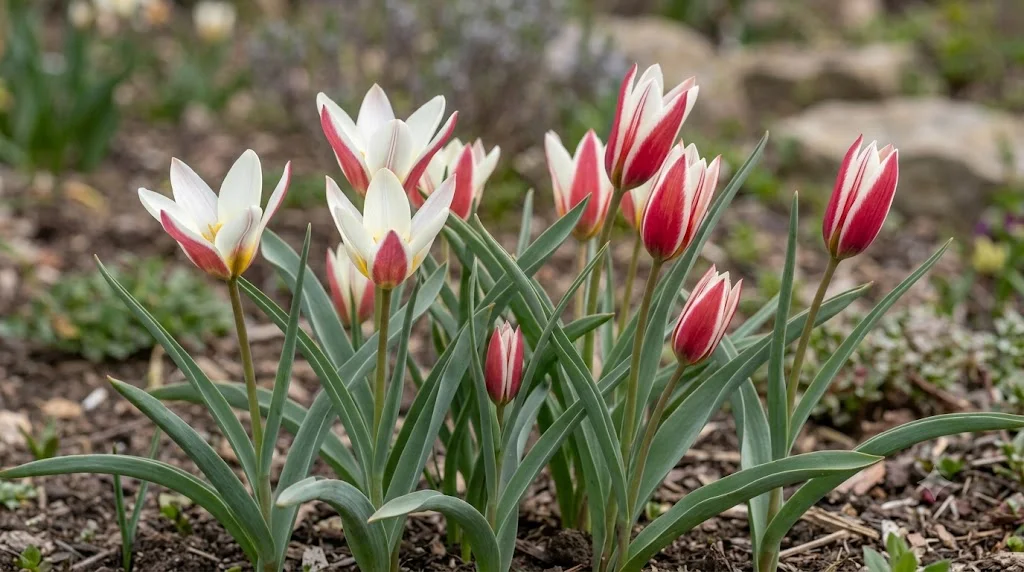

Planting lady tulips correctly is the foundation of healthy growth, dependable flowering, and gradual naturalisation. These small botanical tulips prefer a sunny site, sharply drained soil, and enough depth to protect the bulbs from temperature changes and surface disturbance. Propagation is possible through offsets and seed, although the two methods differ greatly in speed and predictability. Careful timing and patient aftercare allow a few bulbs to develop into an attractive colony over several seasons.
Preparing the site and planting bulbs
The planting area should be prepared before the bulbs arrive so they can be placed in the ground without unnecessary delay. Remove perennial weeds, loosen compacted soil, and check how quickly water drains after rainfall. If puddles remain for many hours, the bed should be raised or amended with coarse mineral material. Simply adding a small amount of sand to heavy clay rarely provides sufficient improvement.
Autumn is generally the best planting period because cool soil encourages root formation before winter. Bulbs planted too early in warm, wet ground may become vulnerable to fungal disease. Late planting is still possible while the soil remains workable, although root development may be delayed. In mild climates, planting can continue later than in areas where the ground freezes deeply.
Lady tulip bulbs are usually planted at a depth of approximately two to three times their own height. Deeper planting can provide stability and reduce rapid temperature fluctuations, especially in light soil. The pointed end should face upward, while the flat basal plate rests firmly on the soil. If the bulb’s orientation is unclear, placing it on its side is safer than forcing a potentially inverted position.
Spacing depends on whether the desired effect is formal, naturalistic, or intended for future expansion. Close groups create a strong display in the first spring, while wider spacing leaves room for offsets and seedlings. Bulbs should not be pressed together because contact can encourage disease transmission. Irregular clusters usually look more natural than straight lines or evenly measured rows.
More articles on this topic
Dividing offsets and rebuilding crowded clumps
Mature lady tulip bulbs often produce small daughter bulbs, known as offsets, around the parent bulb. These offsets gradually increase the size of the colony when growing conditions are favourable. Some may flower after one or two growing seasons, while very small bulbs require longer. Their development is faster than seed propagation because they already contain stored tissue from the parent plant.
The best time to lift and divide a clump is after the foliage has died back completely. At this stage, the bulbs are dormant and less vulnerable to physical disturbance. Use a hand fork at a safe distance from the visible planting position, then lift the soil gradually. Pulling directly on dried stems may detach the foliage without bringing the bulbs to the surface.
Once lifted, the bulbs should be separated gently rather than forced apart. Healthy offsets usually detach with light pressure, although some may remain firmly connected to the parent. Damaged, soft, or mouldy bulbs should be discarded to prevent problems after replanting. Sound bulbs can be allowed to dry briefly in a shaded, airy place before sorting.
Large offsets can be replanted at normal flowering depth, while very small ones may be placed in a nursery bed or container. A nursery area makes it easier to provide consistent care and monitor their development. The bulbs should still receive full sun and excellent drainage because sheltered conditions must not become wet conditions. Labels are valuable because young foliage can be difficult to identify among weeds.
More articles on this topic
Raising lady tulips from seed
Seed propagation produces genetic variation and can create large, natural-looking colonies over time. It is slower than division because seedlings require several years to reach flowering size. The resulting plants may differ slightly in height, colouring, flowering time, or vigour. This variability is part of the appeal for gardeners interested in species tulips and naturalistic planting.
Seed capsules should be left on selected healthy plants until they become dry and begin to split. Harvesting too early may produce immature seed with poor germination. The capsules can be collected into a paper bag and opened indoors once fully dry. Plastic containers should be avoided for fresh material because trapped moisture may encourage mould.
Fresh seed can be sown in pots or trays filled with a free-draining, low-fertility medium. The seeds should be spread thinly and covered with a light layer of grit or compost. Outdoor exposure to seasonal temperature changes often supports natural germination. The containers should be protected from rodents while still receiving rain, cold, and air circulation.
Seedlings usually produce a single narrow leaf during their early seasons. Their tiny bulbs must remain undisturbed while they slowly increase in size below the surface. Regular but restrained watering is needed during active growth, followed by a drier summer rest. Transplanting should be postponed until the young bulbs are large enough to handle safely.
Establishing new plantings after propagation
Recently divided or seed-grown bulbs need time to establish before they perform like mature plants. Their first priority is root development and bulb enlargement rather than immediate flowering. A modest display in the first season does not indicate failure. Consistent light, drainage, and undisturbed foliage are more important than forcing rapid results.
Newly planted bulbs should be watered after installation if the soil is dry. This settles loose soil around the basal plate and begins the rooting process. Further watering is usually unnecessary when autumn rainfall is regular. In containers or unusually dry weather, moisture levels should be checked rather than assumed.
A thin top dressing of grit can protect the planting surface and improve the microclimate around emerging shoots. Grit reduces soil splash, suppresses some weeds, and helps mark the planted area. It also makes the surface less attractive to animals that prefer loose organic compost. The material should not be piled deeply enough to bury new growth excessively.
Successful propagation requires patience because lady tulips develop according to a seasonal rhythm that cannot be rushed safely. Offsets may flower relatively quickly, while seedlings often take several years. Heavy feeding or excessive watering may increase disease rather than accelerate maturity. Steady, low-intervention care usually produces the strongest and longest-lived colonies.