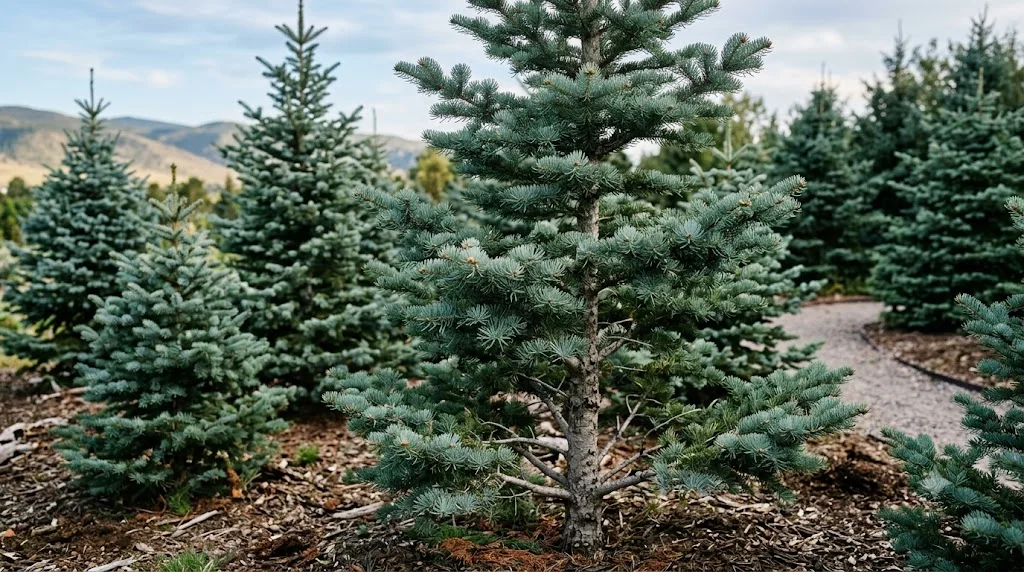

Colorado white fir can remain healthy for many years when it grows in well-drained soil and experiences limited environmental stress. Most serious problems begin when roots are weakened by waterlogging, drought, compaction, planting damage, or unsuitable climate. Accurate diagnosis is essential because several diseases, insects, and physiological disorders produce similar symptoms. Effective control starts with identifying the affected tissue, the distribution of damage, and the conditions that preceded it.
Recognizing early warning signs
Inspect the tree several times during the growing season rather than waiting for extensive decline. Look for changes in needle color, premature shedding, dead shoot tips, thinning branches, resin flow, bark injury, or fungal growth. Compare affected sections with healthy portions of the same tree. The location and pattern of symptoms often provide important diagnostic clues.
Uniform browning across exposed foliage may indicate drought, winter desiccation, heat, or chemical injury. Scattered dead shoots can suggest insects, cankers, or mechanical damage. Decline beginning near the base may be associated with root or trunk disorders. Symptoms that move upward from lower branches can differ significantly from those beginning at the leader.
Examine both sides of needles and inspect twigs closely with a hand lens when possible. Tiny insects, scale coverings, webbing, eggs, or fungal fruiting structures can easily be overlooked. Sticky honeydew may reveal sap-feeding insects even when the pests themselves are hidden. Fine speckling or bronzing often points toward mite feeding.
Consider recent changes around the tree before assuming an infectious disease is present. Excavation, soil filling, paving, herbicide drift, irrigation failure, and road salt can all produce serious injury. Root damage may not become visible in the crown until much later. A complete history of the site is therefore part of diagnosis.
More articles on this topic
Root and lower-trunk diseases
Poorly drained soil creates favorable conditions for destructive root pathogens. Affected trees may develop pale foliage, weak annual growth, branch dieback, or sudden wilting during warm weather. Roots can become dark, soft, or reduced in number, although they are difficult to inspect without causing further damage. Symptoms are often advanced by the time the crown visibly declines.
Water-mold organisms can infect roots and the lower trunk when soil remains saturated. Prevention depends largely on drainage, correct planting depth, and careful irrigation. Chemical treatments have limited value if the root zone continues to stay wet. Improving the environment is essential for any long-term recovery.
Armillaria-type root decay may occur in stressed trees, especially where infected stumps or roots remain in the soil. White fungal growth beneath loose bark or clusters of mushrooms near the base can support a diagnosis. The disease can progressively weaken structural roots and increase the risk of windthrow. Severely affected trees may need professional assessment for safety.
Trunk bark should be protected from mowing equipment, string trimmers, and repeated moisture accumulation. Wounds provide entry points for decay organisms and disrupt the movement of water and carbohydrates. Mulch rings reduce machinery damage when maintained correctly. Soil and mulch must never be piled against the root flare.
More articles on this topic
Needle, shoot, and branch diseases
Needle diseases may cause spotting, banding, discoloration, and premature shedding. Infection often becomes more severe where foliage stays wet for long periods and air circulation is poor. Dense surrounding vegetation can increase humidity around lower branches. Correct identification may require microscopic examination because several fungi produce similar symptoms.
Removing heavily infected fallen needles may reduce local sources of spores in small plantings. Overhead irrigation should be avoided when a confirmed needle disease is active. Watering the soil directly keeps foliage drier and reduces splash movement. Pruning nearby vegetation can also improve air movement without altering the fir’s natural form.
Canker diseases attack bark and cambial tissue on twigs, branches, or trunks. Affected branches may show resin, sunken bark, discoloration, and progressive dieback beyond the infected area. Drought and root stress often increase susceptibility. Dead branches should be removed back to healthy tissue during dry weather with clean tools.
The top leader can die after insect injury, frost damage, breakage, or infection. Several side shoots may then compete to replace it, producing a forked crown. One vigorous upright shoot can be selected and trained as the new leader. The remaining competitors should be shortened or removed gradually to restore a stable form.
Common insect and mite pests
Sap-feeding aphids and adelgid-like insects may colonize shoots or needles and reduce vigor when populations are high. Some produce waxy coverings, curled growth, or sticky honeydew. Natural predators often keep light infestations under control. Treatment should be considered only after the pest has been identified and damage is likely to become significant.
Scale insects attach to needles, twigs, or bark and may resemble small shells rather than living pests. Heavy infestations can cause yellowing, branch decline, and reduced shoot growth. Control timing is important because the mobile crawler stage is usually more vulnerable than mature scales. Dormant or horticultural oils must be used carefully to avoid foliage injury.
Spider mites can become troublesome during hot, dry, dusty weather. Their feeding causes pale stippling, bronzing, and gradual needle decline. Fine webbing may appear when populations are high, but the absence of visible webs does not rule them out. A white-paper tap test can help reveal moving mites.
Bagworms and other needle-feeding caterpillars may remove foliage from individual branches or entire young trees. Small cases are easier to control than large, mature bags. Hand removal can be effective on accessible trees before eggs hatch. Biological or conventional insecticides work best when larvae are young and actively feeding.
Applying integrated management
The strongest defense against pests and diseases is a healthy root system. Proper planting depth, suitable drainage, deep watering during drought, and protection from compaction improve natural resistance. Stressed trees release signals and develop tissues that may be more attractive or vulnerable to certain insects. Cultural care should therefore accompany every control program.
Pesticides should never be selected only from a general symptom such as browning. The product must be labeled for the identified pest, the specific plant, and the intended site. Timing, coverage, temperature, and pest life stage determine whether treatment succeeds. Incorrect application may injure beneficial organisms or the fir itself.
Pruning tools should be sharp and cleaned when moving between diseased plants. Cuts must be made outside the branch collar without leaving long stubs or damaging the trunk. Diseased material should be handled according to the biology of the confirmed problem. Composting infected branches may be unsuitable when pathogens can survive and spread.
Large trees, rapid decline, trunk damage, and possible structural instability require professional evaluation. Laboratory testing may be necessary when symptoms are complex or several causes are acting together. Early investigation provides more management options than waiting for widespread crown loss. A measured, evidence-based response protects both the tree and the surrounding landscape.