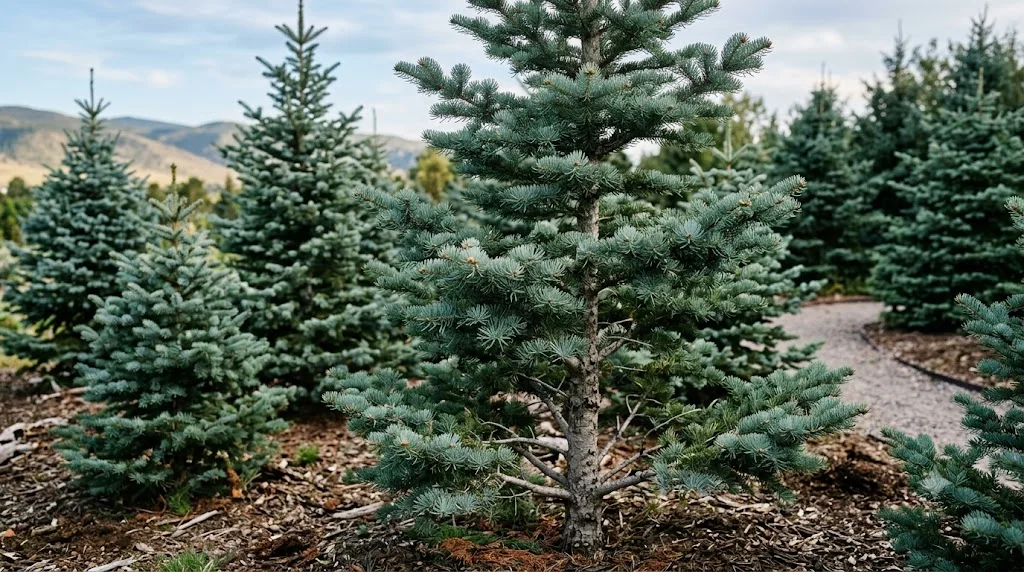

Colorado white fir naturally forms a balanced conical crown and usually needs very little pruning. Most work should be limited to removing dead, damaged, diseased, or structurally weak branches. Heavy cutting can permanently spoil the layered form because old bare wood may not produce new shoots. A careful approach preserves the central leader, branch collars, and living foliage needed for recovery.
Working with the tree’s natural form
A healthy young tree usually develops one dominant central leader surrounded by regular branch whorls. This structure should be protected because it determines the future stability and appearance of the crown. Routine shearing is unnecessary and can create dense outer growth over a bare interior. Natural annual extension produces a more durable and attractive tree.
The best time for corrective pruning is generally during late winter or early spring before strong new growth begins. Dead or dangerously broken branches can be removed whenever necessary. Pruning during dry weather may reduce the movement of certain disease organisms. Extremely cold periods should be avoided because frozen branches can split unpredictably.
Every cut should preserve the branch collar, the slightly swollen area where a branch joins the trunk or a larger limb. Cutting flush against the trunk removes protective tissue and enlarges the wound. Leaving a long stub also delays closure and creates dead tissue. A properly placed cut follows the natural boundary between branch and trunk.
Tools must be sharp enough to make clean cuts without crushing bark. Hand pruners suit small twigs, loppers handle moderate branches, and a pruning saw is safer for larger limbs. Tools should be cleaned when disease is suspected or when moving between trees. Large, high, or tensioned branches require professional equipment and experience.
More articles on this topic
Correcting leaders and damaged branches
Storms, animals, frost, or mechanical injury may destroy the terminal leader. When this happens, several upper side shoots often turn upward and compete for dominance. Select the strongest, best-positioned shoot to become the replacement leader. The other competing shoots can be shortened or removed without stripping the entire top.
A flexible replacement shoot may be tied loosely to a temporary vertical support. The tie should guide rather than constrict the stem and must be checked during the growing season. Once the shoot holds an upright position independently, the support should be removed. Gradual training produces a smoother transition than severe cutting.
Crossing, rubbing, or inward-growing branches can be removed while they remain small. Early correction prevents bark wounds and crowded unions later. When two healthy branches occupy the same space, retain the one that fits the crown structure better. Avoid removing many branches from a single whorl during one season.
Broken branches should be cut back to a suitable lateral branch or to the branch collar. Ragged tears must be trimmed without enlarging the wound unnecessarily. Wound paint is generally not needed on ordinary pruning cuts. Healthy tissue closes most effectively when the cut is correctly positioned and the tree is not under severe stress.
More articles on this topic
Avoiding damaging reductions
Colorado white fir cannot be maintained safely as a permanently small tree through repeated topping. Removing the upper crown destroys the central structure and encourages multiple weak leaders. Large exposed cuts may decay, while the replacement shoots can form unstable attachments. Selecting a naturally compact cultivar is better than forcing a large-growing tree into limited space.
Cutting branches back into old, leafless wood often leaves permanent bare stubs. New buds are most reliable on younger sections that still carry living needles. Reduction cuts should therefore end at a healthy lateral branch with enough foliage to continue growth. Even then, the natural outline may take several seasons to recover.
Severe pruning removes photosynthetic area and stored energy at the same time. A stressed tree may respond with weak shoots, additional dieback, or increased vulnerability to pests. If substantial corrective work is unavoidable, it should be distributed over several years. Root health and soil moisture should be improved before major pruning begins.
Mature Colorado white fir should be assessed by a qualified tree professional when branches threaten buildings, roads, or utility lines. Climbing and cutting large evergreen limbs can be dangerous because of their weight and arrangement. Professional assessment may show that selective reduction is possible, or that the tree has outgrown the site. Thoughtful early placement remains the most reliable way to avoid destructive cutting later.