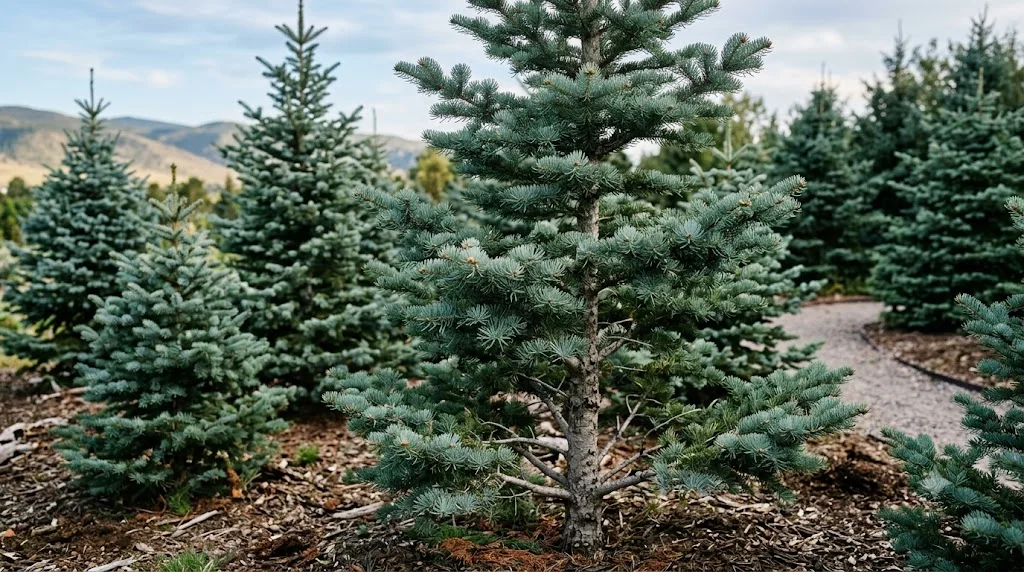

Colorado white fir develops its most symmetrical crown and strongest blue-green needle color when it receives abundant light. It can tolerate some shade, particularly while young, but persistent low light usually produces thinner foliage and wider spacing between branches. Climate strongly affects how much direct sun the tree can comfortably receive. The best position balances good illumination with protection from extreme heat and moisture stress.
Understanding full sun and partial shade
A sunny position generally produces compact growth, strong branch structure, and a well-defined central leader. Light reaching all sides of the crown helps the tree retain lower branches and maintain an even outline. Open sites also improve airflow and allow rain or dew to dry more quickly. These conditions reduce the prolonged foliage wetness associated with some needle diseases.
Young Colorado white fir can grow in partial shade, particularly where summers are hot or dry. Light shade during the hottest part of the afternoon may reduce moisture loss and needle scorch. The tree should still receive several hours of direct or bright filtered light. Deep shade beneath dense mature trees is unsuitable for long-term development.
A tree leaning toward an opening or producing sparse growth on one side may be responding to uneven light. Nearby buildings, fences, or fast-growing trees can gradually alter exposure after planting. This change may occur slowly and remain unnoticed until the crown becomes asymmetrical. Future growth of surrounding vegetation should be considered when selecting the site.
Lower branches naturally become less vigorous as the crown expands and shades itself. Severe interior thinning, however, may indicate excessive external shade or prolonged stress. Removing healthy lower branches does not increase light within the upper crown and often reduces the tree’s natural beauty. Improving surrounding conditions is more effective than unnecessary pruning.
More articles on this topic
Balancing sunlight, temperature, and moisture
Full sun is most suitable where summer temperatures remain moderate and soil moisture is dependable. In hot climates, an exposed southern or western position may create excessive heat around the foliage and root zone. The problem becomes greater near stone, concrete, or reflective walls. A cooler eastern exposure may provide sufficient light with less afternoon stress.
Sunlight increases photosynthesis only when the roots can supply enough water. A brightly exposed tree in dry, compacted soil may grow less effectively than one receiving gentle partial shade. Mulch and deep irrigation during drought help the tree use sunlight without losing excessive moisture. Drainage must remain good because constant wetness is equally damaging.
Needle color often appears more strongly blue in good light, although genetics remains the main influence. Shaded needles may look greener and softer because wax development and foliage density differ. Fertilizer cannot reliably turn a naturally green specimen blue. Choosing appropriate nursery stock is the best way to obtain a particular color.
Sudden exposure can damage foliage that developed under shade. This sometimes occurs after a neighboring tree is removed or a structure is demolished. Previously protected needles may scorch during the first hot season. Maintaining adequate soil moisture and avoiding further stress helps the crown adapt gradually.
More articles on this topic
Selecting exposure for different landscapes
In cool northern gardens, an open position with sunlight through most of the day is usually ideal. Air circulation and good drainage remain essential even where heat stress is uncommon. Avoid frost pockets and wet depressions simply because they appear sheltered. Cold tolerance does not compensate for oxygen-starved roots.
In warmer inland areas, morning sun with light afternoon protection may provide a better balance. The site should still be bright enough to maintain dense growth. Deep shade combined with warm, humid air can create weak shoots and persistent foliage wetness. A spacious position beneath high, open shade may work better than a confined courtyard.
Urban settings require careful assessment of reflected heat and artificial shade. Tall buildings may block winter light while walls and paving intensify summer temperatures. Restricted soil volume can further increase stress because roots cannot access cooler, moister ground. A site that looks sunny may therefore be harsher than an open rural position.
The most suitable exposure supports steady growth throughout the year rather than maximum sunlight at every moment. Observe seasonal sun angles, prevailing winds, surrounding surfaces, and soil moisture before planting. Colorado white fir responds best to bright, cool, well-aerated conditions. Matching light to the local climate preserves its dense crown and characteristic foliage.