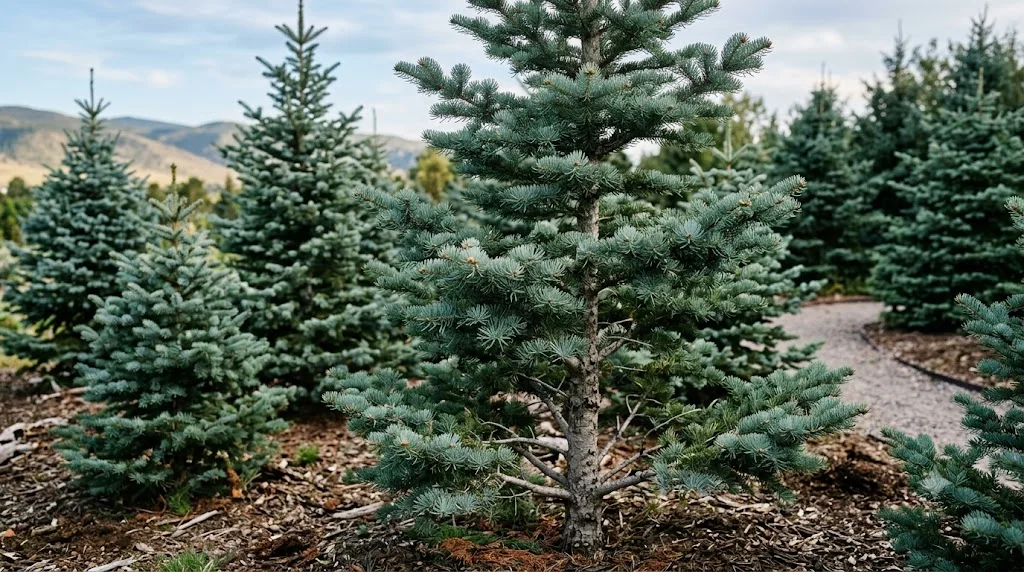

Planting Colorado white fir correctly gives the tree the best possible foundation for decades of healthy growth. The roots need well-aerated soil, reliable moisture, and enough surrounding space to expand far beyond the original root ball. Propagation requires patience because seed-grown trees develop slowly and may vary in color or form. Named cultivars are normally preserved through specialist vegetative methods rather than ordinary home cuttings.
Selecting and preparing the planting site
Choose a position that provides adequate sunlight, unrestricted air movement, and sufficient room for the mature crown. The planting site should not be directly beneath overhead services or close to foundations, narrow paths, or small ornamental beds. A young tree may appear compact, but its lower branches eventually spread over a substantial area. Planning for mature size avoids harmful pruning and transplanting later.
Inspect drainage before planting, especially in heavy or low-lying soil. A simple test hole can reveal whether water remains trapped for an extended period after rainfall or irrigation. Colorado white fir tolerates many soil textures, but it performs poorly where roots remain waterlogged. If drainage cannot be improved broadly, another planting position is preferable.
Remove perennial weeds and competing turf from a wide circle around the selected location. This reduces competition and makes planting, watering, and mulching easier. The soil should be loosened only where compaction is present, without pulverizing it into a fine texture. Excessive cultivation can destroy useful soil structure and create settling after planting.
The ideal planting season is usually during cool weather when the soil is workable and moisture loss is moderate. Early spring and autumn are commonly suitable, although local climate and nursery stock condition should guide timing. Avoid planting into frozen, saturated, or extremely dry ground. Container-grown trees can be planted over a longer period if careful irrigation is available.
More articles on this topic
Planting the tree at the correct depth
Dig a hole that is wider than the root ball but no deeper than necessary. The uppermost structural roots and natural root flare should remain at or slightly above the finished soil level. Planting too deeply deprives roots of oxygen and leaves trunk bark in persistent contact with damp soil. This mistake may weaken the tree gradually and can be difficult to correct later.
Remove the container carefully and inspect the outer root system before setting the tree in place. Circling or tightly matted roots should be loosened and redirected outward where possible. Severely deformed roots may require selective cutting with a clean tool. The objective is to encourage roots to enter the surrounding soil rather than continue circling.
Backfill mainly with the excavated soil so the roots experience a gradual transition into the site. Break large clods by hand, but do not compact the soil heavily around the root ball. Water during or immediately after backfilling to settle soil around the roots and remove large air pockets. Avoid adding concentrated fertilizer or fresh manure to the planting hole.
Create a broad watering area and apply a moderate layer of organic mulch over the root zone. Keep mulch several centimeters away from the trunk and leave the root flare uncovered. Stake only when instability or strong wind makes support genuinely necessary. Finish by watering slowly and checking that the tree remains upright without being buried more deeply.
More articles on this topic
Growing Colorado white fir from seed
Fresh, viable seed is the most practical method for producing ordinary Colorado white fir seedlings. Cones are collected when mature but before they disintegrate and release their seeds naturally. Seed quality can vary greatly, and empty or damaged seeds should be discarded when possible. Seed from healthy, well-formed parent trees offers the best starting material.
The seed normally benefits from a period of moist chilling that imitates winter conditions. It can be mixed with a slightly damp, sterile medium and refrigerated for several weeks. The material should remain moist but not wet, because stagnant conditions encourage mold and decay. Clean containers and regular checks improve reliability.
After chilling, sow the seeds in a free-draining propagation mix and cover them lightly. Maintain even moisture, moderate warmth, and good air circulation while avoiding saturated compost. Germination may be irregular, so trays should not be discarded too quickly. Bright light becomes important as soon as seedlings emerge.
Young seedlings are vulnerable to damping-off, heat, drought, and excessive fertilizer. Water gently and allow the surface to become slightly less moist between applications. Gradually increase light exposure while protecting tender plants from intense midday heat. Seedlings should be transplanted carefully before their roots become tangled or restricted.
Propagating cultivars and managing young plants
Seedlings do not reproduce the exact appearance of a selected cultivar because genetic variation occurs during sexual reproduction. Needle color, growth rate, branch habit, and mature size may differ from the parent tree. This variation is acceptable when growing the species for general landscape use. It is unsuitable when a particular named form must be maintained.
Commercial producers commonly preserve special cultivars through grafting onto compatible fir rootstocks. Grafting requires precise timing, clean technique, controlled humidity, and suitable plant material. It is generally more demanding than seed propagation and may not succeed reliably under ordinary garden conditions. Specialist nurseries are therefore the most dependable source of true-to-name cultivars.
Ordinary stem cuttings from Colorado white fir are difficult to root and often produce disappointing results. Even when roots form, the resulting plant may develop an uneven habit if the cutting came from a lateral branch. Upright leader material is limited and valuable, making cutting propagation impractical for most growers. Experimental attempts require controlled misting, rooting hormones, and considerable patience.
Whether seedlings or grafted plants are raised, young trees should not be rushed into exposed landscape conditions. Gradual hardening prepares foliage and roots for stronger sunlight, wind, and changing temperatures. Containers must drain freely and should not be allowed to overheat in summer. Planting into the permanent position is best completed while the root system remains healthy, active, and free from severe circling.