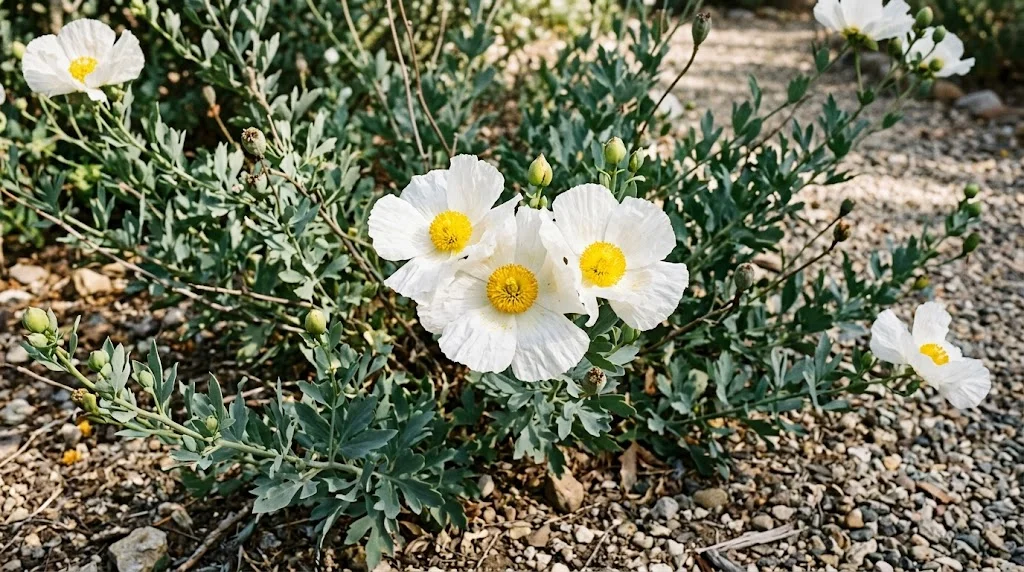

Planting Matilija poppy is less about creating rich garden soil and more about establishing the plant in a place that resembles the dry, open landscapes to which it is naturally adapted. A warm, sunny location with freely draining soil gives new plants the best chance of developing a permanent root system. Once established, the plant can be remarkably resilient and long lived, but young specimens often dislike unnecessary disturbance. Propagation therefore rewards patience, careful timing and an understanding of the plant’s vigorous underground growth.
The best planting period is generally during mild weather when the soil is workable and extreme heat is unlikely. Spring can be suitable in colder regions because it allows roots an entire growing season to develop before winter. In mild climates, autumn planting may also work well if winter soil remains well drained. Avoid planting immediately before prolonged heat, severe frost or a period of saturated soil.
Site preparation should focus on drainage rather than excessive enrichment. Loosen compacted soil over a broad area so developing roots can move beyond the planting hole. If the site is naturally heavy, consider raising the planting level or using a sloping position instead of creating a small pocket of amended soil. The objective is to prevent water from collecting around the crown and root system.
Handle nursery plants gently when removing them from their containers. Matilija poppy has a reputation for resenting root disturbance, especially once substantial roots have developed. Do not aggressively tease apart the root ball unless circling roots make some correction essential. Plant at approximately the same depth as the specimen was growing in its container and firm the surrounding soil without compacting it heavily.
Establishing newly planted specimens
After planting, water thoroughly so the surrounding soil settles around the root ball. This first irrigation is important even when the species will eventually be grown under relatively dry conditions. Air gaps around newly planted roots can reduce contact with the soil and slow establishment. Allow excess water to drain freely rather than leaving the root zone saturated.
More articles on this topic
During the first season, irrigation should encourage deep rooting. Apply enough water to moisten the full root zone and then allow the soil to partially dry before watering again. The exact frequency depends on temperature, soil texture, wind and rainfall, so rigid schedules are rarely ideal. A plant in sandy soil during warm weather will require different management from one growing in deeper loam.
Avoid strong fertilisers immediately after planting. Newly disturbed roots benefit more from stable moisture, oxygen and moderate temperatures than from a high concentration of soluble nutrients. If the soil is extremely poor, a small amount of mature compost can be incorporated before planting. Otherwise, the plant can usually establish successfully without an intensive feeding programme.
Weed control is more important than it may first appear. Young Matilija poppies have not yet developed the extensive root systems that allow mature plants to compete successfully. Keep aggressive weeds and grasses away from the immediate root zone, particularly during the first year. A light mineral mulch can reduce weed germination without creating excessively moist conditions around the crown.
Propagation from root material and division
Established plants frequently produce suckers from underground roots, and these shoots can provide useful propagation material. A sucker that has developed some independent roots may sometimes be separated carefully from the parent and replanted. Success is generally better when the new shoot is not excessively large and weather conditions are mild. Disturb the main plant as little as possible during the process.
More articles on this topic
Root cuttings are another possible propagation method because the plant naturally regenerates from its underground system. Sections of healthy root can be taken during the dormant or relatively inactive season and placed in a free-draining propagation medium. They should be kept slightly moist rather than saturated. New shoots may take time to appear, so the absence of immediate top growth does not necessarily indicate failure.
Dividing a mature clump is more challenging than dividing conventional herbaceous perennials. The root system can be extensive, brittle and reluctant to tolerate major disturbance. For this reason, removing naturally occurring peripheral suckers is usually less disruptive than digging up and splitting the central plant. Any division work should be planned carefully because recovery may be slow.
When transplanting propagated sections, minimise the time that roots remain exposed to air and drying. Prepare the new planting location before lifting the material so it can be replanted promptly. Water thoroughly after replanting, then return to a moderate irrigation regime. Excessive moisture after root disturbance can be just as damaging as severe drought.
Growing Matilija poppy from seed
Seed propagation is possible, although germination can be irregular and slower than many gardeners expect. In nature, germination may be influenced by environmental cues associated with disturbance and fire. This helps explain why untreated seed can remain dormant even when temperature and moisture appear favourable. Patience is therefore an important part of seed propagation.
Various pre-germination treatments are sometimes used to improve germination, including carefully controlled heat or smoke-related treatments that mimic natural ecological triggers. Whatever method is chosen, avoiding damage to the seed is essential. A treatment intended to break dormancy can easily become destructive if temperatures or chemical concentrations are excessive. For home propagation, using fresh seed and a well-researched, conservative method is preferable to aggressive experimentation.
Sow seed in a clean, sharply draining medium and cover only as deeply as required to maintain contact and moisture. Keep the medium evenly but lightly moist while avoiding saturation. Good air movement helps reduce fungal problems around slow-germinating seed. Germination may occur unevenly, so trays should not be discarded too quickly.
Seedlings should be handled with particular care when transplanted. Move them before they become severely root-bound but after they are large enough to withstand handling. Containers that allow deep root development can be useful because they reduce root deformation and later disturbance. Gradual acclimatisation to full sun is also important if seedlings have been raised under protected conditions.
Choosing the best propagation method
For most gardeners, separating rooted suckers from an established plant is the most straightforward way to obtain genetically identical new specimens. The method takes advantage of the plant’s natural spreading habit and avoids the unpredictability of seed germination. It is particularly useful when a parent plant has already demonstrated desirable vigour and flower quality. The main limitation is that suitable suckers are not always available exactly when required.
Root cuttings can provide a larger number of plants without relying entirely on naturally positioned suckers. They are particularly useful when the parent has a healthy, vigorous root system and propagation facilities are available. Success depends heavily on correct moisture management because cut root material is vulnerable to decay in wet media. Clean tools and a well-aerated substrate improve the chances of establishment.
Seed propagation is most valuable when genetic variation is desirable or when vegetative material is unavailable. It can also be rewarding for gardeners interested in the species’ natural regeneration biology. However, germination may be inconsistent and young seedlings can require considerable patience. Seed-grown plants also cannot be expected to reproduce every characteristic of a particular parent exactly.
Whichever method is used, the final planting site remains the decisive factor. A perfectly propagated specimen can still fail if placed in deep shade or waterlogged soil. Conversely, even a small young plant often develops strongly when given full sun, drainage and sufficient room. Successful propagation should therefore be regarded as the beginning of establishment rather than the end of the process.