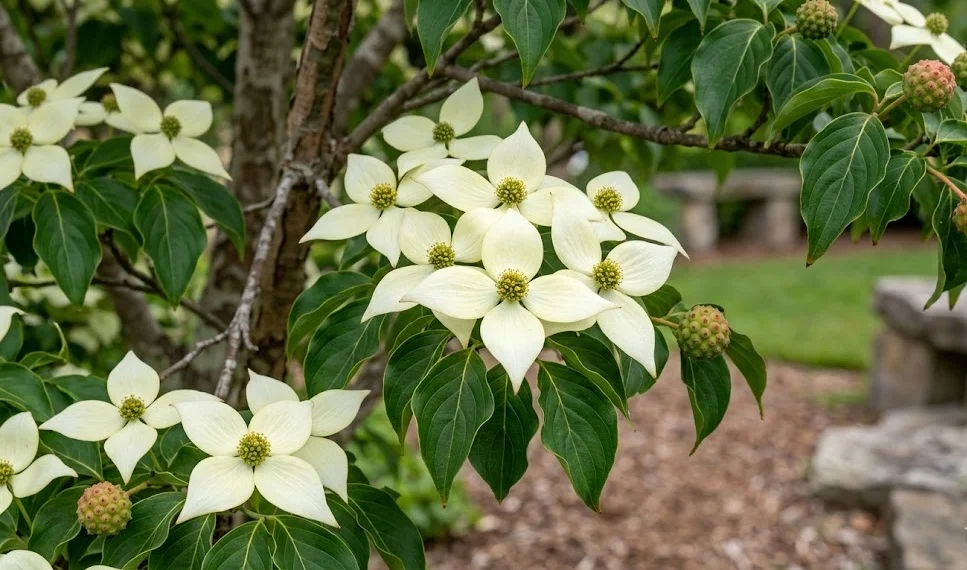

Kousa dogwood grows best when water and nutrients are supplied steadily rather than forcefully. It does not like long drought, but it also suffers in saturated soil where roots cannot breathe. Feeding should support balanced growth, strong flowering, and resilient roots without pushing excessive soft shoots. A professional approach focuses on soil moisture, organic matter, root health, and measured nutrition.
Understanding moisture needs
Kousa dogwood prefers evenly moist soil, especially during establishment and summer heat. Its roots are relatively shallow compared with many larger shade trees, so dry surface soil can affect it quickly. Mulch, organic matter, and proper watering help maintain a stable root environment. When moisture is consistent, the tree produces better foliage, stronger buds, and a more reliable ornamental display.
The tree’s water needs change with age. Newly planted specimens require close attention because their roots have not yet spread into surrounding soil. Mature trees can tolerate short dry periods, but extended drought can still cause leaf scorch, early defoliation, and reduced flowering. Even older trees benefit from deep watering during extreme heat.
Soil type strongly influences watering frequency. Sandy soil drains quickly and may need more frequent irrigation, especially in dry weather. Clay soil holds water longer but can become airless if watered too often. Loam with good organic matter is ideal because it balances drainage and moisture retention.
Weather conditions must also guide watering decisions. Hot wind, reflected heat, and full sun increase water loss from leaves and soil. Cool, cloudy, or rainy periods reduce irrigation needs substantially. Checking the soil by hand is often more accurate than relying on a fixed schedule.
More articles on this topic
Watering young trees
During the first year after planting, deep watering should be a priority. The root ball can dry out even when the surrounding soil seems damp, especially in container-grown trees. Water should be applied slowly so it penetrates the root zone instead of running away across the surface. A watering basin or drip line can help direct moisture where it is needed.
In dry weather, a young kousa dogwood may need water once or twice a week. The exact amount depends on tree size, soil texture, temperature, and rainfall. The aim is to wet the soil deeply and then allow the upper layer to begin drying before the next watering. Constantly soggy conditions should be avoided because they weaken roots.
A watering bag can be useful, but it should not become a substitute for observation. Bags release water slowly, yet they can hide trunk problems if left pressed against the bark for too long. They should be removed periodically so the trunk can dry and be inspected. Clean contact between mulch, soil, and trunk is important for long-term health.
The second and third years remain important, even if the tree appears established above ground. Root growth continues outward, and drought during this period can slow development significantly. Regular watering during hot, dry spells helps the tree build a wider root system. Once roots are well distributed, the tree becomes much easier to manage.
More articles on this topic
Watering established trees
Established kousa dogwoods should be watered during prolonged dry periods rather than on a rigid routine. Deep soaking every ten to fourteen days during drought is often more effective than frequent sprinkling. Water should reach the area beneath and slightly beyond the canopy, where many absorbing roots are found. A slow application gives the soil time to absorb moisture evenly.
Leaf symptoms can indicate water stress, but they should be interpreted carefully. Curling, browning edges, dull foliage, and early colour change often suggest drought stress. Similar symptoms can also appear when roots are damaged by excess water or compaction. Before adding more water, the soil should be checked to confirm whether it is actually dry.
Overhead watering is not ideal for kousa dogwood. Wet leaves can encourage fungal problems, particularly in humid weather or crowded plantings. Soil-level irrigation is more efficient and supports the roots directly. Drip irrigation, soaker hoses, or slow hand watering are all better options than frequent canopy spraying.
Late-season watering can be important in dry autumns. Trees entering winter with dry roots may be more vulnerable to cold injury and dieback. This is especially true for newly planted trees and specimens in sandy or exposed sites. A deep watering before the ground freezes can be beneficial when rainfall has been insufficient.
Feeding principles and fertilizer timing
Kousa dogwood rarely needs heavy feeding if planted in healthy soil. Annual organic mulching often provides gradual nutrition while improving soil structure. This slow nutrient release supports steady growth and beneficial soil biology. It is a more natural approach than repeated high-nitrogen fertilization.
If fertilizer is needed, early spring is usually the best time to apply it. At this stage, roots are becoming active and can use nutrients for new growth. A balanced slow-release fertilizer is generally safer than a quick, strong dose. The product should be spread over the root zone and watered in properly.
Fertilizer should never be concentrated against the trunk. Roots that absorb nutrients are usually distributed outward, not clustered at the bark. A wide, even application reflects the real shape of the root system. This also reduces the risk of burning tender roots.
Late summer and autumn feeding should usually be avoided. Nutrients applied too late can encourage soft growth that may not harden before cold weather. In climates with cold winters, this can increase the risk of frost injury. For strong winter preparation, balanced moisture and healthy soil are more useful than late fertilizer.
Organic matter, deficiencies, and soil testing
Organic matter is central to good watering and feeding. Compost, leaf mould, and aged bark improve the soil’s ability to store moisture without becoming stagnant. They also support microorganisms that gradually release nutrients in plant-available forms. This creates a resilient root environment that responds better to both rain and irrigation.
Nutrient deficiencies should not be guessed too quickly. Pale leaves may result from poor soil pH, compacted roots, drought, waterlogging, or actual nutrient shortage. Applying fertilizer without understanding the cause can waste money and worsen the problem. Soil testing is the most reliable way to decide what correction is needed.
Kousa dogwood generally prefers slightly acidic to neutral soil. In soil that is too alkaline, iron and other micronutrients may become less available, causing chlorosis. This often appears as yellowing between leaf veins while veins remain greener. Correcting pH and improving root health is usually more effective than simply adding more general fertilizer.
A professional maintenance plan combines observation with restraint. Water deeply when the soil is dry, mulch properly, avoid compaction, and feed only when the tree shows a real need or soil testing supports it. This approach produces stronger roots, better flowering, and fewer stress-related problems. Kousa dogwood thrives when care is consistent, moderate, and guided by the condition of the soil.