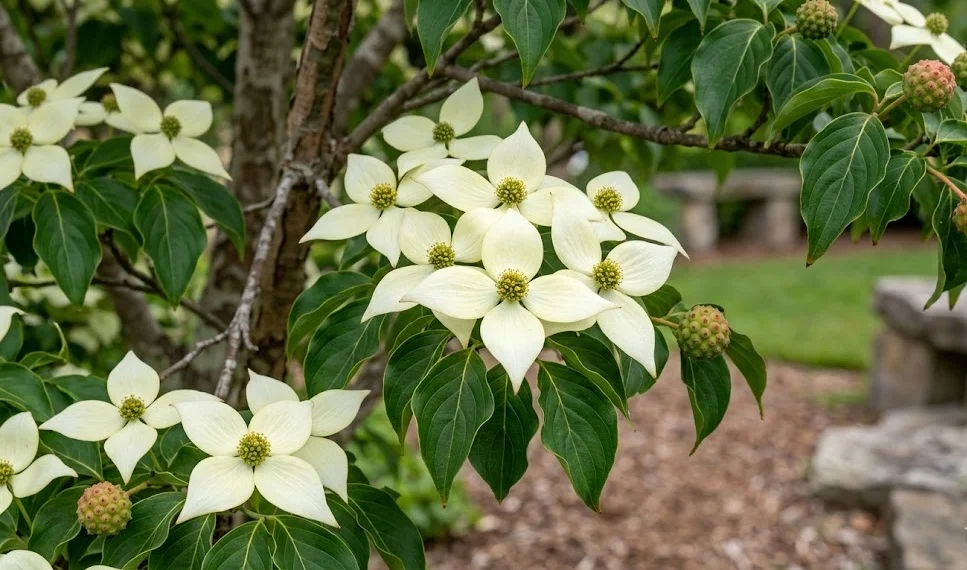

Kousa dogwood has a naturally graceful structure, so pruning should refine its form rather than dominate it. The tree is valued for layered branches, elegant flowering, attractive fruit, and a balanced silhouette that can be spoiled by harsh cutting. Most pruning should be light, selective, and based on clear reasons such as removing dead wood, improving structure, or preventing branch conflict. Cutting back hard is rarely appropriate and often creates more problems than it solves.
When and why to prune
The best time for significant pruning is usually late winter or early spring before strong growth begins, or shortly after flowering when shape can be assessed. Dead, broken, or diseased branches may be removed whenever they are noticed. Avoid unnecessary pruning during periods of drought, severe heat, or active stress. A stressed tree heals more slowly and may respond with weak growth.
Pruning should have a specific purpose. Good reasons include removing crossing branches, improving clearance, correcting storm damage, and reducing future structural weakness. Poor reasons include trying to force the tree into a rigid shape or keeping it too small for an unsuitable space. Kousa dogwood looks best when its natural habit is respected.
Young trees benefit from careful structural guidance. Competing leaders, sharply angled branches, and rubbing shoots can be corrected early with small cuts. Early pruning is less stressful than removing large limbs later. A well-trained young tree usually needs less intervention as it matures.
Mature trees should be pruned conservatively. Large cuts are more visible and take longer to seal. Removing too much canopy at once reduces energy production and can trigger unwanted shoots. A professional approach removes only what is necessary and preserves the tree’s layered character.
More articles on this topic
Proper pruning technique
Cuts should be made with sharp, clean tools. Dull tools crush tissue and leave rough wounds that heal poorly. Disinfecting tools is especially important when disease is suspected. Clean technique reduces stress and lowers the risk of spreading pathogens.
Branches should be removed just outside the branch collar. This swollen area at the base of a branch contains tissue that helps the tree seal the wound. Cutting flush against the trunk damages this protective zone, while leaving a long stub creates dead tissue that can decay. Correct cut placement is one of the most important pruning skills.
For larger limbs, a three-cut method should be used. The first cut under the branch prevents bark tearing, the second removes the weight, and the final cut cleans the stub at the branch collar. This method protects the trunk and produces a safer wound. It is especially important on ornamental trees where bark damage can remain visible for years.
Cutting back branch tips should be done sparingly. Repeated heading cuts can create dense, awkward regrowth and spoil the natural outline. If a branch must be shortened, it is usually better to cut back to a suitable lateral branch. This keeps growth more natural and reduces clusters of weak shoots.
More articles on this topic
What to avoid when cutting back
Severe reduction is one of the biggest mistakes with kousa dogwood. Topping destroys the natural shape and can lead to weak, poorly attached regrowth. It also removes flowering wood and reduces the tree’s ornamental value. A tree that is too large for its space should usually be replaced or professionally managed, not repeatedly topped.
Avoid stripping all lower branches too quickly. Gradual lifting may be useful for access, but excessive removal changes the tree’s proportions. Low branches contribute to the layered beauty of kousa dogwood, especially when the tree is young. Removing them too early can create a bare trunk and an unbalanced canopy.
Do not prune heavily just because flowering is light. Poor bloom may be caused by shade, youth, drought, late frost, or excessive nitrogen. Heavy pruning can further reduce flowering by removing buds or stressing the tree. Cultural conditions should be assessed before assuming pruning is the solution.
Wound paints and sealants are generally unnecessary for routine pruning cuts. Trees seal wounds through natural biological processes, and coatings can sometimes trap moisture. The priority should be clean cuts, correct timing, and healthy growing conditions. With careful pruning and patient management, kousa dogwood keeps its elegant shape and remains a refined feature in the garden.