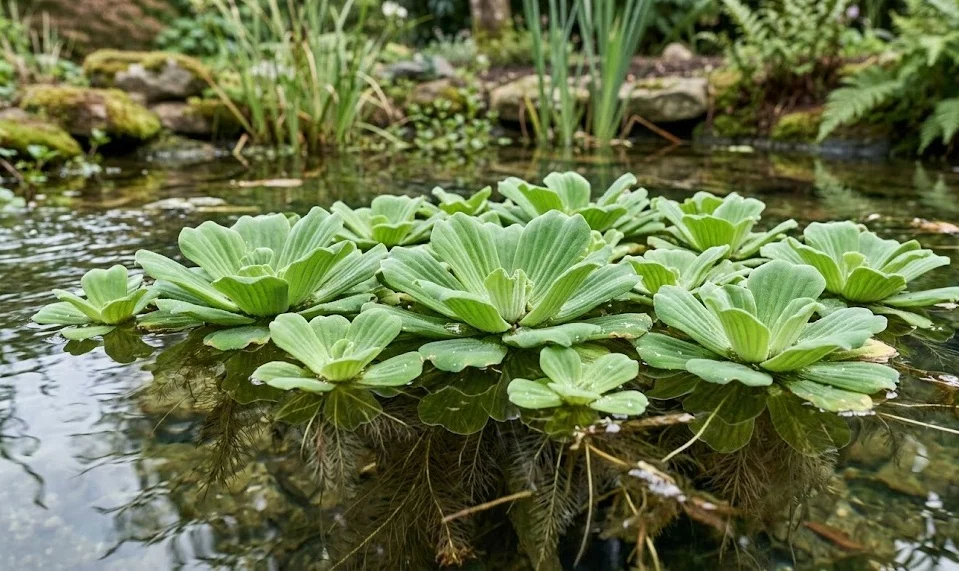

Water lettuce does not require conventional watering because it lives directly on the surface of ponds, tubs, or aquariums. Its roots remain submerged continuously and absorb both moisture and dissolved nutrients from the water. The real challenge is therefore maintaining suitable water depth, chemistry, temperature, and nutrient balance. Stable conditions support firm green rosettes, while sudden changes often produce yellow leaves, damaged roots, or stalled growth.
Evaporation is particularly important in small container water gardens. As the water level falls, dissolved minerals become more concentrated and temperatures fluctuate more rapidly. Fresh water should be added before roots become crowded into a shallow, overheated zone. Large additions should be temperature-matched whenever possible.
Rain can dilute nutrients and alter water chemistry, especially in small tubs. Heavy rainfall may also overflow containers and carry plants into drains or surrounding habitats. An overflow screen helps prevent escape while allowing excess water to leave safely. After storms, the plants should be checked for leaf wetting and physical damage.
In ponds, water replacement is usually less frequent than in small containers. Partial water changes may still be necessary where nutrients, salts, or organic waste accumulate. Replacing all the water at once is rarely desirable because it causes abrupt chemical and temperature changes. Gradual maintenance is safer for both plants and aquatic animals.
Understanding water quality
Water lettuce responds best to clean, biologically active water with moderate nutrient availability. Crystal-clear water is not automatically ideal, because extremely nutrient-poor conditions can limit growth. Conversely, dark, foul-smelling water usually contains excessive decomposing material. The goal is stability rather than sterility.
More articles on this topic
The pH should remain within a moderate range and should not shift sharply between morning and evening. Dense algae growth can create significant daily changes in carbon dioxide and pH. These fluctuations stress roots and reduce nutrient availability. Improving ecological balance is usually more valuable than chasing a precise number.
Hardness influences the availability of calcium, magnesium, and other minerals. Very soft water may support growth if nutrients are supplied appropriately, but deficiencies can appear more quickly. Extremely hard water may contribute to mineral deposits on roots or container surfaces. Consistency remains more important than small variations.
Chlorine and chloramine in tap water can damage sensitive roots. Water conditioners may be required when municipal water is used for aquariums or small tubs. Alternatively, replacement water can be prepared in advance where local treatment methods allow. Sudden exposure should always be avoided.
Recognising nutrient requirements
Water lettuce absorbs nitrogen, phosphorus, potassium, and trace elements through its roots. Nitrogen supports leafy growth, while potassium contributes to tissue strength and stress tolerance. Iron and other micronutrients are needed in smaller quantities for chlorophyll formation and enzyme activity. A shortage of any essential element can distort the appearance of new growth.
More articles on this topic
Pale green leaves often indicate inadequate nutrition, but the exact cause is not always obvious. Nitrogen deficiency commonly affects older leaves first, while iron shortage is more visible in young leaves. Root damage can mimic deficiency because nutrients may be present but inaccessible. Water conditions should therefore be assessed before fertiliser is added.
Fish ponds may already contain sufficient nutrients from fish waste and decomposing organic matter. In such systems, additional fertilisation can encourage algae and reduce water quality. The growth rate and leaf colour of the plants provide useful guidance. Vigorous green rosettes usually need no extra feeding.
Nutrient-poor display ponds and containers may require supplementation. Products designed for aquatic plants are safer than general garden fertilisers because their composition and dosing are better suited to water systems. Fertiliser should never be poured directly over the leaves. Diluted application to the water is more even and less likely to burn the roots.
Fertilising ponds and aquariums safely
Begin with a lower dose than the maximum recommendation, particularly in a newly established system. Water lettuce can respond quickly once nutrients become available. The plants should be observed for several days before more fertiliser is added. Gradual adjustment reduces the risk of algae blooms.
Aquarium fertilisers may contain nitrogen and phosphorus or may be designed mainly to supply trace elements. The correct choice depends on fish stocking, feeding, filtration, and the needs of other plants. Testing nitrate and phosphate can provide useful guidance. Adding nutrients without understanding existing levels often creates imbalance.
Pond fertiliser tablets intended for rooted plants should not be attached to water lettuce. These concentrated products are made for placement in soil or planting baskets. Direct contact with floating roots may cause damage. Liquid or water-soluble aquatic fertilisers are generally easier to distribute safely.
Fertilisation should be reduced when growth slows in autumn or under cool indoor conditions. Plants use fewer nutrients when light and temperature are limited. Continued heavy feeding leaves more resources available for algae and microbes. Seasonal adjustment is therefore an essential part of nutrient management.
Correcting imbalances and avoiding excess
Excess nutrients often reveal themselves through green water, filamentous algae, surface films, or unusually rapid but weak growth. Water lettuce may produce large, soft leaves that damage easily. Dense colonies can then worsen oxygen depletion at night. Thinning and reducing nutrient input are usually the first corrective steps.
Overfeeding fish is a common hidden source of excess nutrients. Uneaten food decomposes and releases nitrogen and phosphorus into the water. Improving feeding practices may solve the problem without changing plant fertilisation. Removing sludge and dead leaves further reduces the nutrient load.
Salt accumulation can occur in containers that are repeatedly topped up but never partially emptied. Evaporation removes water while leaving minerals behind. Occasional partial water changes help control this concentration. Replacement water should be introduced gradually to avoid shock.
When deficiency and excess symptoms overlap, the newest growth should be examined carefully. Healthy new leaves indicate that a past problem may already be resolving. Damaged old leaves will not repair themselves and can be removed when they decline. Decisions should be based on developing tissue rather than expecting scarred leaves to recover.
Building a seasonal water and feeding routine
Spring care begins when water temperatures rise and active growth resumes. Nutrient demand gradually increases as new roots and daughter plants develop. Early feeding should remain cautious because cool water slows nutrient uptake. The dose can be adjusted once growth becomes steady.
Summer requires closer monitoring of evaporation, temperature, algae, and surface coverage. Small containers may need frequent topping up during hot weather. Pond plants may multiply rapidly and remove substantial quantities of nutrients. Regular thinning prevents the colony from overwhelming the system.
Autumn growth slows as days shorten and temperatures fall. Fertilisation should be reduced before the plants become fully dormant or begin to decline. Dead leaves and weak rosettes should be removed promptly. This prevents unnecessary nutrient release into the water.
Indoor winter specimens require a routine based on actual growth rather than the calendar alone. Under strong lighting and stable warmth, they may continue using nutrients. In cooler, dimmer conditions, feeding should be minimal. The safest approach is to respond to plant performance while maintaining clean, stable water.