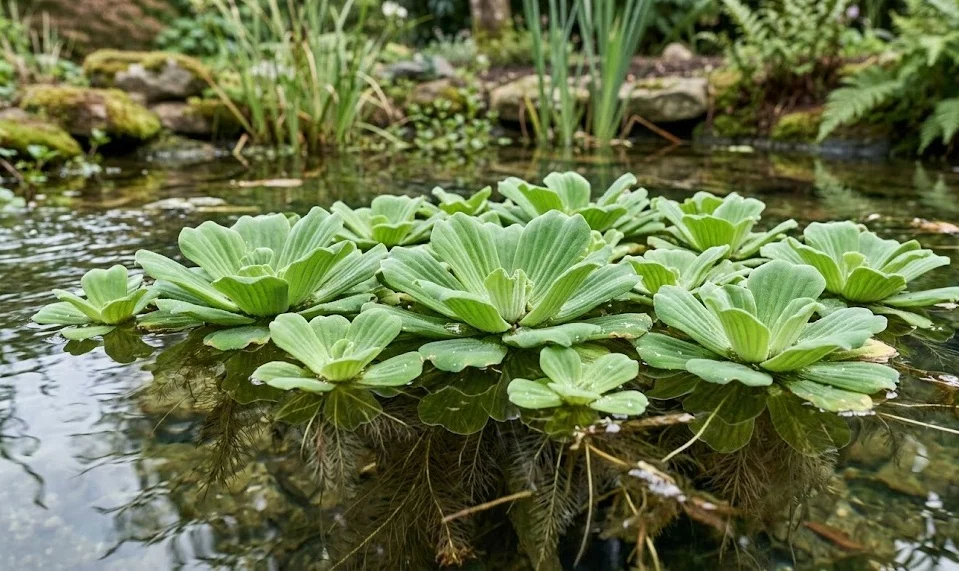

Planting water lettuce is different from planting rooted pond plants because its roots must remain suspended in the water rather than buried in soil. The rosette floats naturally, while the hanging root system absorbs nutrients directly from the surrounding water. Successful establishment depends on gentle handling, warm conditions, and protection from strong currents. Once settled, the plant usually propagates readily by producing daughter rosettes on short runners.
Water lettuce can be introduced to ponds, tubs, and open aquariums. The chosen site should provide calm water and enough surface space for the rosettes to spread. The leaves must remain above the waterline, with only the roots submerged. Pushing the plant into gravel or aquatic compost usually leads to crown decay.
New specimens should be inspected before they are added to an established water garden. Damaged leaves, soft crowns, pests, and decaying roots should be removed or treated first. A short quarantine period is particularly valuable for aquarium plants. This reduces the risk of introducing unwanted organisms into a stable system.
Planting is best carried out when the water is already warm enough to support active growth. Cold water slows root recovery and makes newly handled plants more vulnerable. Outdoor introduction should follow the end of frost risk. A gradual transition from indoor to outdoor conditions helps prevent temperature and light shock.
Establishing plants in ponds and containers
Begin by placing water lettuce gently on the surface rather than dropping it from a height. Spread the roots naturally beneath the rosette and make sure they are not trapped around stones or equipment. The plant should float level, with its central crown clear of standing water. A sheltered position allows it to establish without constant movement.
More articles on this topic
Floating rings can be useful in ponds with pumps, waterfalls, or skimmers. They keep the plants within a calm zone and prevent roots from being pulled into equipment. Rings also stop wind from repeatedly pushing rosettes against rough pond edges. The barrier should be large enough to avoid crowding as the plants expand.
In container water gardens, leave generous space around each specimen. Water lettuce may look sparse initially, but daughter plants can fill the surface quickly in warm weather. Starting with a few healthy rosettes usually produces better growth than densely packing the container. Overcrowding from the beginning encourages weak roots and small leaves.
Aquarium planting requires particular attention to the lid and lighting system. Condensation dripping from a cover can keep the foliage wet and promote rot. Hot lamps positioned too close to the leaves may cause bleaching or scorch. An open top or well-ventilated cover generally creates a more suitable microclimate.
Propagating through daughter rosettes
Water lettuce naturally produces daughter plants at the ends of slender runners. These young rosettes initially remain connected to the parent and receive support while developing roots. Separation is not immediately necessary. Allowing the daughter to gain several leaves and a visible root system improves its chance of independent growth.
More articles on this topic
When the young plant is well formed, the runner can be cut with clean scissors. Hold both rosettes gently to avoid tearing their crowns. The cut should be made between the parent and daughter without removing healthy leaves. The separated plant can then be floated in a nursery container or placed directly in suitable water.
Propagation is fastest under warm, bright, nutrient-balanced conditions. Weak parent plants should not be divided repeatedly because they need foliage and roots to rebuild their reserves. It is better to select vigorous rosettes with firm centres. Healthy stock produces stronger and more uniform offspring.
Daughter plants may vary in size and growth rate even when they develop from the same parent. Some form compact rosettes, while others produce larger leaves as space becomes available. Early differences are often caused by light, crowding, and access to nutrients. Weak specimens can be removed so that stronger plants have more room.
Managing young plants after separation
Recently separated rosettes benefit from calm water and stable warmth. Their root systems are still developing, so strong currents may delay establishment. A shallow nursery tub can be useful, provided the water does not overheat. The container should receive bright light without harsh exposure during the hottest part of the day.
Young plants should be monitored for crown rot and leaf wetting. Their small leaves sit close to the surface and can be more easily splashed. If water repeatedly gathers in the centre, the rosette should be moved away from pumps or dripping covers. Damaged outer leaves may be removed once the plant is stable.
Nutrients should be available, but concentrated fertiliser should not be applied directly to delicate roots. Balanced pond or aquarium water often contains enough dissolved nutrition for initial growth. If deficiency develops, nutrients should be introduced gradually and monitored carefully. Rapid fertilisation may encourage algae before the young plants can use the added resources.
Several established young plants can be retained as replacement stock. This is useful when outdoor specimens are exposed to storms, fish grazing, or sudden temperature changes. Keeping a small nursery group also allows the best-shaped rosettes to be selected. Surplus plants must be disposed of responsibly rather than released into natural waters.
Preventing propagation problems
Crowding is the most common problem in rapidly multiplying colonies. Daughter plants become trapped between larger rosettes and may receive too little light. Their roots can also become tangled into a dense mass. Regular spacing encourages stronger individual plants and reduces decay.
Poor propagation may result from low temperatures, insufficient light, or nutrient shortage. A plant can remain alive for weeks without producing runners if conditions are merely adequate rather than favourable. The crown should first be checked for health. Improving the overall environment is more effective than forcing division.
Fish and aquatic animals may damage runners or consume new roots. Large fish can separate daughter plants before they are ready. A protected floating basket or separate propagation tub can prevent repeated losses. Once the young plants are larger, they can be returned to the main pond.
Responsible control is essential because successful propagation can create more plants than the garden can hold. Only the number required for cultivation should be retained. Excess growth should be dried or securely composted according to local guidance. Careful disposal prevents an ornamental plant from becoming an environmental problem.