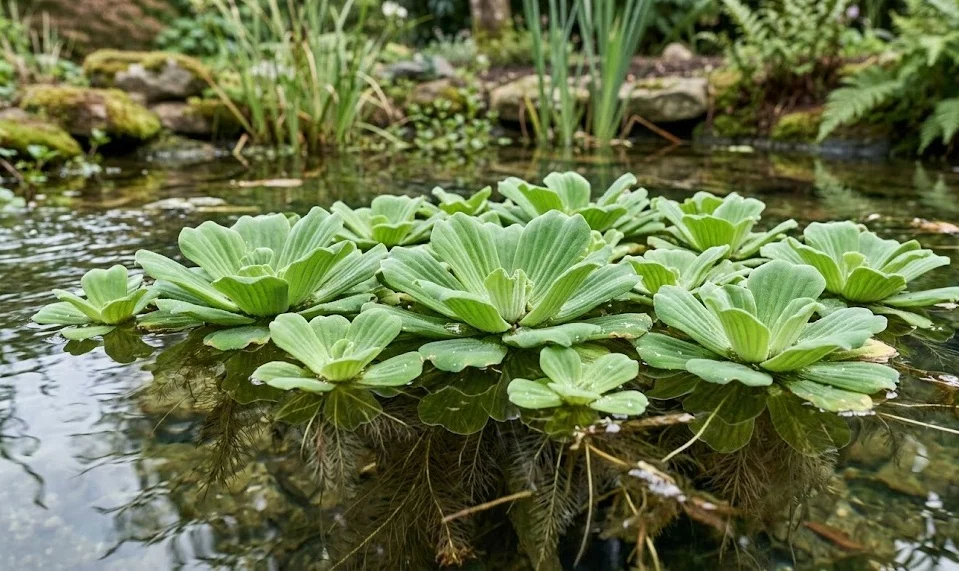

Water lettuce is generally vigorous, but its floating growth habit exposes it to several distinctive health problems. Wet foliage, cold water, poor circulation, nutrient imbalance, and physical damage often play a greater role than infectious disease alone. Pests may attack the soft leaves or hanging roots, especially when plants are grown outdoors. Accurate diagnosis begins with examining the crown, new leaves, roots, and surrounding water rather than reacting to a single damaged spot.
Healthy tissue should feel firm and remain evenly green. The crown should sit above the water, while the roots hang freely beneath it. Softness, unpleasant odour, translucency, or rapid disintegration indicates active decay. Early removal of affected tissue can prevent deterioration from spreading through a crowded colony.
Many symptoms have environmental causes. Brown patches may follow intense sunlight, cold nights, splashing, chemical exposure, or rough handling. Yellow leaves can result from nutrient deficiency, root damage, or normal ageing. Understanding recent changes is often more useful than searching immediately for a pathogen.
Crowded plants are more vulnerable because damaged leaves remain damp and air movement is limited. Dense roots also trap debris and reduce circulation. Regular thinning improves both plant health and diagnostic visibility. Problems are easier to control when individual rosettes can be inspected.
Crown and leaf rots
Crown rot is one of the most serious problems because the central growing point produces all new leaves. The crown may become brown, soft, or water-soaked before the outer leaves collapse. Persistent wetting and low temperatures are common triggers. A severely affected rosette is unlikely to recover.
More articles on this topic
Minor outer-leaf decay can sometimes be managed by removing damaged tissue and correcting the environment. The cut should be made with clean scissors, avoiding the firm central crown. Plants should then be moved away from splashing water. Improved warmth and airflow support new growth.
Fungal and bacterial organisms often invade tissue that has already been weakened. This means treatment without environmental correction gives poor results. Wet leaves, decomposing debris, and overcrowding should be addressed first. Chemical control is rarely the best starting point in a pond or aquarium.
Infected plants should be isolated when practical. A separate container allows close observation and protects the main collection. Water used for isolation should be clean and similar in temperature to the original system. Tools should be rinsed and disinfected before they are used on healthy plants.
Sap-feeding and leaf-chewing pests
Aphids may gather among the folds of water lettuce leaves and around the crown. They remove plant sap, distort young growth, and leave sticky honeydew behind. Ants may also appear because they are attracted to the honeydew. Small infestations are easier to manage than established colonies.
More articles on this topic
A strong jet of water is unsuitable because it can flood the rosette and spread pests through the pond. Individual aphids can instead be removed by hand or with a soft brush. Heavily infested leaves may be cut away. Any treatment used near fish or other aquatic animals must be specifically suitable for aquatic environments.
Caterpillars, beetles, snails, and other chewing pests may produce irregular holes or ragged edges. Night inspection can reveal animals that remain hidden during the day. A few damaged leaves do not usually threaten a strong plant. Repeated severe feeding, however, weakens young rosettes and reduces their ability to compete.
Outdoor pests can often be controlled by physical removal and good sanitation. Dead leaves should not remain among healthy plants because they provide shelter and food. Fine mesh may protect nursery containers from some insects. Broad-spectrum pesticides should be avoided around ponds unless their aquatic safety is firmly established.
Root damage and underwater pests
Fish are frequent causes of root loss. Koi, large goldfish, and other curious species may nibble, pull, or repeatedly disturb the hanging roots. The resulting damage can resemble disease because the plant becomes pale and growth slows. Observation of fish behaviour helps confirm the cause.
Protective floating baskets can allow water circulation while keeping fish away from the root mass. A separate propagation tub is another practical solution. Once roots recover, some plants may be tested again in the main pond. Persistent grazing usually requires permanent separation.
Aquatic snails and small invertebrates may feed on decaying roots without attacking healthy tissue. Their presence can therefore indicate an existing problem rather than being its primary cause. Slimy or foul-smelling roots should be trimmed and the water quality assessed. Healthy roots should be preserved whenever possible.
Chemical residues can also destroy roots rapidly. Algaecides, fish medications, cleaning agents, and untreated tap water are common risks. Damage may appear soon after a product is introduced. Partial water changes and relocation to clean water can limit further injury.
Environmental disorders that resemble disease
Sun scorch produces pale, tan, or brown areas on leaves that were suddenly exposed to stronger light. Plants moved directly from indoor shade to intense outdoor sun are especially vulnerable. The damaged areas remain visible, but new leaves may grow normally after gradual acclimatisation. Temporary midday shade can reduce stress during recovery.
Cold injury often causes translucent, grey, or collapsed tissue. The symptoms may appear after a single chilly night even when daytime temperatures are mild. Affected plants should be moved to warmth before decay spreads. Severely damaged specimens are best discarded.
Nutrient deficiencies can create yellowing, reduced leaf size, and weak root growth. These symptoms develop more gradually than acute chemical damage. The age of affected leaves helps narrow the cause. Balanced feeding should be introduced only after water quality and root health have been checked.
Strong currents can twist roots, overturn rosettes, and bruise leaf margins. Repeated physical stress prevents the plant from establishing. Floating barriers or relocation to a calmer area usually solves the problem. New foliage should then emerge without the same pattern of injury.
Prevention and integrated management
Prevention begins with suitable temperature, calm water, and dry upper foliage. Healthy plants resist opportunistic infections more effectively than stressed plants. Regular thinning reduces humidity and contact between damaged leaves. Clean water limits the accumulation of harmful organic material.
New plants should be quarantined before joining an established pond or aquarium. During quarantine, inspect leaf folds, crowns, runners, and roots. Pests and decay are easier to manage in a small separate container. This practice also prevents accidental introduction of snails and other organisms.
Mechanical and cultural controls should be prioritised. Hand removal, pruning, isolation, improved spacing, and correction of water conditions solve many problems without chemical intervention. These methods are less likely to harm fish, amphibians, insects, or beneficial microbes. They also address the underlying cause rather than only suppressing symptoms.
When a plant continues to decline despite correction, disposal may be the safest decision. A soft crown or widespread rot can contaminate surrounding water with decomposing tissue. The specimen should be removed before it breaks apart. Responsible disposal prevents both disease spread and environmental escape.