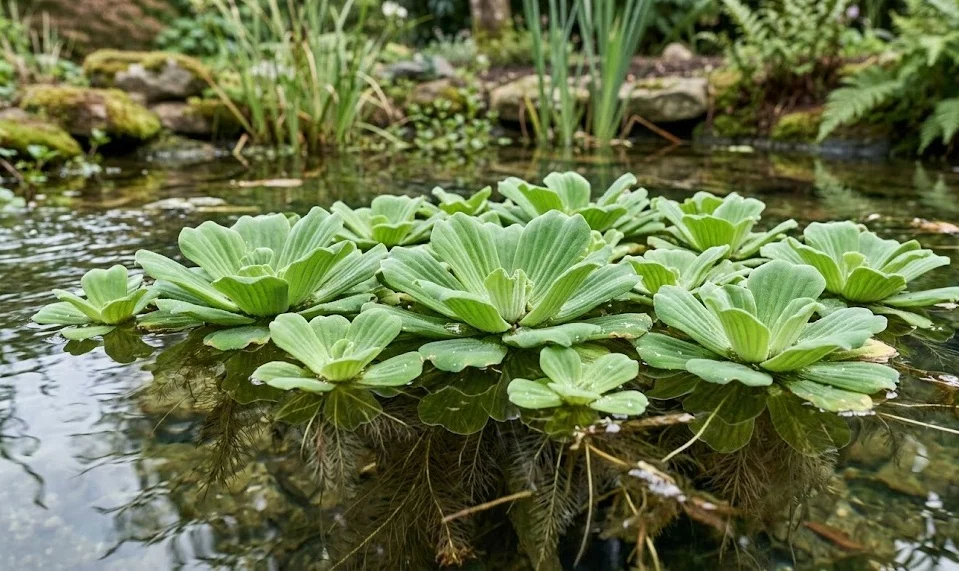

Water lettuce is a floating aquatic plant valued for its velvety green rosettes, feathery roots, and ability to soften the appearance of ponds and water gardens. Although it often grows rapidly in warm conditions, attractive specimens still depend on stable water quality, suitable light, and protection from cold weather. Its leaves must remain above the surface because prolonged wetting can cause spotting, yellowing, and crown rot. Successful care therefore begins with understanding that water lettuce floats freely rather than growing in ordinary garden soil.
The plant develops a compact rosette of ribbed leaves covered with fine water-repellent hairs. Beneath the rosette hangs a dense network of roots that absorbs dissolved nutrients directly from the water. These roots also provide shelter for small aquatic animals and young fish. In healthy conditions, the root system may become considerably longer than the visible portion of the plant.
Water lettuce performs best in calm or gently moving water. Strong fountains, waterfalls, and turbulent filters may repeatedly splash the leaves or push the plants into unsuitable corners. Constant agitation can damage the delicate roots and prevent the rosettes from remaining level. A sheltered part of the pond is usually the most reliable position.
Growth speed varies significantly according to temperature, light, nutrient availability, and plant maturity. Warm water and long summer days generally encourage rapid production of daughter plants. Cooler conditions slow growth and may cause older leaves to decline. Observing these seasonal changes helps distinguish normal behaviour from genuine care problems.
Choosing the right growing environment
Outdoor ponds offer excellent conditions when the water is warm, relatively still, and exposed to suitable light. Water lettuce can float among water lilies and other aquatic plants, although overcrowding should be avoided. The surface must remain open enough for gas exchange and for submerged plants to receive light. Regular thinning is especially important during periods of vigorous summer growth.
More articles on this topic
Container water gardens are useful where space is limited or closer control is required. A wide tub, half barrel, or purpose-made aquatic container provides more surface area than a narrow vessel. The container should be deep enough to prevent rapid temperature fluctuations during sunny weather. Dark containers may heat quickly, so their position should be chosen with care.
Indoor aquariums can support water lettuce when sufficient light, warmth, and humidity are available. Open-topped tanks are often more suitable than tightly covered aquariums because condensation can drip onto the leaves. The plants should not be positioned directly beneath powerful filter outlets. Gentle circulation below the roots is acceptable, but the rosettes should remain dry and stable.
Water lettuce should never be allowed to escape into natural waterways. Its rapid vegetative growth can create dense surface mats in suitable climates. Gardeners should dispose of excess plants responsibly rather than placing them in streams, lakes, drainage channels, or wetlands. Local cultivation rules should also be checked before obtaining or moving the plant.
Maintaining suitable water conditions
Water lettuce generally prefers water that is moderately warm and chemically stable. Sudden changes in temperature, hardness, or nutrient concentration can stress the roots and leaves. Rainwater may be useful in some container gardens, but very soft water can lack minerals needed for balanced development. A mixed and stable water source often produces better results than repeated drastic adjustments.
More articles on this topic
The plant tolerates a reasonably broad pH range, provided the water does not change abruptly. Slightly acidic to neutral or mildly alkaline conditions are commonly suitable. Extreme acidity or alkalinity may interfere with nutrient uptake and root health. Testing is particularly useful in small containers, where water chemistry can change faster than in large ponds.
Chlorinated tap water should ideally be treated before sensitive aquatic plants are introduced. Freshly filled containers may also need time to reach a stable temperature. Water lettuce added immediately to cold or chemically untreated water may develop root damage or leaf yellowing. Gradual acclimatisation reduces the likelihood of this shock.
Organic debris should not be allowed to accumulate excessively beneath floating plants. Decomposing leaves, uneaten fish food, and pond sludge may release nutrients but can also reduce oxygen and encourage microbial problems. Removing dead material improves both appearance and water quality. This simple maintenance task becomes more important in warm weather.
Managing temperature and seasonal growth
Water lettuce is fundamentally a warmth-loving plant. Active growth is strongest when both air and water remain consistently warm. Prolonged exposure to low temperatures weakens the rosettes, while frost usually causes severe or fatal tissue damage. Outdoor plants should therefore be treated as seasonal aquatics in regions with cold winters.
Young plants may react more quickly to temperature changes than established specimens. A sudden cold night can cause the outer leaves to yellow or become translucent. The plant may recover if the crown remains healthy and warmth returns promptly. Repeated chilling, however, gradually exhausts the rosette.
Very hot conditions can also create difficulties in shallow containers. Water may overheat during the afternoon, especially where a dark vessel receives uninterrupted sun. High temperatures reduce dissolved oxygen and can accelerate nutrient imbalances. Partial afternoon shade and adequate water volume help moderate these extremes.
Seasonal growth should guide the care routine. During warm months, plants may require frequent thinning and closer observation of nutrient levels. As temperatures decline, growth slows and fertilisation should be reduced. Winter care requires a separate strategy based on whether the plants will be discarded, replaced, or maintained indoors.
Supporting healthy roots and foliage
Healthy water lettuce usually has firm, fresh green leaves and a well-developed root system. Root colour may vary from pale brown to dark brown without necessarily indicating disease. The most important signs are good root density, active new growth, and a firm central crown. Slimy, foul-smelling, or rapidly disintegrating roots suggest unsuitable conditions.
The leaves should remain dry on their upper surfaces whenever possible. Water trapped among the leaf bases interferes with gas exchange and encourages decay. Rain is rarely a problem in open ponds because plants can dry naturally, but repeated splashing from pumps may be damaging. Relocating the plants is often more effective than treating the resulting symptoms.
Yellow outer leaves can be removed once they have clearly begun to deteriorate. This improves air movement and prevents decomposing tissue from entering the water. Leaves should be pinched or cut close to the base without injuring the crown. The central growing point must remain intact.
Root trimming is sometimes helpful in aquariums where long roots obstruct equipment or dominate the display. Only a portion of the root mass should be removed at one time. Severe trimming can reduce nutrient uptake and temporarily slow growth. Clean scissors help prevent crushing and unnecessary damage.
Controlling spread and overcrowding
Water lettuce commonly reproduces through short runners that produce daughter rosettes. Under favourable conditions, this process can fill a small pond or container surprisingly quickly. Dense coverage restricts light penetration and may interfere with oxygen exchange. Routine thinning is therefore part of normal care rather than a sign that anything has gone wrong.
A balanced surface should contain open water between groups of plants. This spacing allows each rosette to expand without being forced upright by its neighbours. Crowded plants often become smaller, paler, and more susceptible to decay. Open water also improves access for fish feeding and equipment maintenance.
Excess plants can be removed by gently lifting them from the water and allowing surplus water to drain back into the pond. Selected healthy specimens may be retained for propagation or indoor culture. Unwanted plants should be dried, composted securely where appropriate, or disposed of with household green waste. They should never be released into the wider environment.
Regular control also prevents roots from clogging pumps and filter intakes. Floating barriers or planting rings can keep water lettuce away from moving equipment. These devices are especially useful in ornamental ponds with fountains. They also make the overall arrangement appear more deliberate and organised.
Recognising and correcting common problems
Pale leaves often indicate insufficient nutrients, poor root function, or unsuitable light. The pattern of discolouration provides useful clues, because older-leaf yellowing differs from bleaching on the newest growth. Before applying fertiliser, water quality and root condition should be checked. Adding nutrients blindly can worsen algae problems.
Brown spots on the upper leaves frequently result from splashing, sun scorch, cold damage, or physical injury. Damaged tissue does not usually return to green. The objective is to correct the underlying conditions and protect the developing leaves. New growth provides the clearest indication of recovery.
A shrinking root system may be caused by fish grazing, nutrient deficiency, chemical shock, or poor water quality. Large goldfish and koi sometimes nibble or uproot floating plants. Protective baskets or separate growing containers may be required where grazing is persistent. The plants should also be inspected for soft or decaying root tissue.
Slow growth is not always a problem. Newly introduced plants often require time to adjust, and cooler weather naturally reduces development. Concern is justified when the crown softens, new leaves fail to appear, or decline continues despite stable warmth. In such cases, improving light, water quality, and root protection is more effective than making many abrupt changes.
Creating a practical care routine
A weekly inspection is usually sufficient during moderate growth. Check the crown, outer leaves, roots, surface coverage, and proximity to pumps or fountains. Remove damaged material before it decomposes. This regular observation prevents small issues from becoming widespread.
During rapid summer growth, thinning may be needed more than once a week. The plants should not be allowed to form an unbroken mat across the entire surface. Open areas support a healthier aquatic environment and reduce competition. The removed material also provides an opportunity to select the strongest rosettes.
Water quality should be assessed whenever appearance changes suddenly. Temperature, pH, nutrient availability, and recent chemical treatments are all relevant. Fish medication, algaecides, and untreated tap water may affect floating plants even when fish appear comfortable. Careful records can reveal patterns that are otherwise easy to miss.
The best results come from steady conditions rather than constant intervention. Water lettuce responds well to warmth, moderate nutrition, suitable light, and gentle water movement. When these requirements are met, the plant usually maintains itself with relatively little effort. Thoughtful thinning and responsible disposal complete a sustainable care routine.