
Planting and propagating weeping mulberry require more than simply placing a young tree in the ground and waiting for the canopy to develop. This ornamental tree has a distinctive grafted structure, and that detail strongly influences how it should be handled. The final form depends on planting depth, trunk stability, graft protection, and early training. When these steps are done carefully, the tree establishes faster and develops a stronger, more elegant crown.
The first decision is choosing a high-quality young tree from a reliable nursery. A good specimen should have a straight, sound trunk, a healthy graft union, and a balanced head of flexible weeping shoots. The bark should be undamaged, and the root system should be moist but not waterlogged. Weak, pot-bound, or poorly grafted plants often struggle after planting.
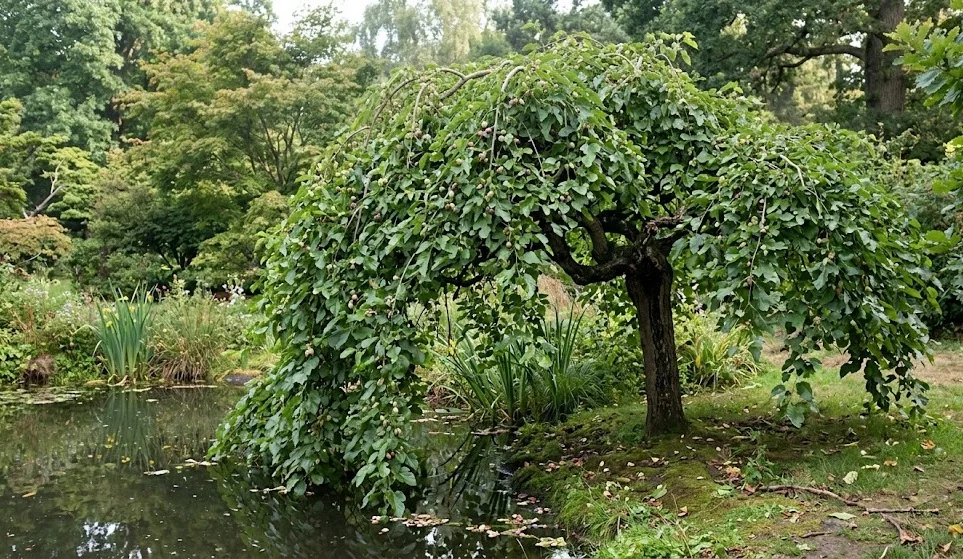
Weeping mulberry is commonly sold as a grafted standard, meaning the cascading crown is joined to an upright trunk. This makes it different from many shrubs or naturally branching trees. The height of the trunk is largely fixed, so choosing the right size at purchase is important. A low-grafted tree will remain low, while a high-grafted tree will create a taller umbrella effect.
Propagation is possible, but it is more specialised than ordinary seed sowing. Seed-grown plants do not reliably reproduce the weeping form and may develop into ordinary upright mulberries. For true-to-type plants, nurseries usually use grafting or budding techniques. This is why purchasing a named, grafted tree is the most dependable option for most gardeners.
Choosing the right planting time and tree quality
The best planting time is generally autumn or early spring, when the soil is workable and temperatures are moderate. Autumn planting allows roots to begin settling before strong summer heat arrives. Spring planting is also suitable, especially in colder regions or where winter wetness is a concern. Planting during hot, dry weather creates avoidable stress and demands much more aftercare.
More articles on this topic
Container-grown trees can technically be planted over a longer season, but timing still matters. Even a container plant suffers if its root ball dries quickly after installation. Planting during mild weather gives the tree a gentler transition from nursery conditions to open ground. The less stress it experiences early on, the better the first season’s growth will be.
Before buying, inspect the graft union carefully. It should be well healed, firm, and free from cracks, swelling, or signs of decay. The crown should emerge cleanly above this point, with no strong shoots growing from below the graft. Any vigorous shoots below the graft may belong to the rootstock and should be removed.
The root system is just as important as the visible crown. Roots should be active, pale at the tips, and distributed through the growing medium without forming a hard spiral. A severely root-bound plant may have difficulty anchoring and absorbing water after planting. If only such a plant is available, the root ball must be loosened carefully before planting.
Preparing the soil and planting hole
The planting hole should be wider than the root ball but not significantly deeper. A wide hole encourages roots to grow outward into loosened soil. Planting too deeply is a common mistake and can lead to bark decay, poor aeration, and slow establishment. The top of the root ball should sit level with, or slightly above, the surrounding soil.
More articles on this topic
The soil removed from the hole can usually be improved with compost if it is very poor, sandy, or compacted. However, the backfill should not become a rich, soft pocket that discourages roots from moving into the native soil. Mixing moderate organic matter evenly through the planting area is better than creating a sharply different zone. Roots establish best when the transition between planting hole and surrounding soil is gradual.
Drainage must be checked before planting in heavy soils. If water remains standing in the hole for a long time after filling, the site may not be suitable without improvement. Raised planting, soil restructuring, or choosing a better-drained location may be necessary. Weeping mulberry tolerates many conditions, but stagnant water around the roots is a serious risk.
Once the tree is positioned, backfill the hole gently and firm the soil enough to remove large air pockets. Heavy stamping should be avoided because it compacts the soil and reduces oxygen around the roots. Water thoroughly after planting to settle the soil naturally. A mulch layer can then be added to conserve moisture and protect the root zone.
Supporting, training, and early establishment
A newly planted weeping mulberry often benefits from staking, especially if the trunk is tall or the site is windy. The stake should support the tree without holding it completely rigid. Slight movement helps the trunk strengthen over time. Ties must be soft, adjustable, and checked regularly to prevent rubbing or girdling.
The graft union and crown should be protected during early establishment. The ornamental head must not be buried, damaged, or forced against support materials. Branches should be allowed to hang naturally, but any broken or badly crossing shoots can be removed. Early training is about guiding the tree gently, not imposing a harsh shape.
Watering after planting is critical. The root ball can dry out even when surrounding soil appears moist, especially in the first few months. Deep watering encourages roots to expand into the garden soil. Mulch helps maintain even moisture but should always be kept a little away from the trunk.
During the first year, avoid heavy fertilising. The tree’s priority is root establishment, not lush top growth. A small amount of compost or a mild slow-release feed may be useful if the soil is poor. Strong nitrogen applications can produce soft growth before the roots are ready to support it.
Propagation methods and practical expectations
True weeping mulberry is usually propagated by grafting or budding onto a compatible mulberry rootstock. This preserves the pendulous crown form and allows the tree to be produced at a chosen trunk height. The process requires skill, clean tools, correct timing, and suitable plant material. It is more commonly done by professional growers than by casual gardeners.
Hardwood or softwood cuttings may root in some circumstances, but they do not always produce a strong, standard-form tree. Even if a cutting roots, it may not develop the same architectural quality as a grafted specimen. Cuttings can also be slower to form a decorative canopy. For ornamental landscape use, grafted plants remain the more reliable choice.
Seed propagation is not suitable when the goal is to reproduce the weeping form. Seedlings vary genetically and usually grow as ordinary mulberries with upright habits. They may still be useful as rootstocks or experimental plants, but they should not be expected to match the parent tree. This distinction is important for gardeners who want predictable results.
After propagation or planting, patience is essential. A young weeping mulberry may look sparse in its first season while roots settle and the crown adjusts. With good care, the branch curtain becomes fuller and more refined over time. The strongest specimens are built gradually through correct planting, light training, and consistent aftercare.