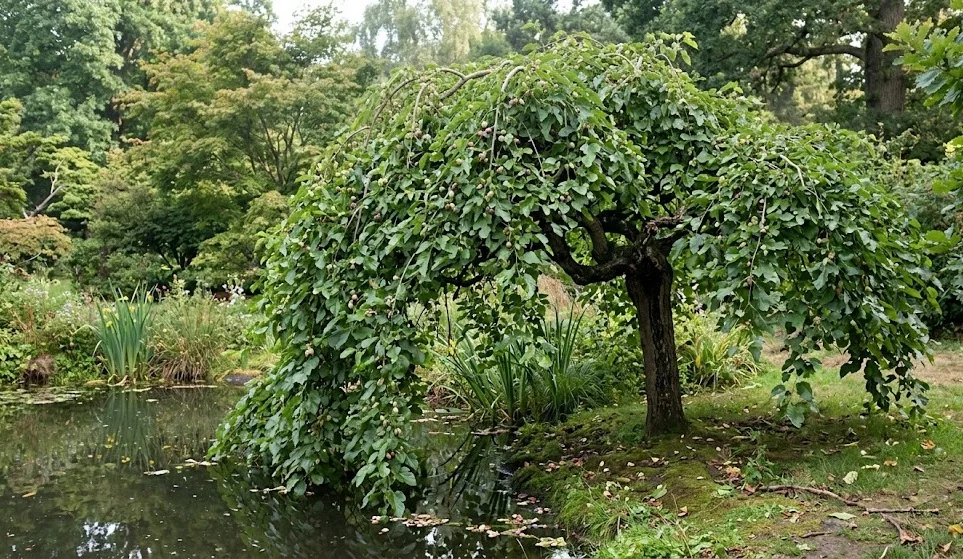

Weeping mulberry performs best in bright, open conditions where its crown receives generous sunlight for much of the day. Light influences not only leaf density, but also shoot strength, canopy balance, disease resistance, and the overall ornamental effect of the tree. Although the plant may tolerate some light shade, it rarely reaches its best form in dim or crowded positions. A carefully chosen sunny site is one of the simplest ways to ensure long-term success.
The tree’s weeping habit depends on healthy annual shoot growth. Strong light supports the production of well-spaced, leafy branches that hang naturally and create a full curtain. In too much shade, shoots may become thin, elongated, and uneven. The crown can then look patchy rather than lush.
Sunlight also affects plant health indirectly. Leaves that dry quickly after rain are less likely to suffer from certain fungal problems. Dense shade often keeps the canopy humid for longer periods. This creates a more favourable environment for leaf diseases and mildew.
Gardeners should evaluate light throughout the whole growing season, not just at planting time. Nearby trees, hedges, buildings, and pergolas can cast longer or denser shade as the season changes. A site that seems bright in early spring may be shaded heavily by midsummer. Observing the garden at different times of day helps avoid mistakes.
Full sun and ideal exposure
Full sun is generally the ideal exposure for weeping mulberry. A position receiving at least six hours of direct sunlight during the growing season usually supports vigorous and compact growth. More light often results in denser foliage and a stronger ornamental silhouette. This is especially important for specimen trees placed in prominent garden areas.
More articles on this topic
Morning sun is particularly valuable because it dries dew and overnight moisture from the leaves. This reduces the time the canopy remains wet. In climates with humid summers, quick drying can make a real difference to disease prevention. A tree that receives both morning and midday sun often stays cleaner and healthier.
Afternoon sun can be beneficial as well, but extreme heat and drought may increase stress in very dry regions. In such conditions, good soil moisture and mulch become important partners to light exposure. Sun is not harmful when the root zone is well managed. Problems usually arise when intense light is combined with drought and poor soil.
An open lawn or broad planting bed often provides the best setting. Light reaches the crown from several sides, encouraging symmetry. The tree can develop its characteristic umbrella-like form without leaning toward a brighter gap. Balanced exposure reduces the need for corrective pruning later.
Partial shade and its effects
Weeping mulberry can tolerate partial shade, but the results depend on the amount and timing of available light. Light shade for part of the day is usually acceptable if the tree still receives several hours of direct sun. Dappled shade from high, open trees may also be manageable. Deep shade from buildings or dense evergreens is much less suitable.
More articles on this topic
In partial shade, growth may be slower and the canopy may become less dense. The hanging branches may stretch toward the light, creating an uneven outline. Leaves may be larger but fewer, and inner branches may die back more readily. This can reduce the sculptural quality that makes the tree desirable.
Shade also increases competition when caused by nearby trees or large shrubs. The weeping mulberry may have to compete for water and nutrients as well as light. Root competition can intensify stress during dry periods. A shaded and dry position is particularly unfavourable.
If a tree is already planted in partial shade, pruning can sometimes improve its condition. Removing nearby crowding growth or thinning surrounding vegetation may allow more light and air into the canopy. The mulberry itself should not be over-pruned in an attempt to compensate for shade. Improving the environment is usually more effective than repeatedly cutting the tree.
Light, canopy form, and seasonal care
Light strongly influences the shape of the weeping crown. In good sun, shoots tend to develop more evenly around the grafted head. This creates a fuller, more natural canopy. In one-sided light, the crown may become heavier on the brighter side and thinner on the shaded side.
Pruning should take light distribution into account. Removing congested inner branches allows sunlight to penetrate deeper into the canopy. This helps maintain live growth throughout the crown rather than only on the outer surface. A well-lit interior is less prone to dead twigs and fungal issues.
Seasonal changes can reveal light problems. If the tree leafs out poorly on one side, becomes sparse in the centre, or drops leaves early in shaded sections, light may be part of the issue. These symptoms should be interpreted together with water, soil, and disease conditions. Light is rarely the only factor, but it is often a major one.
The best ornamental results come from matching light, space, and maintenance. A sunny site gives the tree the energy it needs, while good pruning helps use that light efficiently. Mulch and watering protect the roots that support sun-grown foliage. Together, these practices create a weeping mulberry with a dense, healthy, and graceful canopy.