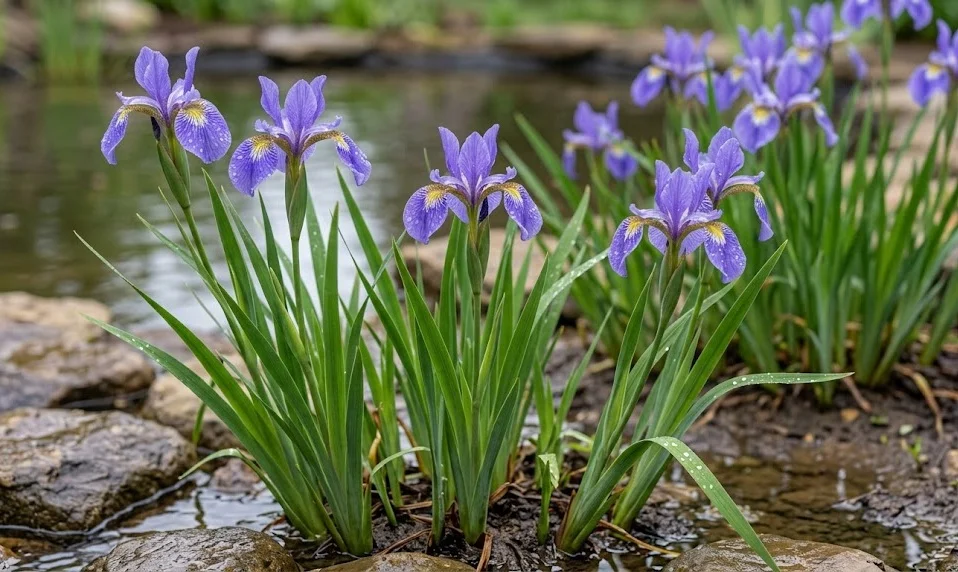

Planting Virginia iris successfully begins with understanding that it is a wetland-edge perennial rather than a dry-border iris. Its rhizomes establish best in consistently moist soil where they can remain hydrated through spring and summer. The plant is naturally suited to marshes, stream banks, lake margins, and other open wet places, so the garden site should echo those conditions as closely as possible. When planted in the right setting, it settles quickly and develops into a strong, long-lived clump. missouribotanicalgarden.org+1
The best planting sites are low, moist, and open to strong light. Rain gardens, pond shelves, drainage swales, and damp meadow edges are often excellent choices. Ordinary borders can also work if the soil remains evenly moist and irrigation is available during dry spells. The least suitable sites are dry slopes, hot raised beds, and compacted areas that alternate between drought and waterlogging without biological activity.
Before planting, prepare the bed with long-term maintenance in mind. Remove weeds, especially rhizomatous grasses and deep-rooted perennials, because they are difficult to extract later. Work compost into poor soil to improve moisture retention and structure. In heavy clay, avoid overworking wet soil because it can smear and compact, reducing oxygen around the roots.
Planting is easiest when temperatures are mild and soil moisture is reliable. Spring planting gives the plant a full growing season to establish before winter. Early fall planting can also work in many regions if the rhizomes have enough time to root before hard freezes. Avoid planting during extreme summer heat unless the site can be watered consistently.
Preparing the planting area
Start by observing how water moves through the site after rain. Virginia iris can use wet ground well, but it should not be placed in a basin where polluted runoff accumulates. Clean roof runoff, garden swales, and pond margins are usually better than roadside ditches treated with salt or chemicals. Water quality matters because rhizomes remain in close contact with the saturated soil.
More articles on this topic
The soil should hold moisture without becoming lifeless. A dark, humus-rich loam is excellent, but the plant can adapt to clay, sand, acidic soil, and slightly alkaline soil when moisture is adequate. Adding compost helps sandy soil retain water and helps clay soil develop a more open structure. The aim is not to make the site dry and free-draining, but to make it moist, fertile, and biologically active. Ask IFAS – Powered by EDIS
If the planting area is part of a rain garden, place Virginia iris in the lower or middle moisture zone. It can tolerate periodic saturation and shallow water better than many ornamental perennials. However, young plants still need stable moisture while they root. In the first season, check them after long dry intervals even if the garden is designed to catch stormwater.
Spacing should reflect the design goal. For a naturalized colony, plants can be spaced closer so they knit together over time. For specimen clumps, allow more room so each plant forms a distinct fan-shaped mass. A spacing range of about 24 to 36 inches is commonly practical in managed landscapes. Ask IFAS – Powered by EDIS
Planting rhizomes and container-grown plants
Container-grown Virginia iris should be watered thoroughly before planting. Moist roots slide out more easily and suffer less damage during transplanting. If the plant is pot-bound, gently loosen the outer roots without tearing the crown apart unnecessarily. A firm, living crown with white or pale active roots is a good sign of plant health.
More articles on this topic
Set the plant at roughly the same depth it grew in the container. The crown should not be buried deeply under heavy soil. Roots need full soil contact, while the growing points should be able to push upward without obstruction. After backfilling, press the soil gently to remove air pockets without compacting the planting hole.
Bare rhizomes should be handled carefully because they can dry out before planting. Keep them cool, shaded, and lightly moist until they go into the ground. Trim away any soft or rotted tissue with clean tools before planting. Firm rhizome sections with visible buds are the best candidates for quick establishment.
After planting, water deeply and repeatedly during the establishment period. Even in damp soil, watering helps settle the root zone and connect the rhizome with surrounding soil. A light mulch around the plant can reduce evaporation, but the crown should remain open. Thick mulch directly over the rhizome may trap excessive moisture and hide early signs of trouble.
Propagation by division
Division is the most dependable method for propagating Virginia iris. Because the plant spreads by rhizomes, mature clumps naturally produce sections that can be separated and replanted. This method preserves the characteristics of the parent plant. It also renews old clumps that have become crowded or less floriferous.
The best time to divide is usually after flowering or in early fall. After bloom, the plant still has time to rebuild roots before winter. Early fall division works well where autumn is long and moist. Avoid dividing during severe heat, drought, or active flowering because stress is higher at those times.
Lift the clump with a garden fork rather than slicing blindly with a spade. Shake or wash away enough soil to see the rhizome structure clearly. Cut or pull apart sections that have firm rhizomes, healthy roots, and at least one strong fan of leaves. Discard old, hollow, soft, or foul-smelling portions because they are unlikely to establish well.
Trim the foliage back moderately after division to reduce water loss and make handling easier. Do not remove all green tissue unless it is badly damaged. Replant divisions promptly into moist soil at the correct depth. Water them thoroughly and keep the soil evenly damp while new roots form.
Propagation by seed and establishment care
Virginia iris can also be propagated from seed, though it is slower and less predictable than division. Seed-grown plants may show natural variation in vigor, size, and flower color. This can be useful in ecological plantings where genetic diversity is desirable. It is less useful when a uniform ornamental effect is required.
Allow seed capsules to mature on the plant before collecting. The capsules should be firm and beginning to dry, but they should be gathered before seed is lost. Sow fresh seed in a moist medium and protect it from drying. Many iris seeds benefit from seasonal temperature changes, so outdoor sowing in a protected nursery bed can be effective.
Seedlings should be kept moist but not smothered. They need light, air movement, and protection from aggressive weeds. Young plants may take several seasons to reach flowering size. Patience is part of the process, especially when growing them for restoration-style or naturalistic plantings.
Whether propagated by division or seed, young Virginia iris plants need careful establishment. Moisture must remain consistent, competition should be controlled, and crowns should be monitored for rot or displacement. Once rooted, the plants become much more resilient. Strong early care creates clumps that require far less intervention later.