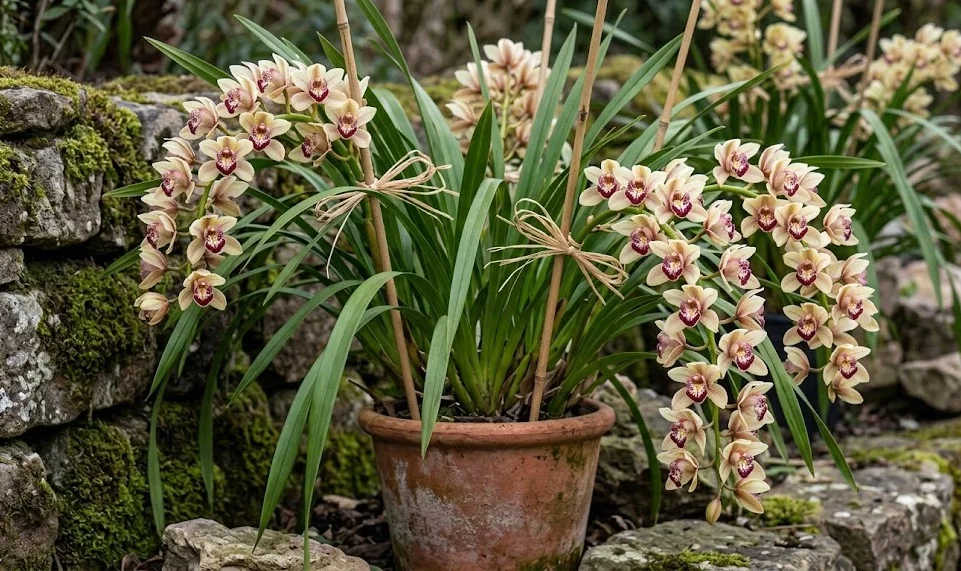

Pruning a boat orchid is less about shaping and more about hygiene, flowering management, and protecting healthy storage organs. These orchids should not be cut back like shrubs, because their pseudobulbs and leaves store energy for future growth. Excessive trimming can weaken the plant and delay flowering. Careful removal of spent spikes, dead leaves, and diseased tissue is usually all that is needed.
What should and should not be cut
Spent flower spikes can be removed after the blooms fade. The spike should be cut near the base with a clean sharp tool. Leaving a dry spike for a short time is not usually harmful, but it has no further ornamental value. Removing it improves appearance and hygiene.
Healthy green leaves should not be cut simply to reduce plant size. They produce energy and support developing pseudobulbs. Cutting them unnecessarily reduces the plant’s ability to grow and flower. Only damaged, diseased, or fully dead leaves should be removed.
Old pseudobulbs should usually remain unless they are rotten, hollow, or diseased. Even leafless back bulbs can store reserves. They may also support new growth under favorable conditions. Removing them too aggressively can weaken the whole clump.
Dry sheaths around pseudobulbs can sometimes be removed if they harbor pests. This should be done gently. Pulling too hard can injure live tissue or developing buds. If a sheath resists, it is better to leave it than tear the plant.
More articles on this topic
Clean technique and disease prevention
Pruning tools should be disinfected before use. Orchids can transmit disease through contaminated blades. This is especially important when cutting several plants. Clean technique is a basic professional habit.
Cuts should be made cleanly rather than crushed. A sharp blade causes less tissue damage. Ragged cuts dry poorly and may become infection points. The plant should be kept dry around fresh cuts for a short period.
Diseased tissue should be removed with a margin of healthy-looking tissue when necessary. After each cut into suspicious material, the tool should be cleaned again. Removed diseased leaves should be discarded away from the growing area. They should not be composted near valuable orchids.
Pruning is best done when the plant can dry quickly afterward. Cool, wet conditions increase the risk of infection. Good airflow supports wound drying. This is one reason overcrowded growing areas create more problems.
More articles on this topic
Trimming after flowering and during repotting
After flowering, the plant can be cleaned and assessed. Spent spikes, dead leaf tips, and dry debris may be removed. This is also a good time to check for pests hidden around the base. Post-flowering care prepares the plant for the next growth cycle.
Leaf tips that are brown can be trimmed for appearance if the tissue is dry and inactive. The cut should follow the natural leaf shape so it looks less obvious. However, trimming does not solve the cause of browning. Water quality, humidity, root health, and fertilizer levels should also be reviewed.
During repotting, dead roots should be removed. Firm healthy roots should be preserved as much as possible. Root pruning should never be excessive unless the roots are already dead. The plant needs living roots to recover quickly.
Division may involve cutting the rhizome between pseudobulbs. This should be done only when the plant is large enough. Each section needs adequate stored energy and roots. Careless division is more damaging than helpful pruning.