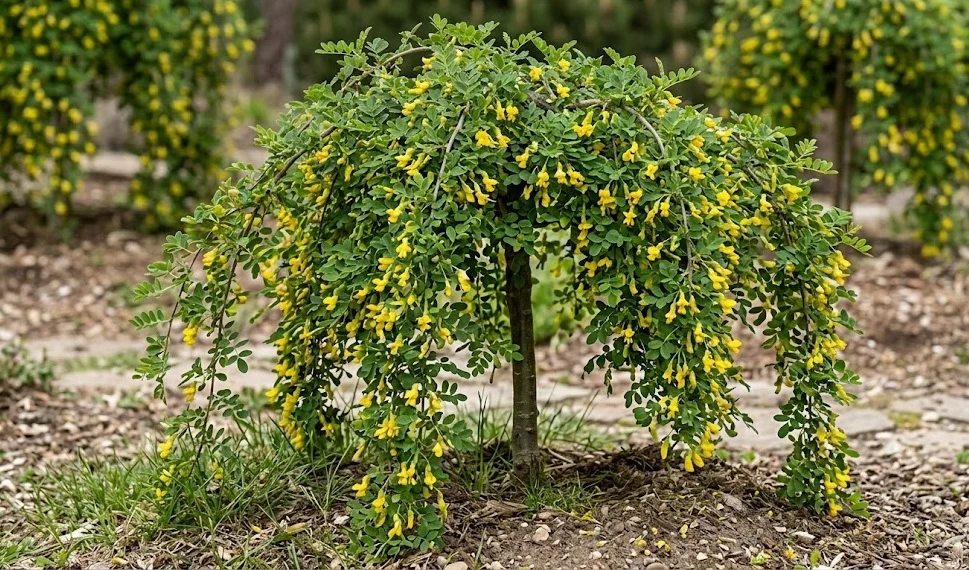

Planting the weeping pea tree successfully begins with understanding that this ornamental form depends on both a strong root system and a carefully preserved grafted crown. The tree is usually sold as a grafted standard, meaning its weeping branches are carried on an upright stem of a related rootstock. This makes correct planting depth, support, and early aftercare especially important. A well-planted tree establishes quickly, keeps its elegant outline, and remains easier to maintain throughout its life.
Choosing planting material and timing
Healthy nursery stock should have a straight stem, a well-healed graft union, and a balanced weeping crown. The bark should be firm and undamaged, and the root ball should hold together without smelling sour or rotten. Bare-root plants are less common for this ornamental form, while container-grown and root-balled specimens are widely used. A compact but not pot-bound root system is ideal.
The best planting periods are spring and autumn. Spring planting gives the tree a full growing season to establish before winter, which is useful in colder or windier regions. Autumn planting works well in mild conditions because soil remains warm enough for root growth while the crown is dormant. Planting during hot, dry summer weather requires more intensive watering and is generally less forgiving.
When buying the plant, the height of the graft should be considered carefully. The grafting height largely determines the final height of the cascading crown, because the weeping top does not naturally develop a taller trunk. A low-grafted specimen creates a small umbrella-like form, while a higher graft produces a more dramatic standard tree. The chosen size should match the garden space from the beginning.
Transport and handling also matter. The tree should be carried by the container or root ball, not by the stem or crown. The graft union is a valuable structural point and should not be twisted or damaged. Before planting, the root ball should be watered thoroughly so the plant begins establishment with adequate moisture.
More articles on this topic
Preparing the planting site
The planting area should be sunny, open, and well drained. The soil should be loosened over a wider area than the root ball so young roots can expand easily. A narrow planting hole with hard compacted sides can trap roots and water. Broad preparation creates a more natural transition between the nursery root ball and the garden soil.
The planting hole should usually be twice as wide as the root ball but only as deep as necessary. Planting too deeply is a serious mistake, especially for grafted ornamental trees. The top of the root ball should sit level with the surrounding soil or slightly above it in heavy ground. The graft union must remain clearly above soil level.
If the soil is very poor, mature compost can be mixed into the excavated soil. The amendment should improve structure without creating a rich pocket that discourages roots from moving outward. In clay soil, adding coarse mineral material and creating a raised planting position may improve drainage. Fresh manure, strong fertilizer, and heavy peat-based amendments should be avoided at planting.
Before placing the tree, the final orientation should be considered. The most attractive side of the crown can face the main viewing point, such as a path, terrace, or window. Because the form is asymmetrical by nature, small adjustments in position can make a major visual difference. Once planted and rooted, repositioning becomes difficult.
More articles on this topic
Planting technique and establishment care
The tree should be placed carefully in the prepared hole with the stem upright and the root ball stable. Soil should be returned gradually around the roots and firmed gently to remove large air pockets. Heavy stamping should be avoided because it compacts the soil and reduces oxygen around new roots. After planting, the area should be watered deeply to settle the soil.
Staking is often useful for newly planted standard trees. A single sturdy stake or a double-stake system can protect the trunk from wind movement while roots establish. The tie should be flexible and positioned so it supports the stem without rubbing the bark. Stakes should not be left in place longer than necessary, because the trunk also needs natural movement to strengthen.
A watering basin can be shaped around the root zone during the first season. This helps direct water toward the roots rather than allowing it to run away from the planting area. The basin is especially useful on slopes or in dry, sandy soils. It can be leveled later once the tree is established.
Mulch should be applied after planting to conserve moisture and reduce weed competition. A layer of bark, composted wood chips, or leaf mould is suitable if kept away from direct trunk contact. The mulch should cover the root zone broadly rather than forming a narrow mound. This simple step improves establishment and reduces stress during the first summer.
Propagation methods and practical limitations
The weeping pea tree is usually propagated by grafting, not by ordinary seed sowing. Seeds of the species may produce upright plants, but they do not reliably produce the ornamental weeping form. The named weeping cultivar must be clonally propagated to preserve its habit. This is why nursery-grown grafted plants are the standard option.
Grafting requires compatible rootstock, clean tools, good timing, and experience. The weeping scion is joined to a vigorous upright stem that determines the height of the final plant. Successful grafting depends on close cambium contact and careful aftercare while the union heals. For professional nurseries, this method provides uniform and marketable trees.
Home gardeners sometimes attempt propagation by cuttings, but results are usually inconsistent. Even if a cutting roots, it may not create the same standard tree form unless trained for many years. The natural weeping habit can be attractive on its own roots, but it will not automatically produce a clear trunk. For most gardens, buying a well-grafted young tree is more reliable.
After propagation or planting, rootstock suckers must be removed promptly. These shoots can grow faster and stronger than the grafted crown. If allowed to remain, they may dominate the plant and reduce the ornamental effect. Regular inspection is therefore part of both propagation management and long-term care.