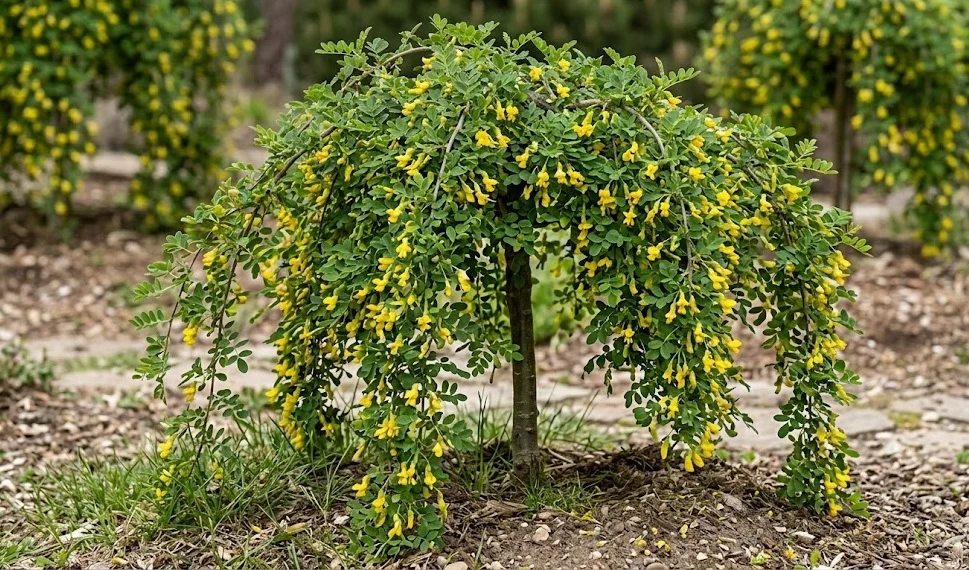

The weeping pea tree is a compact, sculptural ornamental tree valued for its arching crown, fine-textured foliage, yellow spring flowers, and exceptional resilience in difficult garden conditions. Its graceful habit makes it useful in small gardens, front yards, courtyards, and formal planting schemes where a distinctive focal point is needed. Although it looks delicate, it is a tough plant once established and tolerates cold, wind, drought, poor soil, and urban exposure better than many decorative trees. Successful care depends on understanding its growth habit, choosing the right position, and maintaining a balanced routine that supports structure without forcing overly lush growth.
Site selection and garden use
The weeping pea tree performs best in open, airy positions where its cascading branches can develop without being crowded. It should be planted where the crown has room to hang naturally, because the ornamental value of the plant depends largely on its flowing silhouette. Narrow corners, dense shrub borders, and positions directly against walls often reduce its visual impact. A clear planting space also improves air circulation and helps lower the risk of fungal leaf problems.
This tree is especially effective as a specimen plant because its form is naturally architectural. It can anchor a small lawn, soften the edge of a paved terrace, or create a graceful accent beside an entrance path. In minimalist gardens, the weeping crown adds movement without overwhelming the design. In cottage-style gardens, it pairs well with hardy perennials, ornamental grasses, and low groundcovers.
The plant is also suitable for exposed sites where more sensitive ornamental trees may struggle. It tolerates wind better than many broadleaf flowering trees, although young trees still benefit from staking during establishment. Its hardiness makes it useful in cold regions where winter temperatures limit the choice of small ornamental trees. The key is to avoid waterlogged ground, because excessive moisture around the roots can cause more harm than winter cold.
When planning the surrounding planting, it is important to respect the tree’s low, cascading branch structure. Tall or aggressive neighboring plants can hide the grafted form and compete for water and nutrients. Low-growing companions are usually the best choice because they frame the trunk and crown without interfering with the branches. Gravel mulch, creeping thyme, low sedums, catmint, and compact ornamental grasses can all create a clean and practical planting composition.
More articles on this topic
Soil requirements and root conditions
The weeping pea tree is not demanding about soil fertility, but it grows best in well-drained soil with a loose, moderately deep structure. Sandy loam, light loam, and improved garden soil are all suitable if water drains away after rainfall. Heavy clay can be used only if drainage is improved before planting. The plant dislikes standing water around its roots, especially during cold seasons when evaporation is slow.
Poor or lean soil is often less problematic than rich, wet soil. Excessive fertility can encourage soft, elongated shoots that spoil the compact weeping form and may be more vulnerable to winter damage. A moderate nutrient supply is enough for healthy foliage, flower production, and steady annual growth. The aim should be balanced growth rather than rapid growth.
Before planting, compacted soil should be loosened across a broad area rather than only in the planting hole. Roots establish more successfully when they can move outward into surrounding soil. Adding compost can improve texture, but it should be mixed thoroughly rather than placed in a concentrated layer. Very fresh manure or strong fertilizer should be avoided because it can damage young roots and disturb the natural growth rhythm.
Soil pH is usually not a major limitation, as the species is tolerant of a wide range of garden soils. Slightly alkaline soils are generally accepted well, which makes the plant useful in regions with lime-rich ground. Extremely acidic or poorly structured soils may require gradual improvement with organic matter and mineral amendments. Good drainage remains more important than achieving a perfect pH value.
More articles on this topic
Watering and moisture management
Newly planted weeping pea trees need regular watering during the first growing season. The root ball should not be allowed to dry out completely before the roots have expanded into the surrounding soil. Deep watering is better than frequent shallow sprinkling because it encourages roots to grow downward. After watering, the soil should be moist but not saturated.
Once established, the tree becomes notably drought tolerant. Its natural adaptation to dry and exposed conditions means it can survive periods of limited rainfall better than many ornamental trees. However, drought tolerance does not mean that prolonged stress is ideal for appearance. During extreme summer heat, occasional deep irrigation helps preserve leaf quality and prevents premature yellowing.
Mulching can improve moisture stability, especially in sunny and windy gardens. A layer of organic mulch reduces evaporation and keeps the root zone cooler during hot weather. The mulch should not be piled against the trunk, because constant moisture at the bark can encourage decay. A clear gap around the stem is a simple but important detail.
Overwatering is a more common care mistake than underwatering with this tree. Constantly wet soil can lead to poor root function, reduced vigor, yellow leaves, and dieback. Containers and raised beds need particular attention because drainage conditions can vary widely. Water should always be applied according to soil moisture, not according to a fixed calendar alone.
Feeding and nutrient balance
The weeping pea tree usually needs only light feeding in ordinary garden soil. In many cases, an annual application of compost around the root zone is enough to maintain steady growth. Strong nitrogen fertilizers are rarely necessary and can produce long, weak shoots. The most attractive specimens often grow at a moderate pace with firm, well-ripened wood.
If the soil is very poor, a balanced slow-release fertilizer can be applied in spring. It should be used sparingly and spread evenly over the root area rather than concentrated near the trunk. Feeding late in the season is not recommended because it may stimulate new growth that does not harden before winter. Spring is the safest time to support growth without disrupting dormancy.
Leaf color and shoot development offer useful clues about nutrient status. Pale foliage, weak shoot extension, and poor flowering may indicate limited nutrition, especially in extremely sandy soil. However, similar symptoms can also result from water stress or root problems. It is better to assess soil moisture and drainage before assuming that fertilizer is the solution.
Organic soil care is often more effective than heavy feeding. Maintaining a healthy mulch layer, avoiding compaction, and allowing natural leaf litter to enrich the soil can support the root system gently. This approach suits the plant’s naturally rugged character. It also reduces the risk of overstimulation and keeps maintenance simple.
Pruning and crown maintenance
Pruning should respect the natural weeping habit of the tree. The goal is not to force a geometric shape but to maintain a clean, balanced, and healthy crown. Dead, damaged, crossing, or inward-growing shoots should be removed as needed. Light corrective pruning is usually better than severe cutting.
The best time for structural pruning is late winter or early spring before strong new growth begins. At this stage, the branch framework is visible and cuts can be made with precision. Light trimming after flowering is also possible if only small adjustments are needed. Heavy summer pruning should be avoided because it can stress the plant during hot weather.
Because many weeping pea trees are grafted, special attention must be paid to shoots emerging from below the graft union. These upright shoots belong to the rootstock and can quickly spoil the appearance of the plant if left in place. They should be removed as close to their point of origin as possible. Regular inspection prevents rootstock growth from becoming woody and difficult to control.
The crown can become dense over time if old shoots accumulate in the center. Selective thinning allows light and air to enter the canopy, reducing the chance of leaf disease and improving the visibility of the elegant branch lines. It is usually enough to remove a few poorly placed branches rather than cutting the entire crown back. Pruning should always enhance the plant’s character, not erase it.
Seasonal care through the year
In spring, the main tasks are inspection, light feeding, mulching, and pruning if needed. This is also the season when yellow flowers appear, often before the foliage has fully matured. Young trees should be checked for winter damage and for any loosened stakes. Early care sets the tone for steady, healthy growth during the rest of the year.
In summer, watering should be adjusted according to rainfall and temperature. Established trees usually need little intervention, but newly planted specimens still require monitoring. Weeds should be kept away from the root zone because they compete for moisture during dry periods. The crown can be inspected occasionally for pests, broken shoots, or rootstock suckers.
In autumn, care should focus on preparing the plant for dormancy. Late fertilization should be avoided, and watering should gradually decrease unless the season is very dry. Fallen leaves can be removed if disease was present during the year. A fresh but moderate mulch layer can protect soil structure before winter.
In winter, the weeping pea tree usually needs little protection in the ground. Its cold tolerance is excellent, but young grafted trees may benefit from protection against strong wind, snow load, or mechanical damage. Heavy wet snow should be gently shaken from the crown if branches bend excessively. The trunk should also be protected from damage by tools, animals, or repeated freeze-thaw stress near paved surfaces.
Common care mistakes and professional recommendations
One of the most common mistakes is planting the tree in soil that stays wet for long periods. The plant is hardy, but it is not a bog plant and cannot thrive with oxygen-starved roots. Symptoms of wet soil can include yellowing leaves, sparse growth, and branch dieback. Improving drainage before planting is far easier than correcting root problems later.
Another frequent error is excessive fertilization. A weeping pea tree does not need the same feeding intensity as a fruit tree or a fast-growing hedge. Too much nitrogen encourages loose growth that weakens the refined outline of the crown. Professional maintenance should aim for controlled vigor and strong wood.
Poor pruning can also reduce ornamental value. Cutting all hanging branches to the same length creates a stiff, artificial shape and removes the natural movement of the canopy. Better results come from selective thinning and careful shortening of individual shoots. Each cut should have a clear purpose.
The best specimens are usually those maintained with restraint. They receive enough water during establishment, enough nutrients to stay healthy, and enough pruning to remain balanced. They are not overmanaged or forced into unnatural growth. With this approach, the weeping pea tree can remain a durable and elegant feature for many years.