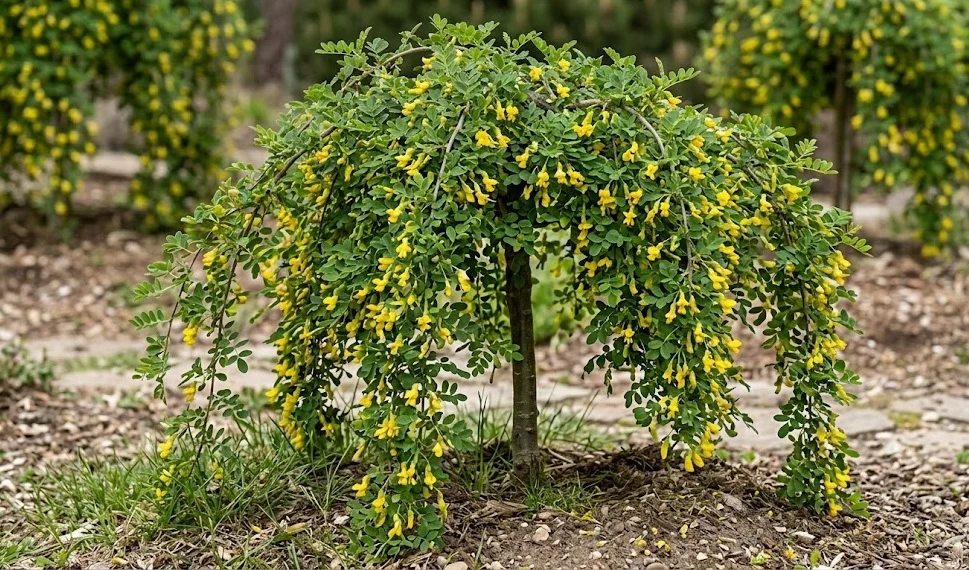

Watering and fertilizing the weeping pea tree should be guided by moderation, because this ornamental tree is naturally adapted to relatively lean and dry conditions. It does not require intensive feeding or constantly moist soil to perform well. In fact, excessive water and fertilizer often cause more problems than careful restraint. The goal is to support establishment, maintain healthy foliage, and preserve the compact weeping form without encouraging weak or excessive growth.
Watering after planting
During the first growing season, the tree needs consistent attention to soil moisture. Newly planted roots are still confined mostly to the original root ball, which can dry faster than the surrounding soil. Deep watering once or twice a week during dry weather is usually more effective than daily light sprinkling. The exact frequency depends on soil type, rainfall, wind, and temperature.
Water should be applied slowly so it penetrates the root zone. If water runs off the surface, it should be applied in stages rather than all at once. A watering basin around the plant helps keep moisture where it is needed. This is especially useful on sloping sites or in light sandy soil.
The root ball should be checked directly during establishment. Surface soil can appear moist while the root ball inside remains dry, especially when container-grown plants are installed in different-textured garden soil. A hand check a few centimeters below the surface gives a more accurate picture. Good establishment depends on moisture reaching the original roots.
Watering should gradually become less frequent as roots spread outward. The aim is to encourage independence, not to keep the plant permanently dependent on irrigation. By the second or third growing season, a well-planted tree often needs water only during extended drought. This transition is important for long-term resilience.
More articles on this topic
Watering established trees
Established weeping pea trees are drought tolerant and can handle dry spells better than many ornamental trees. Their ability to grow in lean, exposed conditions makes them practical for low-maintenance gardens. However, extreme drought can still reduce flowering, dull the foliage, and cause early leaf drop. Occasional deep watering during prolonged heat helps maintain ornamental quality.
The best watering method is slow soaking over the root area. Short watering that only wets the surface encourages shallow roots and evaporates quickly. Deep watering supports a stronger root system and helps the tree cope with dry periods. Drip irrigation, a slow hose, or a watering ring can all be effective.
Soil type strongly influences watering needs. Sandy soil drains quickly and may require more frequent watering during heatwaves. Clay soil holds moisture longer but can become problematic if it remains saturated. Loamy soil usually offers the best balance between moisture retention and aeration.
Visual symptoms should be interpreted carefully. Wilting, yellowing, or leaf drop may suggest drought, but they can also indicate root stress from excess water. Before watering heavily, the soil should be checked. A plant in wet soil should never be treated as if it were drought-stressed.
More articles on this topic
Avoiding overwatering and drainage problems
Overwatering is one of the main causes of decline in the weeping pea tree. Constant moisture excludes oxygen from the root zone and weakens the root system. In severe cases, branch dieback and root rot can follow. The plant is much more tolerant of short dry periods than of prolonged waterlogging.
Poor drainage is often hidden at planting time. A planting hole dug into compacted clay can act like a basin that collects water. Even if the surface appears dry, water may remain trapped below the root ball. This is why site preparation is so important before planting.
Mulch should be used wisely in moisture management. A moderate mulch layer helps reduce evaporation and temperature fluctuations. A thick, wet mound against the trunk can create bark problems and encourage pests. The correct method is to spread mulch widely and keep the stem clear.
Container-grown weeping pea trees require extra drainage attention. Pots must have open drainage holes and a free-draining growing medium. Water should never be allowed to stand permanently in saucers. In containers, the balance between drying out and staying too wet must be checked more often than in open ground.
Fertilizing principles
The weeping pea tree is a light feeder compared with many ornamental shrubs and trees. In average garden soil, it may need no regular fertilizer beyond organic mulching. Excessive feeding can produce long, soft shoots that disrupt the weeping outline. Moderate growth is usually stronger, neater, and more winter-hardy.
Spring is the best time for any necessary feeding. A balanced slow-release fertilizer can be applied when new growth begins. The dose should be conservative, particularly for young trees and plants growing in already fertile soil. Fertilizer should be spread over the root zone rather than placed close to the trunk.
Compost is often the safest nutrient source. A thin layer worked lightly into the surface or used under mulch improves soil structure and biological activity. It releases nutrients gradually and supports roots without forcing rapid shoot growth. Well-rotted compost is preferable to fresh organic material.
Late-season fertilizing should be avoided. Feeding in late summer or autumn can stimulate tender growth that may not mature before frost. This is especially undesirable in cold climates. By the end of summer, the plant should be allowed to slow naturally and prepare for dormancy.
Diagnosing nutrient and moisture problems
Pale leaves may suggest low nitrogen, but they do not always mean the tree needs fertilizer. Poor drainage, drought stress, root damage, or soil compaction can produce similar symptoms. Careful diagnosis prevents unnecessary feeding. The first step should always be to examine soil moisture and root conditions.
Weak growth may also result from shade rather than poor nutrition. A tree growing in insufficient light may stretch, flower poorly, and develop a sparse crown. Fertilizer cannot correct a fundamentally unsuitable site. Light, drainage, and soil structure should be assessed together.
Leaf scorch often appears during hot, dry, or windy weather. Brown edges can indicate water stress, especially in newly planted trees. However, roots damaged by waterlogging may also fail to supply enough moisture to the crown. This is why both drought and excess water can lead to similar visible stress.
The most professional approach is preventive rather than reactive. Plant in well-drained soil, water deeply during establishment, mulch correctly, and fertilize lightly only when needed. This routine supports strong roots and a stable canopy. It also keeps the natural elegance of the weeping pea tree intact.