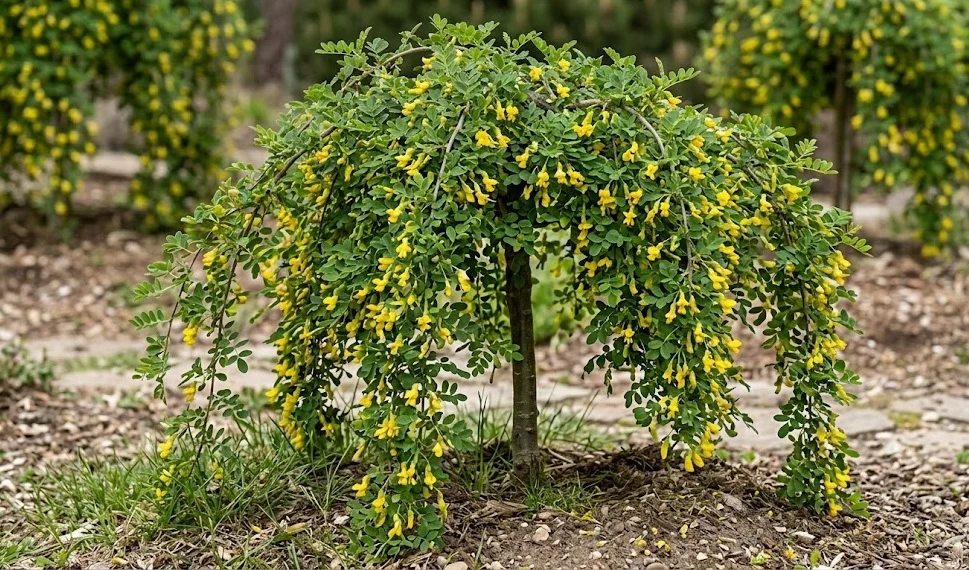

Pruning the weeping pea tree is mainly about preserving its natural cascading form while keeping the crown healthy, balanced, and free of unwanted growth. This ornamental tree should not be clipped like a hedge or forced into a rigid outline. Its beauty comes from movement, layered branches, and a soft umbrella-like habit. Good pruning is therefore selective, restrained, and guided by the structure of the individual plant.
Timing and basic pruning principles
The best time for structural pruning is late winter or early spring before new growth begins. During dormancy, the branch framework is easy to see and cuts can be made accurately. This timing also allows the plant to respond with fresh growth in spring. Severe pruning during active heat or drought should be avoided.
Light corrective pruning can also be done after flowering. This is useful when only minor shortening or tidying is needed. Removing a few poorly placed shoots at this stage will not usually harm the plant. However, heavy cutting immediately after bloom can reduce the natural grace of the crown.
Every cut should have a clear purpose. Dead, diseased, damaged, crossing, or inward-growing branches should be removed first. Shoots that drag excessively on the ground can be shortened to maintain clearance. The crown should still look relaxed and flowing after pruning.
Sharp, clean tools are essential. Ragged cuts heal poorly and can create entry points for disease. Thin shoots can be removed with hand pruners, while older wood may require a small pruning saw. Tools should be cleaned if disease is suspected.
More articles on this topic
Managing the weeping crown
The crown should be thinned selectively rather than sheared. Shearing creates a dense outer shell and leaves dead or weak growth inside. It also removes the natural variation in branch length that gives the tree its character. A professional-looking crown has rhythm, not a blunt edge.
Long shoots can be shortened to an outward-facing bud or a well-placed side branch. This keeps the branch line natural and avoids stubby growth. Cuts should follow the direction of the existing branch structure. The aim is to guide the crown, not to fight it.
Older crowns may need renewal if they become too dense or tangled. A few aging or congested branches can be removed near their origin to allow light into the center. This encourages better airflow and reveals the elegant branch architecture. Renewal should be gradual rather than drastic.
Ground clearance depends on the intended garden style. Some gardeners prefer the branches to nearly touch the ground, creating a living curtain. Others keep the crown lifted slightly to show the trunk and allow underplanting. Either approach can work if the cuts are balanced and not overly harsh.
More articles on this topic
Suckers, graft care, and cutting back mistakes
Because the tree is usually grafted, suckers from below the graft union must be removed promptly. These shoots often grow upright and more vigorously than the weeping crown. If left in place, they can dominate the plant and spoil the ornamental form. They should be cut cleanly at their point of origin.
Shoots growing from the trunk below the crown should also be watched closely. Some may arise from the rootstock, while others may be unwanted stem growth. Removing them early prevents large wounds later. Regular inspection during the growing season makes this task simple.
Hard cutting back should be used only with caution. Severe reduction can stimulate awkward regrowth and destroy the layered weeping effect. It may also expose older wood suddenly to sun and temperature stress. A badly overgrown tree is better corrected over several seasons.
The most common pruning mistake is trying to make the crown too even. A perfectly rounded, clipped shape often looks artificial and weakens the plant’s natural charm. Uneven branch lengths are part of the graceful habit. The best pruning leaves the tree looking cared for but not overworked.