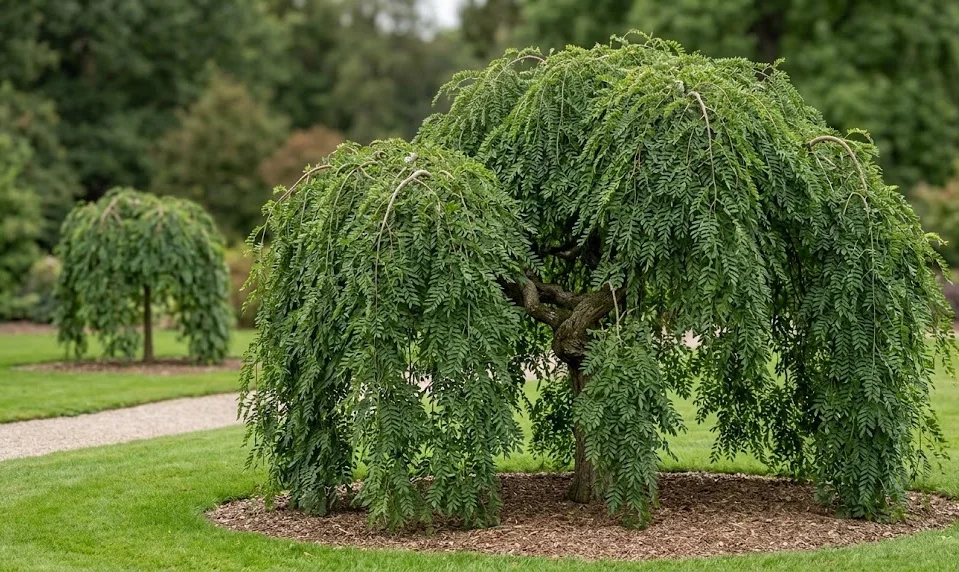

Planting a weeping Japanese pagoda tree is a long-term landscape decision, because the tree’s form becomes more expressive as it matures. The success of the plant depends heavily on correct site preparation, careful handling of the root ball, and a realistic understanding of how ornamental weeping cultivars are produced. This is not a tree to squeeze into a temporary gap or place where its branches will need constant restriction. When planted with enough space and supported properly during establishment, it can become one of the most distinctive features in the garden.
Selecting a suitable planting site
The planting site should be open, bright, and large enough for the tree’s mature canopy. Even though the weeping form may appear compact when young, its branches can widen and descend with age. A position too close to paths, walls, windows, or driveways may create maintenance problems later. Proper spacing prevents unnecessary pruning and allows the natural form to remain elegant.
The tree should receive plenty of sunlight for strong growth and good foliage quality. Light shade may be tolerated, especially in hot regions, but deep shade weakens the crown and reduces density. In too much shade, branches may stretch toward the light and lose their balanced outline. A sunny to lightly sheltered position is usually ideal.
Soil should be checked before the tree is purchased. Good drainage is essential, because newly planted roots are vulnerable in wet, airless ground. If the soil is heavy, compacted, or slow to drain, it should be improved over a broad area rather than only inside the planting hole. A narrow pocket of amended soil in poor surrounding ground can trap water and restrict root expansion.
The site should also be protected from accidental damage. Young trees are easily injured by lawn equipment, pets, foot traffic, and careless staking. A mulched planting circle helps mark the root zone and keeps mowers away from the trunk. This simple detail often prevents wounds that could affect the tree for years.
More articles on this topic
Planting technique and early establishment
The planting hole should be wider than the root ball but not deeper. A wide hole allows the new roots to move easily into loosened soil. Planting too deeply is one of the most common mistakes, because it can suffocate roots and encourage trunk problems. The top of the root ball should sit level with the surrounding soil or slightly above it in heavy ground.
Before planting, the root ball should be inspected. Container-grown trees may have circling roots, which should be loosened or corrected carefully. If these roots are left untouched, they may continue to grow around the root system rather than spreading outward. Bare-root or balled-and-burlapped plants should be handled gently to avoid breaking fine roots.
After placing the tree, the hole should be backfilled with the original soil, improved only lightly if needed. The soil should be firmed gently to remove large air pockets, but it should not be compacted heavily. Watering during backfilling helps settle soil around the roots. The first deep watering after planting is essential, even if rain is expected.
Staking may be necessary, especially for young grafted trees with a top-heavy weeping crown. The stake should stabilize the root ball without holding the trunk completely rigid. Some movement helps the trunk strengthen naturally. Ties must be soft, flexible, and checked regularly so they do not cut into the bark.
More articles on this topic
Propagation possibilities and limitations
Weeping Japanese pagoda trees are usually propagated by grafting, not by simple seed sowing. Seedlings do not reliably produce the same weeping form, because ornamental characteristics may not be inherited consistently. A seed-grown plant may become upright, variable, or unsuitable for the intended landscape effect. For a true weeping tree, a grafted plant from a reliable nursery is normally required.
Grafting allows the desired weeping cultivar to be joined to a compatible root system. This method preserves the crown habit and helps create a more predictable ornamental plant. The height of the graft often influences the final appearance, because branches usually begin to fall from the grafted head. A higher graft creates a more tree-like specimen, while a lower graft may produce a more compact, cascading form.
Home propagation is possible for skilled grafters, but it is not usually the easiest option for ordinary gardeners. Successful grafting requires suitable plant material, correct timing, clean cuts, compatible rootstock, and careful aftercare. Even when the graft takes, the young plant needs training before it becomes garden-worthy. For most gardens, purchasing a well-grown specimen is more reliable.
Cuttings may be attempted, but they are generally less dependable than professional propagation methods. Rooting success can vary, and the resulting plant may lack the strength or uniformity expected from nursery-grown material. If cuttings are tried, they require controlled humidity, clean media, and close attention to disease prevention. This is best treated as an experimental method rather than a guaranteed way to produce a quality tree.
Aftercare during the first years
The first year after planting is mainly about root establishment. The tree should be watered deeply whenever the soil begins to dry below the surface. A consistent moisture supply helps roots grow beyond the original planting hole. Irregular watering can cause stress, especially in warm or windy weather.
Mulch should be applied over the planting area to protect the soil. It reduces evaporation, limits weed competition, and improves soil conditions as it breaks down. The mulch layer should remain moderate in thickness and should not touch the trunk. Fresh mulch can be added each spring as older material decomposes.
Pruning should be minimal during the establishment period. Only broken, dead, crossing, or clearly unwanted shoots should be removed. Heavy shaping too soon can reduce the leaf area that the young tree needs for energy production. The main goal is to help the plant settle, not to force a finished crown immediately.
The tree should be inspected regularly for signs of stress. Wilting, yellowing leaves, dieback, loose staking, or bark injury should be addressed quickly. A young tree often gives early warning before serious decline begins. Careful attention during the first few seasons greatly improves the chance of long-term success.