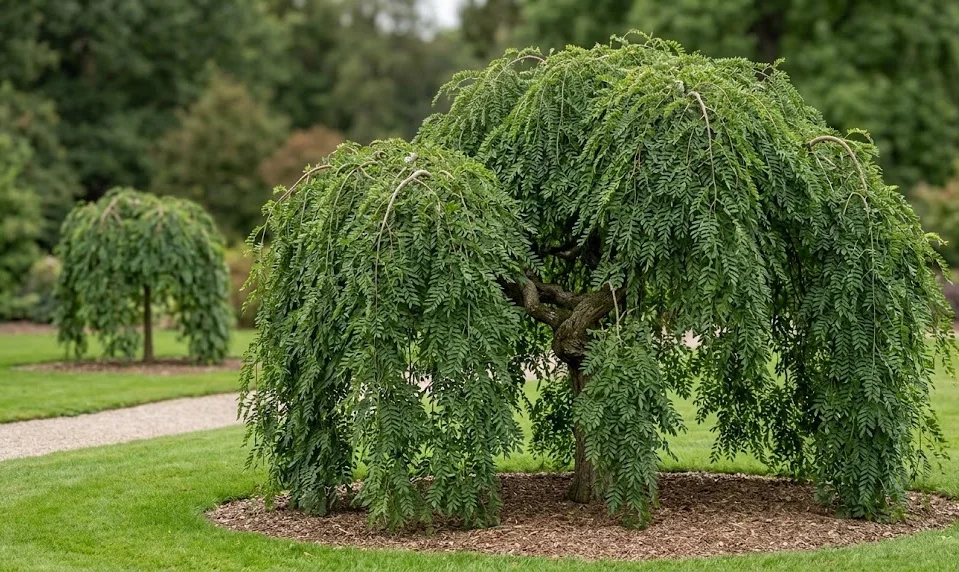

A weeping Japanese pagoda tree grows best when water and nutrients are supplied with restraint, consistency, and respect for the tree’s moderate growth habit. It does not usually need intensive feeding, and it should not be kept constantly wet in an attempt to accelerate development. The goal is to support a strong root system, healthy leaves, and firm woody growth that can carry the weeping crown over many years. Balanced care produces a tree that is elegant, resilient, and easier to maintain.
Understanding moisture needs
The tree’s water needs change significantly with age. A newly planted tree depends on the gardener because its roots are still confined to the original root ball and nearby soil. During this stage, even short dry spells can cause stress. Regular deep watering is therefore essential during the first growing seasons.
Established trees are more independent, but they are not completely drought-proof. Long periods of heat and dry weather can still affect leaf quality and shoot growth. In dry summers, supplemental watering helps prevent premature leaf drop and stress-related decline. The amount of water should be adjusted according to soil type, weather, and tree age.
Soil texture strongly influences watering frequency. Sandy soil drains quickly and may require more frequent watering during hot periods. Clay soil holds water longer, but it can become airless if watered too often. Loamy soil is usually easiest to manage because it balances moisture retention with drainage.
The best way to judge moisture is to check the soil directly. Surface dryness alone can be misleading, because deeper soil may still be moist. A hand check several centimeters below the surface gives a much better picture. Water should be applied only when the root zone actually needs it.
More articles on this topic
Practical watering methods
Deep watering is more effective than frequent shallow watering. A slow trickle from a hose, watering bag, or drip system allows water to soak into the root zone. This encourages roots to grow downward and outward. Shallow watering keeps roots near the surface, where they are more vulnerable to heat and drought.
Water should be applied around the root zone rather than directly against the trunk. The absorbing roots are generally spread through the soil beyond the trunk base. Concentrating water only at the stem can leave much of the root system dry. A broad watering area becomes increasingly important as the tree grows.
Morning is usually the best time to water. The soil can absorb moisture before the hottest part of the day, and any wet surfaces dry more quickly. Watering in strong midday heat can be inefficient because evaporation is higher. Evening watering is acceptable in dry weather, but wet foliage should not be encouraged overnight.
Mulch improves watering efficiency. It slows evaporation, reduces temperature swings, and protects the soil from crusting. Organic mulch also supports soil organisms as it gradually decomposes. The layer should be renewed when it becomes thin, but it should never be piled like a mound around the trunk.
More articles on this topic
Avoiding overwatering and root stress
Overwatering is a common problem, especially in heavy soils or poorly drained planting sites. Roots need oxygen to function, and constantly saturated soil prevents healthy root respiration. When roots are weakened, the canopy may wilt even though the soil is wet. This can mislead gardeners into adding more water and worsening the problem.
Symptoms of excess water can include yellowing leaves, weak growth, branch dieback, and sour-smelling soil. These signs can resemble drought stress, so checking soil moisture is important. If the ground remains wet for too long after irrigation or rain, watering should be reduced immediately. Drainage problems may need structural correction rather than simple changes in watering frequency.
Container-grown young trees are especially vulnerable before planting. Their root balls can dry out quickly in hot weather, yet they can also become waterlogged if left standing in saucers or impermeable coverings. Before planting, the container should be monitored carefully. A stressed root ball often establishes poorly even if the planting process is otherwise correct.
A balanced watering routine should respond to real conditions. Fixed schedules are useful as reminders, but they should not replace observation. Weather, soil, mulch depth, and tree size all affect water demand. The healthiest trees are cared for by gardeners who adjust rather than follow rigid habits blindly.
Feeding for steady growth
Feeding should be moderate and well timed. A weeping Japanese pagoda tree does not benefit from excessive fertilizer, especially if the soil is already reasonably fertile. Too much nitrogen can produce soft, long shoots that are more prone to damage and less attractive in form. Slow, firm growth is much better for the structure of a weeping tree.
Spring is the most suitable time for feeding. A light layer of mature compost around the root zone can improve soil condition and provide gentle nutrients. If additional fertilizer is needed, a slow-release balanced product can be applied sparingly. It should be watered in well and kept away from direct contact with the trunk.
Soil testing can be useful in gardens where growth is poor for no obvious reason. Nutrient deficiencies, pH problems, and soil compaction can all affect the tree’s ability to absorb what it needs. Feeding without diagnosing the problem may waste effort and create new imbalances. A professional soil test is especially valuable before making repeated fertilizer applications.
Late summer and autumn feeding should generally be avoided. Nutrients applied too late may encourage tender growth that does not harden before winter. This can increase susceptibility to cold damage and dieback. Nutrient support should follow the natural rhythm of the growing season.
Organic matter and long-term soil fertility
Organic matter is often more valuable than strong fertilizer. Compost, leaf mold, and decomposed bark improve soil structure while releasing nutrients slowly. They help sandy soils retain moisture and help clay soils become more workable. This creates a healthier root environment over time.
The quality of organic material matters. Fresh manure, uncomposted green waste, or overly rich amendments can damage roots or encourage unbalanced growth. Only mature, stable materials should be used around ornamental trees. A mild, steady improvement program is safer than sudden heavy enrichment.
Mulch and compost should be used differently. Compost can be applied thinly as a soil conditioner, while mulch is used as a protective surface layer. Mixing large amounts of organic matter deeply into the planting hole is not always helpful, because it can create a sharp contrast with the surrounding soil. Improving the broader area is usually more effective.
A healthy soil ecosystem supports the tree quietly in the background. Earthworms, fungi, bacteria, and fine roots all benefit from stable moisture and organic cover. Chemical overuse, compaction, and constant disturbance can reduce this living structure. Long-term fertility comes from maintaining the soil as a living root environment, not from repeatedly forcing growth.