
Drumstick allium develops its strongest stems and richest flower colour in abundant sunlight. Light influences not only flowering but also bulb replenishment, disease resistance, and the ability of stems to remain upright. The plant can tolerate a limited amount of shade, yet performance declines when surrounding vegetation blocks too much sun. Understanding daily and seasonal light patterns helps you choose the most productive planting position.
Full sun and flowering performance
A site receiving at least six hours of direct sunlight is generally ideal. Eight hours or more can produce especially compact, intensely coloured flower heads when moisture remains adequate. Strong light encourages efficient photosynthesis. This allows the bulbs to store enough energy for future flowering.
Morning and midday sun are particularly valuable. They warm the foliage and help dry dew quickly. Rapid drying reduces the humid conditions that favour leaf diseases. Plants in open positions usually appear more vigorous than those enclosed by shrubs.
Adequate sunlight also supports sturdy, vertical stems. In low light, stems often lean toward the brightest direction. This phototropic growth can make the planting appear uneven. Support from neighbouring plants may disguise the problem but does not correct the underlying shortage.
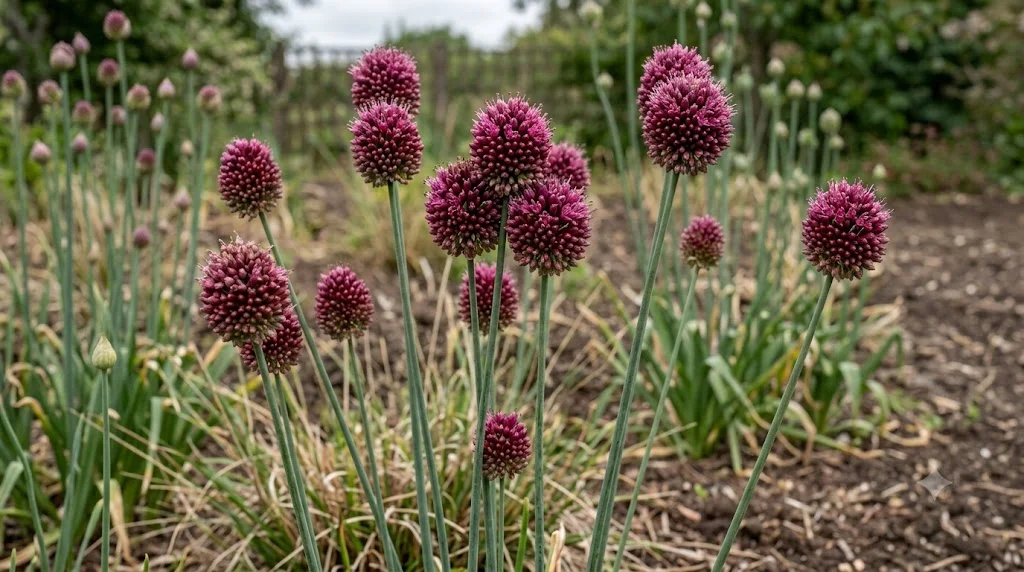
Flower colour can be less intense in deep shade. The characteristic transition from green to burgundy-purple may develop slowly or unevenly. Flower heads can also remain smaller. Moving shaded bulbs during dormancy usually improves later performance.
More articles on this topic
Tolerance of partial shade
Light afternoon shade can be beneficial in very hot climates. It reduces heat stress and slows moisture loss without depriving the plant of essential energy. A position with bright morning sun and filtered late-day light can therefore work well. The soil must still remain well drained.
Open, dappled shade beneath high-canopied deciduous trees may be acceptable. The bulbs receive stronger light in spring before the tree canopy becomes dense. However, root competition can reduce moisture and nutrient availability. Additional monitoring may be necessary during dry periods.
Dense shade from evergreen trees, walls, or buildings is unsuitable. Plants may produce leaves but fail to flower consistently. Bulbs can gradually shrink when they cannot replenish stored reserves. Increased dampness in shade may also encourage rot.
Observe the site through the growing season rather than judging it on a single day. Sun angles and surrounding foliage change from spring to summer. A place that appears bright in early spring may become heavily shaded by flowering time. Seasonal observation leads to better placement decisions.
More articles on this topic
Managing light in mixed borders and containers
Choose companion plants that do not smother the emerging foliage. Low mounds of catmint, hardy geranium, or compact grasses can conceal fading leaves while leaving stems exposed to sunlight. Avoid placing the bulbs directly behind large, dense perennials. Their mature foliage may block light at the most important stage.
Thin overcrowded neighboring plants when allium flowering declines. Selective pruning can restore light and air movement without redesigning the entire border. Make changes gradually to avoid exposing shade-adapted plants suddenly. Reassess the display the following season.
Containers can be moved to follow better light conditions. Rotate pots occasionally if growth leans strongly toward one side. Do not move plants abruptly from deep shade into intense midday sun during hot weather. A short acclimatisation period prevents leaf scorch.
Reflective walls can increase both light and heat. In cool climates this may improve growth, but in hot regions it can cause rapid drying. Adjust watering according to the actual microclimate. Strong light is beneficial only when roots remain healthy and the bulb is not exposed to prolonged heat stress.