
Japanese blood grass is valued for its upright form and striking foliage, which develops increasingly vivid red tones as the growing season progresses. Although it is often treated as a low-maintenance ornamental grass, its best colour and strongest growth depend on thoughtful site selection and balanced care. Gardeners must also watch for green reversions because the parent species can behave aggressively in suitable climates. With proper management, this grass can become a dramatic yet controlled feature in borders, gravel gardens, containers and contemporary planting schemes.
Understanding its growth habit
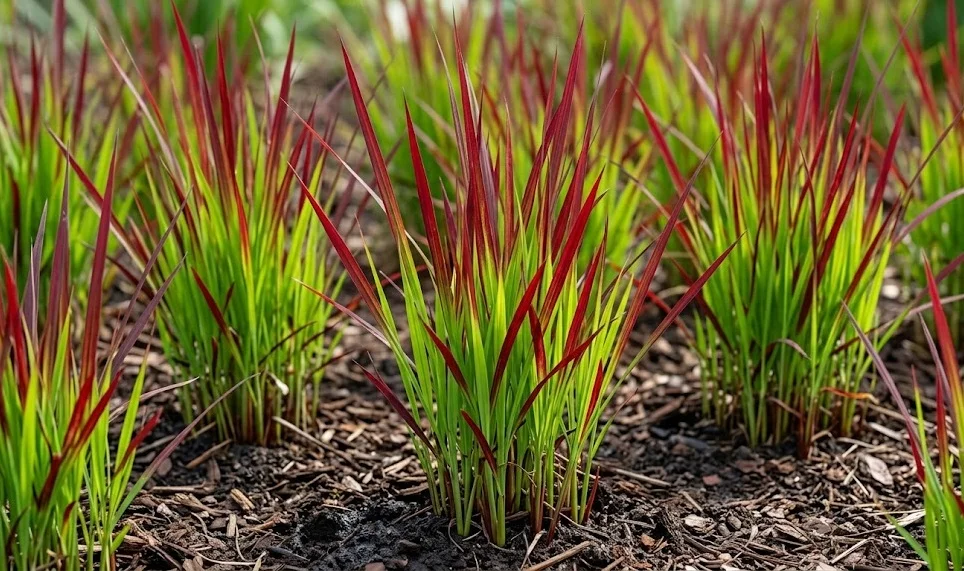
Japanese blood grass forms narrow, upright clumps of blade-like leaves that emerge green before developing red tips and deeper crimson colouring. The plants usually remain relatively compact, although their final size depends on climate, soil fertility, moisture and the length of the growing season. Their vertical outline contrasts well with rounded shrubs, broad-leaved perennials and low ground-cover plants. This architectural quality makes the grass useful even when it is not displaying its strongest autumn colour.
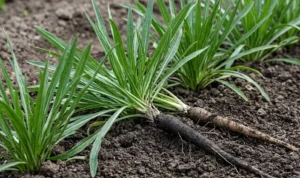
The plant spreads through underground rhizomes rather than forming a completely static crown. In cooler climates, its growth may remain restrained and manageable for many years. In warm regions with long growing seasons, however, rhizomes can travel farther and establish new shoots beyond the original clump. Local climate and growing conditions therefore have a major influence on how carefully the plant must be contained.
Japanese blood grass is commonly sold under names such as ‘Rubra’ or ‘Red Baron’. These ornamental forms are selected for their red foliage and are generally less vigorous than ordinary green cogon grass. Even so, individual shoots may occasionally lose their red colouring and revert to the more aggressive green form. Any entirely green growth should be removed promptly, together with the section of rhizome from which it developed.
Before planting, it is important to check whether Japanese blood grass is permitted in the local area. The underlying species is considered invasive or legally restricted in several parts of the world. Restrictions may apply even when red-leaved cultivars are sold elsewhere as garden ornamentals. Responsible cultivation begins with understanding local regulations and choosing a different ornamental grass where planting is prohibited.
More articles on this topic
Choosing the right site and soil
A sunny position usually produces the richest red colouring and the strongest upright growth. Plants grown in insufficient light often remain greener, develop softer leaves and lean towards the brightest part of the garden. Morning and afternoon sun are both useful, although intense afternoon heat may increase water demand in dry climates. A location receiving at least six hours of direct sunlight is generally suitable where summers are not excessively hot.
The soil should drain freely while retaining enough moisture to prevent repeated drought stress. Japanese blood grass dislikes remaining waterlogged for long periods, particularly during cool weather when roots are less active. Heavy clay can be improved with well-rotted organic matter and, where practical, by planting on a slightly raised area. Very sandy soil benefits from compost that increases moisture retention without creating a dense, airless structure.
A moderately fertile soil supports steady growth without encouraging the plant to become excessively lush. Very rich soil or heavy nitrogen feeding can produce long, soft leaves with weaker red pigmentation. Overfed plants may also spread more rapidly and become more difficult to manage. A balanced soil with moderate organic content is therefore preferable to a heavily amended planting hole.
Good air circulation helps foliage dry after rain and lowers the risk of leaf spotting or crown problems. Avoid squeezing the grass into a permanently damp corner between dense shrubs or against a wall with little airflow. Adequate spacing also allows the vertical leaves to display their natural shape. When several plants are grouped together, allow enough room to inspect the clumps for unwanted green shoots.
More articles on this topic
Establishing healthy plants
Spring is usually the safest planting season because the soil is warming and the plant has an entire growing period in which to establish roots. Early autumn planting may also succeed in mild climates where the ground remains warm for several weeks. In colder regions, late planting can leave roots poorly established before frost arrives. Young plants installed during hot summer weather need especially careful watering and temporary protection from extreme heat.
The planting hole should be wider than the root ball but no deeper than the original container. Setting the crown too low can encourage moisture to collect around the base of the leaves. After positioning the plant, backfill with the surrounding soil rather than creating a pocket of extremely rich compost. Firm the soil gently to remove large air spaces without compacting it around the roots.
Water thoroughly immediately after planting so that the soil settles evenly around the root system. During the first growing season, the root zone should remain consistently moist but never saturated. Deep, less frequent watering usually encourages better rooting than repeated light sprinkling. Mulch can help stabilise moisture, although it should be kept slightly away from the crown.
Newly planted Japanese blood grass may take time to produce strong red colour, especially if it was grown under shade in a nursery. The first priority is root establishment rather than immediate top growth. Once the plant begins producing fresh upright leaves, colour generally strengthens with increasing sunlight and seasonal maturity. Avoid trying to force rapid growth with strong fertiliser because this can weaken foliage and reduce pigmentation.
Caring for the plant through the seasons
In spring, old foliage should be removed before vigorous new shoots become tall enough to be damaged during cutting. The emerging growth may initially appear mostly green, with red colouring developing from the tips as light levels and temperatures increase. Check the centre of the clump for dead material, congestion or soft tissue. Spring is also the most convenient time to divide an overcrowded plant.
Summer care focuses mainly on maintaining even moisture and monitoring the colour of new growth. Prolonged drought can cause leaf tips to brown, while excessive irrigation may lead to weak roots and soft growth. Container-grown plants need more frequent attention because their root balls dry much faster than garden soil. During hot weather, watering is best carried out in the morning so the plant enters the warmest part of the day fully hydrated.
Autumn is often the season when Japanese blood grass reaches its greatest ornamental value. Cooler nights and mature foliage can intensify the red and burgundy tones across a larger portion of each leaf. Avoid cutting the plant back simply because growth has slowed, since the standing foliage remains decorative. Leaving the leaves intact also provides some natural protection for the crown during winter.
In winter, the foliage usually fades to tan, brown or straw-coloured shades. The dry leaves can still contribute structure and movement to the garden, especially when touched by frost. In exposed sites, tying the foliage loosely may help prevent it from collapsing over neighbouring plants. Unless disease or severe wind damage makes removal necessary, final cutting is normally postponed until late winter or early spring.
Managing spread and cultivar stability
Regular inspection is essential because not every shoot within a clump will necessarily retain the expected red colour. Normal young leaves may begin green before reddening, so colour must be judged over time and in relation to sun exposure. A true reversion usually remains solid green even after neighbouring leaves have developed strong red tips. These shoots may also appear broader, taller or more vigorous than the ornamental growth.
Removing only the visible green leaves is not sufficient because the reverted rhizome can continue producing new shoots. Dig around the unwanted section and trace it back into the clump as carefully as possible. Remove the green growth with a generous portion of attached underground stem. Recheck the plant later in the season because small fragments may survive and resprout.
Physical containment may be useful where the plant grows vigorously but remains legally permitted. A deep, durable root barrier can restrict sideways rhizome movement if it is installed correctly and extends above the soil surface. Growing the plant in a large container is another practical method of control. Pots should still be placed on a firm surface or checked regularly because rhizomes may escape through drainage holes.
Flowering is uncommon in many cultivated red forms, but any unexpected seed heads deserve attention. Removing them before seed development reduces a possible route of spread and keeps the plant focused on foliage. Garden waste containing rhizomes should not be dumped in natural areas or added to a poorly managed compost heap. Where local guidance treats the species as invasive, disposal should follow the recommended municipal or agricultural procedure.
Growing Japanese blood grass in containers
Container culture suits Japanese blood grass because the pot restricts its rhizomes and makes the plant easy to position. Its narrow leaves work particularly well in modern planters, mixed seasonal displays and entrances where an upright accent is needed. Choose a frost-resistant container with generous drainage holes. The pot should be broad and stable enough to prevent the tall foliage from tipping in strong wind.
A high-quality, free-draining potting mixture is more suitable than ordinary garden soil. Garden soil can compact inside a container and may drain poorly after repeated watering. Adding fine bark, perlite or another structural component helps preserve air spaces around the roots. The growing medium should hold some moisture while allowing surplus water to leave quickly.
Potted plants need closer monitoring because their roots experience faster temperature changes and more rapid drying. Water when the upper layer of the mixture begins to dry, then continue until water drains from the base. Do not allow the pot to stand permanently in a filled saucer. Repeated cycles of complete drought followed by heavy saturation can damage roots and cause irregular foliage growth.
Repotting or division is usually needed when the root mass fills the container and water begins running around rather than through the compost. Spring is the best time to lift the plant, remove dead roots and separate healthy sections. Replant only vigorous red-leaved divisions and discard suspicious green growth responsibly. A slightly larger container is preferable to an oversized pot that holds excessive moisture around a small root system.
Long-term maintenance and troubleshooting
A mature clump benefits from division when its centre becomes sparse, woody or crowded with dead material. This often occurs after several years, although growth rate varies considerably between regions. Lift the plant in spring and divide it with a sharp spade, pruning saw or sturdy knife. Retain healthy outer sections with strong roots and clearly red-producing shoots.
Weak colour is most often linked to insufficient light, excessive nitrogen or foliage that has not yet matured. Moving the plant to a sunnier location may be more effective than adding fertiliser. If the site is already sunny, review feeding practices and reduce rich organic amendments. Keep in mind that severe heat stress can also dull foliage by causing scorching and premature browning.
Brown leaf tips may result from drought, drying winds, salt accumulation or root damage. Check moisture below the surface rather than judging the soil only by its appearance. Container plants can develop salt stress when fertiliser residues build up, so occasional deep flushing may help. Where irrigation water is naturally saline, rainwater can be used periodically to reduce mineral accumulation.
The healthiest long-term approach combines moderate fertility, good drainage, adequate sunlight and regular inspection. Japanese blood grass should never be allowed to spread beyond the area intended for it. Green reversions, escaping rhizomes and unwanted seedlings require immediate action rather than delayed control. With responsible management, the plant can provide intense seasonal colour without becoming a problem for the surrounding garden or landscape.