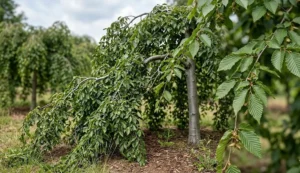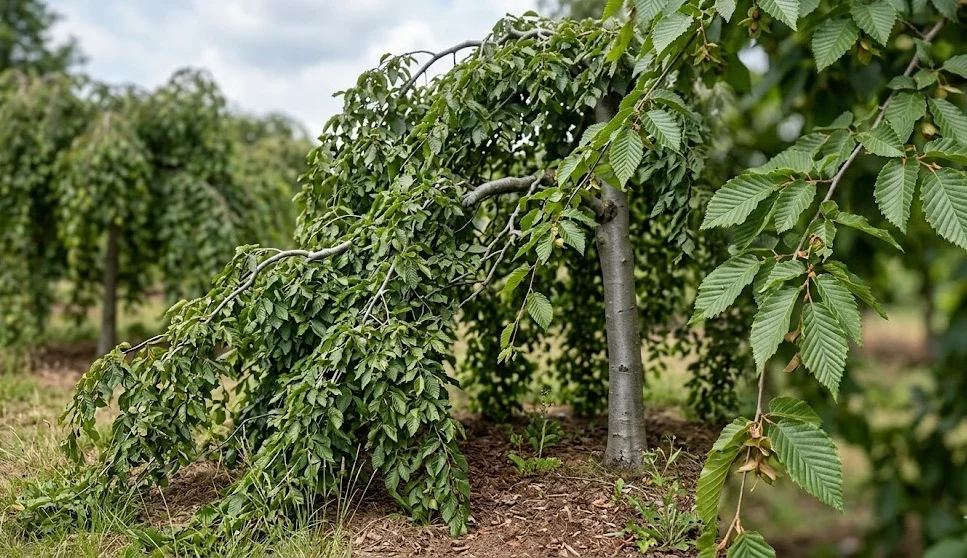

Weeping hornbeam adapts to a range of light conditions, but the quality of light strongly affects crown density, leaf health, and overall form. It can grow in full sun or partial shade, which makes it useful in many designed landscapes. The best position provides enough brightness for compact growth while avoiding the harshest heat in dry or urban gardens. Matching light exposure to soil moisture is the key to reliable performance.
Full sun and crown density
In full sun, weeping hornbeam usually develops a denser crown. Shoots tend to be shorter, stronger, and better branched. The foliage often appears fuller, creating a more defined umbrella or curtain effect. This is useful when the tree is planted as a specimen.
Full sun works best where the soil remains evenly moist. A sunny site with dry, compacted soil can cause stress. Leaf scorch may appear during hot summers. Mulch and deep watering reduce that risk.
Cooler climates are especially suitable for sunnier positions. The tree receives enough light without extreme heat pressure. Autumn color may also be stronger when light levels are good. The crown often matures more evenly.
In hot regions, full sun should be chosen carefully. Reflected heat from paving or walls can intensify stress. A lawn or planted bed around the root zone is better than bare hard surfaces. The tree should never be treated as drought-proof simply because it tolerates sun.
More articles on this topic
Partial shade and sheltered sites
Partial shade is often excellent for weeping hornbeam. Morning sun with afternoon shade provides brightness without excessive heat. This exposure is particularly helpful in dry or warm gardens. It supports leaf quality through summer.
In partial shade, growth may be slightly looser than in full sun. This is not necessarily a defect. The canopy can look softer and more natural. Gentle pruning can refine the outline without forcing unnatural density.
Avoid deep shade beneath large trees. In very low light, the crown may become thin and uneven. Shoots may stretch toward available light. The ornamental effect becomes weaker over time.
Sheltered partial shade near a courtyard, woodland edge, or north-east-facing garden area can be ideal. The position should still have open sky and good air movement. Damp, stagnant shade should be avoided. Leaves need to dry after rain to remain healthy.
More articles on this topic
Adjusting care to light exposure
Watering should reflect the light level. Sunny trees lose more water through their leaves and soil surface. Shaded trees may need less frequent watering. Soil checks are more reliable than fixed schedules.
Fertilizing should also be adjusted. Trees in lower light should not be pushed with strong nitrogen. Extra feeding can produce soft, weak growth that lacks structure. In shade, modest compost is usually enough.
Pruning differs between sunny and shaded specimens. Sunny trees often need light thinning to prevent overly dense, crossing branches. Shaded trees may need selective removal of weak or inward shoots. In both cases, the natural weeping habit should remain the guide.
Observe the canopy during the growing season. Sparse foliage, scorched leaves, and uneven growth all give clues about light balance. Sometimes nearby shrubs or branches can be adjusted to improve conditions. Small changes in exposure can greatly improve long-term appearance.