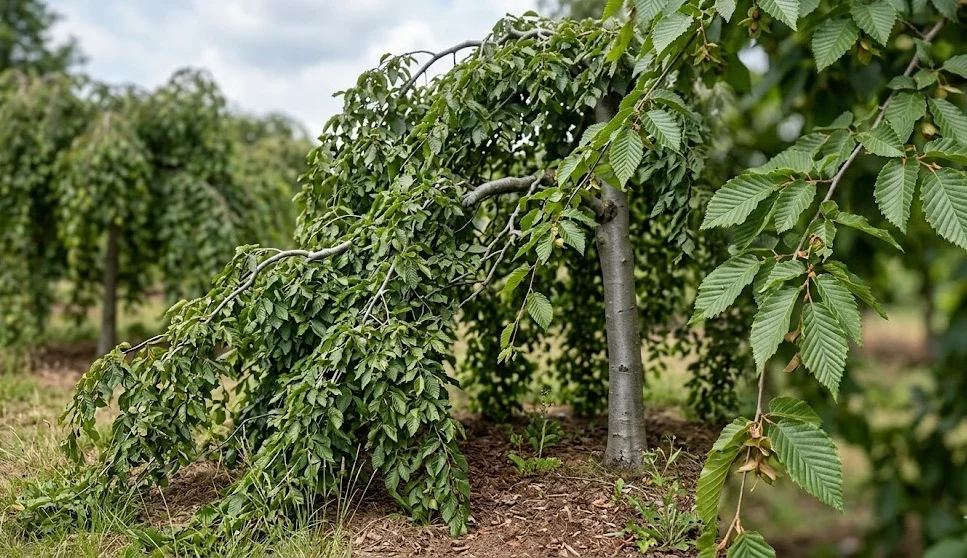

Weeping hornbeam is best planted with careful attention to root depth, soil preparation, graft quality, and long-term space. Although it is a resilient ornamental tree, the first years determine how strongly it establishes and how gracefully its crown develops. Propagation is more specialized because the weeping form is normally maintained through grafting. For gardeners and nursery professionals alike, success depends on understanding both the biology of the tree and the practical needs of the site.
Selecting a quality tree
Choose a young tree with a healthy graft union, balanced crown, and firm root system. The graft should be well healed and free from cracks, swelling, or decay. The trunk should stand securely without severe bends below the crown. A well-grown specimen establishes more easily than a neglected bargain plant.
Container-grown trees are convenient because they can be planted over a longer season. However, the root ball should be checked for circling roots. If roots are tightly wrapped around the pot, they must be loosened before planting. Otherwise, they may continue circling and restrict future stability.
Bare-root trees can establish very well when planted during dormancy. They are usually available in late autumn or early spring. Their roots must be kept moist before planting. Dry roots reduce survival and delay growth.
Inspect the crown before purchase. A few uneven branches are normal in a weeping cultivar. Severe dieback, weak shoots, or multiple rootstock suckers are warning signs. A tree with a clear central framework and healthy hanging branches is the best starting point.
More articles on this topic
Preparing the planting site
Prepare the site before the tree arrives whenever possible. Remove perennial weeds, loosen compacted soil, and improve structure with mature compost. Do not create a rich pocket surrounded by poor soil. Roots should be encouraged to move outward into the garden soil.
The planting hole should be wider than the root ball but not unnecessarily deep. A wide hole allows young roots to spread quickly. The bottom should remain firm enough to prevent sinking. If the tree settles after planting, the root flare may become buried.
Drainage should be checked carefully. If water remains in the hole for many hours after filling, the soil may need improvement. Raised planting can help in heavy ground. In very sandy soil, compost and mulch help retain moisture.
Position the tree where its future crown will not be forced into constant cutting. A weeping hornbeam needs room to express its form. Avoid planting too close to walls, fences, drains, or narrow walkways. Proper spacing reduces maintenance and improves visual quality.
More articles on this topic
Planting technique and aftercare
Set the tree so the root flare sits at natural soil level. The graft union should remain clearly above ground. Backfill with loosened native soil, firming gently to remove large air pockets. Avoid stamping hard around the roots.
Water thoroughly immediately after planting. This settles soil around the roots and begins the establishment process. A watering basin can be shaped around the root zone on dry sites. It should be shallow and temporary, not a permanent raised collar against the trunk.
Staking may be needed, especially for taller grafted specimens. Use a low, flexible tie that supports the trunk while allowing some movement. The stake should not rub the bark or hold the tree rigidly. Remove or adjust ties as the tree becomes stable.
After planting, apply organic mulch over the root zone. Keep it away from the trunk and graft area. Maintain even moisture through the first growing season. Early neglect is one of the main reasons ornamental trees remain weak for years.
Propagation methods and professional practice
Weeping hornbeam is usually propagated by grafting onto common hornbeam rootstock. This method preserves the pendulous form reliably. Seed propagation does not produce identical weeping trees. Cuttings are generally difficult and inconsistent for ordinary gardeners.
Grafting is normally performed by skilled nursery workers under controlled conditions. Matching rootstock and scion correctly is essential. The union must heal cleanly before the plant is grown on. Poor grafts may fail later, even if the young tree initially looks healthy.
Gardeners can sometimes raise rootstock seedlings, but producing a true weeping tree requires suitable scion wood. The scion must come from a healthy, correctly identified weeping specimen. Timing, humidity, cleanliness, and aftercare all influence success. This makes nursery purchase the most practical option for most gardens.
After grafting, rootstock shoots must be removed repeatedly. These shoots compete with the desired crown and can spoil the plant. The grafted crown should be trained gently while young. Once established, the tree needs only selective maintenance to preserve its distinctive shape.