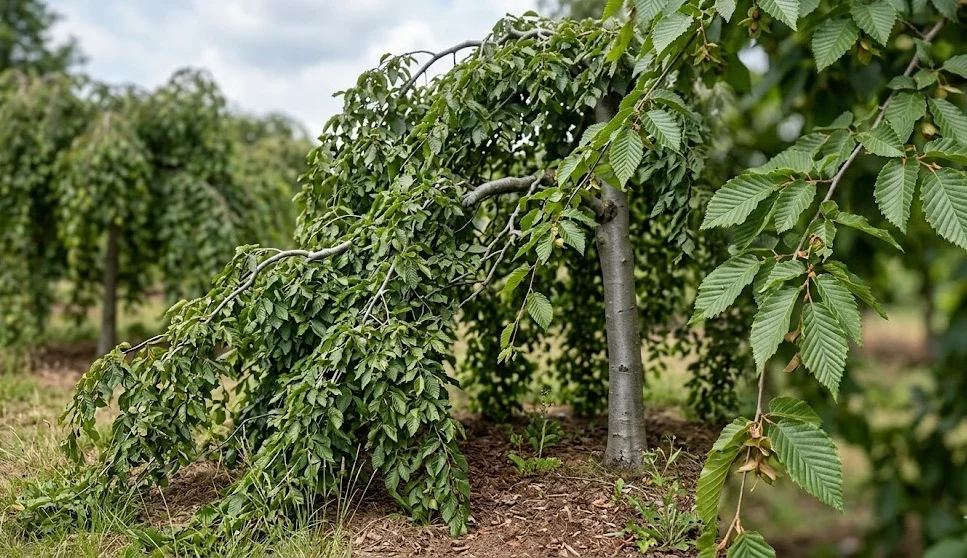

Weeping hornbeam is generally a robust ornamental tree, but it is not completely free from health problems. Most disorders develop when the tree is weakened by drought, waterlogging, poor planting depth, bark injury, or crowding. True pest and disease outbreaks are easier to manage when the tree is otherwise vigorous. A preventive approach based on correct site care is more effective than relying on repeated treatments.
Recognizing stress before disease
Many apparent diseases begin as environmental stress. Browning leaf edges often point to drought, heat, wind exposure, or root restriction. Yellowing leaves may indicate waterlogged soil, nutrient imbalance, or root damage. These symptoms should be interpreted alongside site conditions.
A recently planted tree may show temporary leaf drop during hot weather. This does not always mean infection. The root system may simply be unable to supply enough water to the crown. Improved watering and mulching often correct the problem.
Poor planting depth can cause long-term decline. If the trunk enters the soil like a pole without a visible root flare, the tree may be too deep. Buried bark remains damp and vulnerable. Correcting this early can prevent serious damage.
Mechanical injury is another common source of weakness. Mower strikes, trimmer cuts, and cracked bark create entry points for decay organisms. Protecting the base is therefore a plant health measure, not only a cosmetic detail. Once bark is badly damaged, recovery can be slow.
More articles on this topic
Common leaf problems
Leaf spots may appear during damp seasons. They are often cosmetic when the tree is otherwise healthy. Affected leaves can be removed from the ground in autumn to reduce carryover. Good airflow helps leaves dry more quickly.
Powdery mildew can occur in sheltered, humid positions. It appears as a pale coating on leaf surfaces. Severe cases may distort young leaves, but mild cases are often tolerable. Avoid excessive nitrogen because soft growth is more susceptible.
Leaf scorch is not a pathogen but can look alarming. It appears as brown margins or dry patches, especially after heat or drought. Trees near paving, walls, or compacted soil are more prone to scorch. Deep watering and mulch are the best responses.
Premature autumn-like coloring in summer may indicate root stress. This can follow drought, waterlogging, construction damage, or severe competition from grass. Fertilizer alone will not solve the problem. The root environment must be improved.
More articles on this topic
Insect pests and their management
Aphids may feed on young hornbeam shoots and leaves. They can cause curling, sticky honeydew, and minor distortion. Natural predators often control them without intervention. Strong water sprays or targeted low-impact products may be enough if colonies are heavy.
Scale insects can appear on twigs and branches. They may look like small bumps rather than active insects. Heavy infestations weaken shoots and encourage sooty mold on honeydew. Pruning out infested twigs and improving tree vigor are useful first steps.
Caterpillars sometimes chew leaves. Light feeding is usually not serious on an established tree. Large outbreaks should be identified before treatment because many caterpillars are seasonal and short-lived. Hand removal may be practical on small specimens.
Mites may become troublesome in hot, dry conditions. They cause fine stippling and dull foliage. Improving humidity around the root zone through proper watering can reduce stress. Avoid broad-spectrum insecticides that harm mite predators.
Fungal and bark-related issues
Cankers can develop where bark has been injured or branches are stressed. They may appear as sunken, cracked, or dead areas on stems. Infected branches should be pruned back to healthy wood. Tools should be clean and cuts should be made carefully.
Root rot is mainly associated with poor drainage and overwatering. Symptoms include weak growth, yellowing leaves, dieback, and poor anchorage. Prevention is far easier than cure. Plant only in well-prepared soil with suitable drainage.
Wood decay fungi may enter through large pruning wounds or mechanical damage. Weeping hornbeam should not be heavily cut unless necessary. Smaller pruning wounds close more effectively. This is one reason regular light maintenance is preferred.
Fungal fruiting bodies near the base should be taken seriously. They may indicate internal decay or root problems. A professional arborist should inspect valuable mature trees with such symptoms. Safety matters when structural stability is uncertain.
Preventive plant health strategy
The best defense is a well-sited, well-planted tree. Good drainage, adequate moisture, and correct planting depth prevent many problems. A broad mulch ring reduces both drought stress and trunk injury. These basics are more powerful than most treatments.
Pruning should improve airflow without stripping the crown. Remove dead, rubbing, or diseased branches promptly. Avoid leaving stubs because they die back and invite decay. Clean cuts support natural wound closure.
Rake and remove heavily diseased fallen leaves when leaf diseases have been severe. This reduces overwintering material in the garden. Composting may be acceptable if the compost heats properly. Otherwise, dispose of infected leaves away from susceptible trees.
Monitor the tree several times each season. Early detection allows gentle correction. A small aphid colony, a dry root zone, or a developing canker is easier to handle than a widespread decline. Consistent care is the foundation of pest and disease management.