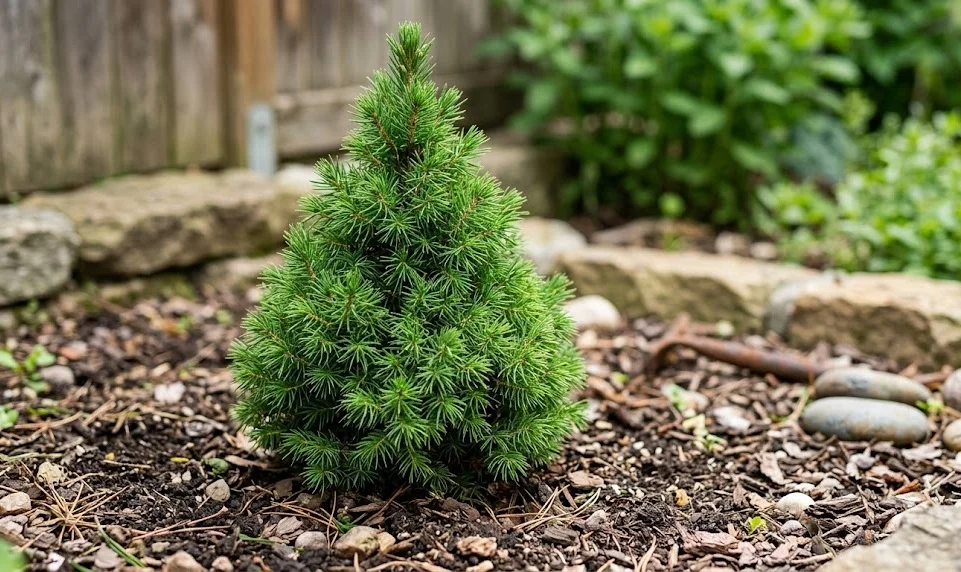

Water and nutrients determine whether dwarf Alberta spruce keeps its clean, compact appearance or slowly declines under hidden stress. This evergreen prefers consistent moisture, but it does not tolerate stagnant, airless soil around the roots. Fertilizing should be measured and conservative because the plant’s natural habit is slow and dense. The best results come from reading the soil, observing the needles, and supporting steady growth rather than trying to accelerate it.
Understanding moisture needs
Dwarf Alberta spruce needs evenly moist soil, especially during establishment. Its dense foliage can make the plant appear robust even when the root zone is drying. By the time browning is obvious, stress may already be advanced. Regular soil checks are therefore more reliable than visual appearance alone.
Moisture demand changes with season, temperature, wind, and planting situation. A plant in full sun and sandy soil dries faster than one in loam with mulch. Container specimens dry faster than in-ground specimens because the root volume is limited. Newly planted specimens need more careful irrigation than established plants.
The goal is not constant wetness. Roots need oxygen, and saturated soil can cause decline. Water should move through the soil and drain away within a reasonable time. If the planting area remains soggy, irrigation should be reduced and drainage should be improved.
Mulch helps stabilize moisture and temperature. A layer of bark, leaf mold, or composted wood chips can reduce evaporation from the soil surface. It also protects shallow feeder roots from heat. Keep mulch off the trunk so the bark can remain dry and healthy.
More articles on this topic
Watering newly planted specimens
After planting, water thoroughly to settle soil around the roots. This first watering should reach both the root ball and the surrounding backfill. A quick splash is not enough, because dry pockets may remain hidden. Slow watering is usually more effective than high-volume runoff.
During the first season, check the soil every few days in warm weather. Water when the upper few inches begin to dry, but before the root ball becomes hard and dry. The original nursery medium may dry differently from the surrounding soil. This difference is one reason hand-checking is so useful.
Avoid watering on a rigid calendar without observing conditions. A rainy week may require no irrigation, while a windy hot week may require repeated deep watering. Soil texture also matters, because clay holds water longer than sandy soil. Adjust frequency according to what the plant and soil actually need.
Late autumn watering is important before winter dormancy. Evergreen needles continue losing moisture during cold months, especially in sun and wind. If the soil freezes dry, roots cannot replace that lost moisture. Deep watering before freeze-up can reduce winter burn and spring browning.
More articles on this topic
Watering established plants and containers
Established in-ground plants usually need supplemental watering during dry periods rather than constant attention. A deep soak every so often is better than frequent light sprinkling. Deep watering encourages a broader, more resilient root system. Surface sprinkling may leave deeper roots dry and encourage shallow dependency.
During heat waves, inspect both soil moisture and foliage condition. Drooping is not common in the same way it is with broadleaf plants, so color and needle texture are better clues. Needles that look dull, grayish, or bronzed may signal stress. However, bronzing can also indicate mites, so inspect carefully.
Container plants need a separate watering strategy. Pots heat up, dry quickly, and expose roots to greater temperature swings. Water until drainage appears, then empty saucers so roots do not sit in water. In hot periods, containers may need monitoring daily.
The potting mix should be open and well drained. Heavy garden soil in a pot can compact and suffocate roots. A high-quality container mix with added mineral structure is usually safer. Repotting becomes necessary when roots fill the container and water either runs straight through or remains unevenly absorbed.
Fertilizer timing and nutrient balance
Dwarf Alberta spruce should be fertilized only when there is a clear need. Good color, steady growth, and dense foliage usually indicate that the plant is adequately nourished. Pale growth, weak extension, or poor performance in lean soil may justify feeding. Soil testing gives the most accurate guidance in professional settings.
Early spring is the preferred time for feeding if fertilizer is needed. At this stage, roots can take up nutrients as growth resumes. Slow-release evergreen fertilizer is generally safer than fast-acting high-nitrogen products. Apply lightly and evenly over the root zone.
Avoid late-season fertilization. Nutrient applications late in summer can encourage tender growth that may not harden before winter. Soft growth is more vulnerable to frost and desiccation. A slow-growing conifer should enter winter firm, mature, and well hydrated.
Organic amendments can support nutrition without overstimulation. Compost, well-rotted leaf mold, and mulch gradually improve the soil environment. They help roots function efficiently rather than simply adding soluble nutrients. This is especially useful in beds managed for long-term plant health.
Diagnosing water and nutrient problems
Browning needles can be caused by drought, waterlogging, mites, winter burn, root damage, or poor siting. It is important not to assume fertilizer will solve every color problem. Feeding a stressed plant can make matters worse if roots are damaged or soil moisture is wrong. Diagnosis should begin with soil moisture, drainage, and pest inspection.
Dry stress often appears after hot, windy periods or where irrigation has missed the root ball. The outer foliage may brown, especially on exposed sides. The soil may be dry several inches down, even if the surface was recently sprinkled. Correct the watering pattern before considering fertilizer.
Waterlogging often causes slower, more generalized decline. Needles may discolor, growth may weaken, and roots may become dark or unhealthy. This problem is common where plants are placed in compacted clay or containers without good drainage. Reducing irrigation alone may not help if the site itself holds water.
Nutrient deficiency is usually less common than moisture stress in garden settings. When it occurs, the symptoms are often gradual rather than sudden. A soil test can identify pH or nutrient imbalances before treatment. Professional care avoids guessing and corrects the actual limiting factor.