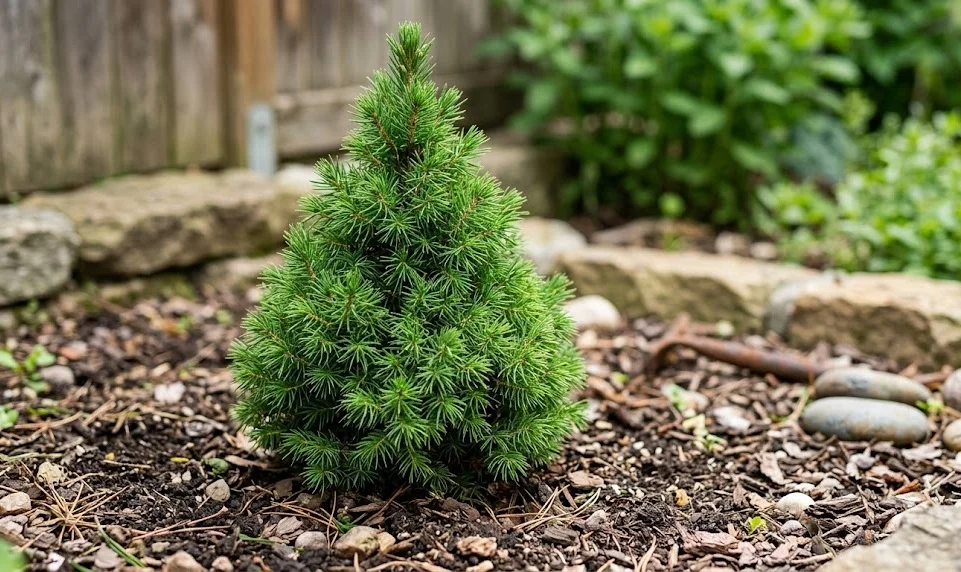

Dwarf Alberta spruce is one of the most recognizable small conifers in ornamental horticulture, prized for its dense, naturally conical outline and fine, bright green needles. Its slow growth makes it suitable for front gardens, formal entrances, rock gardens, containers, and mixed evergreen plantings. The plant performs best where winters are cold, summers are not excessively hot, soil drains well, and air can move freely through the canopy. In professional garden maintenance, success depends less on constant intervention and more on choosing the right position, watering carefully, and preventing stress before it becomes visible. Négyzetes Kertészet Szerszámok+1
Understanding growth habit and garden value
Dwarf Alberta spruce grows slowly, which is one of the main reasons it is so widely used in designed landscapes. Young plants often look almost perfectly symmetrical without pruning, creating a neat architectural accent. After ten years, it commonly remains compact enough for smaller gardens, although older specimens can eventually become much broader and taller than many buyers expect. This slow development makes long-term spacing especially important, because crowding often appears years after planting rather than immediately.
The foliage is made up of short, soft-looking needles arranged densely around the shoots. This creates a fine-textured surface that catches light beautifully in spring and early summer. The new growth is often fresher and lighter in color than the older interior needles, giving the plant a clean seasonal rhythm. Healthy foliage should look firm, evenly green, and free from dusty webbing or patchy bronzing.
Its cone shape gives the plant strong visual order in both formal and naturalistic plantings. It can frame a doorway, mark a path, anchor a small border, or provide evergreen structure among grasses and perennials. In winter, the dense crown keeps a sculptural presence when deciduous plants have disappeared. In summer, the same density can become a liability if heat, drought, or poor air circulation increase pest pressure.
Because the plant is naturally compact, it should not be treated like a hedge or a fast-growing shrub. Its best form comes from restraint, not heavy shaping. The aim of care is to maintain vigor, even moisture, and clean foliage rather than forcing growth. When planted in the right place, it often needs surprisingly little pruning or correction.
More articles on this topic
Choosing the right site
The most reliable site is sunny, open, and cool rather than hot, enclosed, and reflected by masonry. Full sun supports dense growth and helps the plant keep its characteristic tight outline. In warmer regions, light afternoon shade can reduce stress, especially near paving, walls, or south-facing facades. The worst positions are narrow corners where heat accumulates and air movement is poor.
Soil should be moist but well drained, because the plant dislikes both drought and waterlogging. A loamy soil enriched with organic matter usually gives the best root environment. Heavy clay can work only if drainage is improved and the planting area does not stay saturated after rain. Sandy soils need compost and mulch to hold moisture around the root zone.
Avoid planting directly beneath rooflines where rainwater may be uneven or where snow can slide onto the crown. The dense branches can be distorted by repeated mechanical pressure. Likewise, avoid sites exposed to constant winter wind unless the soil can be kept moist before freezing. Winter browning often begins when foliage loses water while frozen soil prevents roots from replacing it.
Good air circulation is a professional-level detail that many gardeners overlook. Dense evergreen foliage can shelter mites, aphids, and fungal problems when the air is still. Leaving enough space around the plant helps foliage dry after rain and makes inspection easier. It also preserves the full cone shape instead of forcing the lower branches to thin out against neighboring plants.
More articles on this topic
Soil preparation and planting depth
Before planting, loosen the soil over a wide area rather than digging only a narrow hole. Dwarf Alberta spruce has a relatively compact root system, but new roots establish better when surrounding soil is not hard or compacted. A planting hole about twice as wide as the root ball is usually more useful than an excessively deep hole. The root flare or top of the root ball should remain level with the surrounding soil.
Do not bury the stem deeper to make the plant stand straighter. Deep planting reduces oxygen around the upper roots and can encourage decline over time. If the root ball is wrapped or pot-bound, tease out circling roots gently before backfilling. This step helps roots move into the native soil rather than continuing to circle inside the original container shape.
Use the excavated soil as the main backfill, improving it moderately with compost if needed. Over-rich planting pockets can hold too much water or discourage roots from moving outward. Firm the soil lightly to remove major air pockets, but do not compact it hard. After planting, water slowly until the whole root ball and surrounding soil are evenly moist.
Mulch is extremely useful, but it must be applied correctly. A layer of organic mulch helps moderate soil temperature, reduce evaporation, and protect shallow roots. Keep mulch away from the trunk, because constant moisture against the stem can cause bark problems. A wide, shallow mulch ring is better than a thick mound piled against the plant.
Watering for steady growth
Watering should be deep, deliberate, and based on soil moisture rather than habit. Newly planted specimens need regular watering through the first growing season while roots expand into the surrounding soil. The aim is to moisten the full root zone, not just wet the surface. Frequent shallow watering encourages weak surface roots and can leave the deeper root ball dry.
Established plants tolerate short dry periods better than newly planted ones, but they still perform best with consistent moisture. During hot or windy weather, check the soil several inches below the surface. If it is dry at that depth, water slowly and thoroughly. If it is still moist, delay watering to avoid suffocating the roots.
Container-grown plants need closer attention because pots dry faster than open ground. The dense canopy can shed light rain away from the potting mix, so rainfall alone may not be enough. Water until excess drains from the bottom, then allow the upper layer to dry slightly before watering again. A container without drainage holes is unsuitable for long-term cultivation.
Autumn watering is especially important in regions with cold winters. A well-hydrated plant enters winter with better resistance to desiccation. Water deeply before the ground freezes if rainfall has been low. This simple practice can reduce winter burn, especially on exposed sites.
Fertilizing without forcing soft growth
Dwarf Alberta spruce is not a heavy feeder, and excessive fertilization often creates more problems than benefits. Strong doses of nitrogen can push soft, vulnerable growth that is less resistant to heat, drought, and pests. In good garden soil, annual feeding may not be necessary at all. The first step should always be assessing growth, color, and soil quality.
If growth is weak and soil fertility is poor, use a slow-release fertilizer formulated for evergreens. Apply it in early spring, following the label rate carefully. Keep fertilizer away from the trunk and spread it over the active root zone. Water after application so nutrients begin moving gently into the soil.
Compost can be a better maintenance tool than strong fertilizer. A thin topdressing improves soil structure and microbial activity over time. It also supports moisture retention without pushing unnatural growth. For mature plants, this approach is often safer and more sustainable than repeated mineral feeding.
Avoid fertilizing in late summer or autumn. Late feeding can stimulate growth that may not harden properly before cold weather. Tender late shoots are more vulnerable to frost, drying winds, and winter discoloration. A compact conifer should be kept steady, not forced into rapid seasonal flushes.
Routine inspection and seasonal maintenance
Regular inspection is one of the most important parts of care. Look closely inside the dense canopy, not only at the outer surface. Early signs of trouble include fine webbing, stippled needles, yellowing patches, browning on one side, or dry interior twigs. Problems caught early are usually far easier to manage.
Spider mites are a common issue, especially in hot, dry, or dusty conditions. A practical monitoring method is to shake a branch over white paper and look for moving specks. Hosing the foliage with a firm spray of water can reduce mite populations and dust, especially when done before infestation becomes severe. Repeated monitoring matters because mites can rebuild quickly under favorable conditions. ask.extension.org+1
Remove dead twigs when they appear, but do not cut deeply into bare old wood. Spruces usually do not regenerate well from leafless interior stems. Light corrective work is best done carefully and sparingly. The natural form is valuable, so every cut should have a clear reason.
Keep the base of the plant clean and free from weeds. Weeds compete for moisture and can restrict air movement near the lower branches. Fallen needles are normal, but heavy debris trapped in the crown can hold moisture and shelter pests. A clean, mulched root zone supports both appearance and plant health.
Long-term performance in the landscape
The plant’s long-term performance depends on matching expectations with its actual biology. It is small for a spruce, but it is not permanently miniature. Over decades, it can become too large for very tight foundation beds. Good design allows for mature width, access for inspection, and airflow around the branches.
In hot climates, this spruce often struggles more than it does in cool temperate regions. Heat reflected from walls, asphalt, and stone can intensify stress. When stress repeats every summer, browning and mite outbreaks become more likely. In such locations, success depends on shade timing, moisture management, and careful site selection.
The plant is excellent in containers for several years, but container culture is more demanding than in-ground planting. Roots are exposed to greater temperature swings, faster drying, and possible winter freezing. Repotting, drainage, and winter protection must be managed consistently. A neglected container specimen can decline faster than one planted in open soil.
A healthy dwarf Alberta spruce should look calm, dense, and balanced rather than aggressively manipulated. Its best quality is the quiet precision of its natural shape. Professional care respects that character by reducing stress and avoiding unnecessary work. With the right site and steady attention, it can remain a refined evergreen feature for many years.