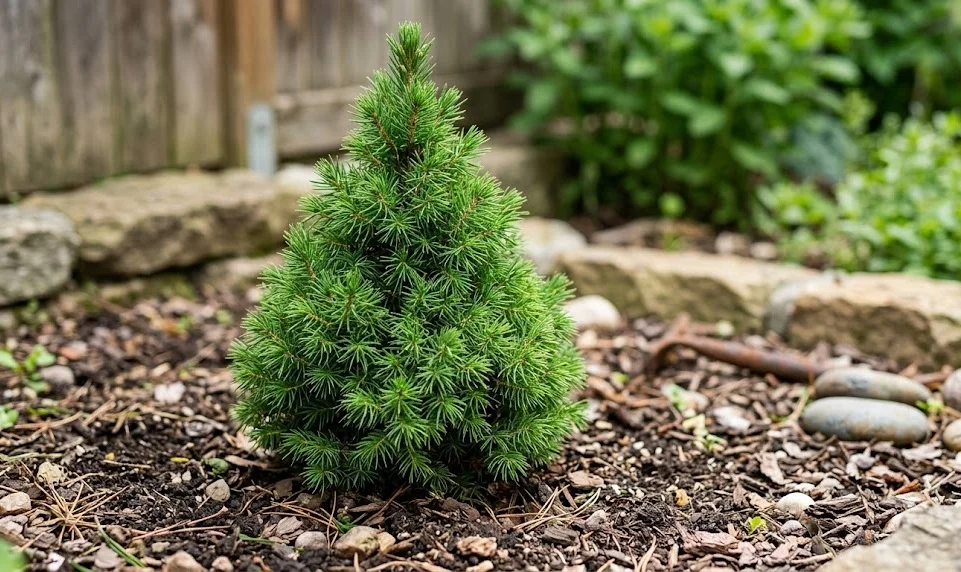

Dwarf Alberta spruce needs very little pruning because its value lies in its naturally compact, symmetrical cone. Heavy cutting can permanently damage the outline, especially if cuts go into old bare wood. The goal is to remove defects, maintain health, and make only small corrections while preserving the plant’s natural architecture. Good pruning is subtle enough that the plant still looks unpruned afterward.
When pruning is necessary
Pruning is necessary when branches are dead, broken, diseased, or clearly out of place. These cuts improve appearance and reduce hidden pest or disease habitats. Dead twigs inside the dense canopy can be removed carefully at any time. Larger corrective work is best done in early spring before active growth expands.
Routine shearing is usually unnecessary. The plant already forms a dense cone without being clipped into shape. Repeated shearing can create a hard outer shell while shading the interior. This increases the risk of bare inner wood and poor air movement.
Occasional reversion shoots may appear and grow faster than the surrounding dwarf growth. These shoots should be removed promptly because they can distort the plant’s shape. Cut them back to their point of origin rather than trimming only the tip. Early removal prevents the stronger shoot from dominating.
Pruning should always begin with inspection. Look for the branch’s origin, the location of live needles, and the effect of the cut on the outline. Do not cut blindly into the dense surface. Careful selective pruning protects both health and form.
More articles on this topic
How to prune correctly
Use clean, sharp hand pruners for small shoots. Clean tools reduce the chance of spreading disease between plants. Make cuts just outside the branch collar when removing a branch. Avoid leaving long stubs that die back and collect debris.
Never cut deeply into leafless interior wood expecting it to regrow. Spruces have limited ability to produce new shoots from old bare stems. If the cut removes all green growth from a branch, that branch may remain permanently bare. This is the most common pruning mistake with dwarf Alberta spruce.
For light shaping, shorten only the current season’s soft growth or small green shoots. Work gradually around the plant rather than cutting one area heavily. Step back often to check symmetry. A few small cuts are safer than a single aggressive correction.
Do not prune during severe heat, drought, or active stress. The plant needs enough energy and moisture to respond well. Pruning a stressed conifer can increase browning and expose interior tissue to sun. Correct water or pest problems before doing cosmetic work.
More articles on this topic
Cutting back overgrown or damaged plants
An overgrown dwarf Alberta spruce cannot be reduced dramatically like a deciduous hedge. Cutting it back hard into old wood usually leaves permanent bare patches. If the plant has outgrown its space, gradual minor reduction may help only if green growth remains where cuts are made. In many cases, replacement or redesign is more realistic.
Winter-burned plants should be assessed after spring growth begins. Some damaged shoots may still contain living buds. Removing them too early can worsen the appearance unnecessarily. Once dead tissue is confirmed, prune selectively back to healthy green growth.
If one side is badly damaged, full symmetry may not return. The plant’s slow growth means recovery takes time. Light pruning can soften the edge of the damaged area, but it cannot instantly rebuild missing foliage. Improving the site conditions is essential to prevent repeated injury.
The best pruning strategy is prevention through proper placement. Allow enough space, maintain moisture, and avoid forcing the plant against walls or paths. A well-sited plant rarely needs more than occasional cleaning and minor correction. Respecting its natural form is the most professional approach.