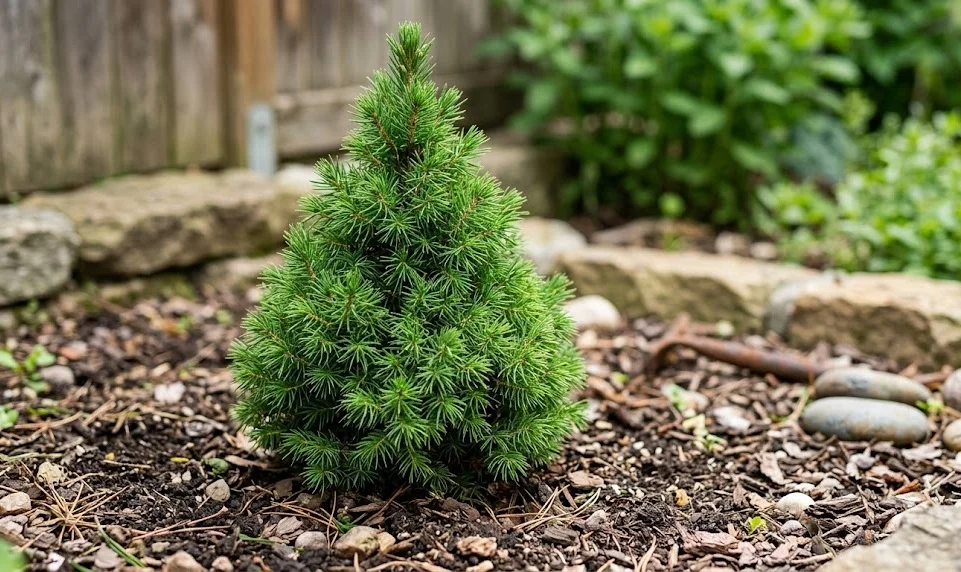

Dwarf Alberta spruce needs strong light to maintain its compact cone shape, dense needles, and balanced growth. Full sun is usually ideal in cool climates, while warmer areas may require protection from harsh afternoon heat. Too little light causes thinning and weak growth, but too much reflected heat can scorch or stress the foliage. The best position provides brightness, air movement, and stable root moisture rather than simply the longest possible exposure.
Full sun and compact growth
Full sun encourages dense branching and even foliage color. In cool temperate gardens, this is usually the best exposure for long-term form. The plant’s naturally tight outline depends on enough light reaching the outer shoots. Shade can loosen the shape and reduce the crisp architectural effect.
Morning sun is especially valuable because it dries dew without intense heat. This helps reduce the humid microclimate that can favor some problems. It also supports photosynthesis early in the day. In many gardens, morning sun with open sky exposure is an excellent compromise.
Plants grown in insufficient light may become thin on the shaded side. The lower branches can weaken when crowded by neighboring shrubs. Once old interior wood becomes bare, it rarely fills in completely. This is why spacing and light planning matter from the beginning.
Balanced light also affects symmetry. A plant shaded heavily from one side may lean visually or grow unevenly. Rotating container plants can help maintain a regular outline. In the ground, good initial placement is the only realistic solution.
More articles on this topic
Managing heat and reflected light
Strong light is beneficial, but heat stress is not. Dwarf Alberta spruce often struggles where sunlight is intensified by walls, paving, gravel, or glass. These surfaces raise air temperature and increase moisture loss from needles. The plant may brown even when the site technically receives the “right” amount of sun.
In warm regions, afternoon shade can be protective. This does not mean deep shade beneath dense trees. It means relief from the hottest part of the day while preserving bright conditions. Light shade from high-canopied trees or an east-facing exposure can work well.
Reflected light can be particularly damaging in foundation plantings. A white wall or stone facade may create a hotter microclimate than the surrounding garden. Soil near buildings may also be drier because of roof overhangs. These details explain many failures in otherwise attractive planting designs.
Container plants are even more sensitive to heat exposure. Dark pots can overheat roots in full afternoon sun. Elevated containers dry faster and experience more temperature fluctuation. Choose pot placement with both foliage and root temperature in mind.
More articles on this topic
Signs of poor light placement
Too little light usually produces open, weak, or uneven growth. The plant may lose density on the shaded side. New growth may appear sparse, and the classic cone outline may soften. These changes develop slowly but are difficult to reverse.
Too much heat exposure often causes browning, bronzing, or dry patches. The damage may appear on the sunniest or windiest side. It can be confused with pests, so inspect for mites before reaching conclusions. Soil moisture should also be checked at depth.
A plant that browns repeatedly in the same spot is probably experiencing a site problem. Annual pruning will not solve exposure stress. Moving nearby reflective materials, improving irrigation, or transplanting a young specimen may be necessary. Mature specimens are harder to relocate successfully.
The best light position keeps the plant bright, cool, and evenly exposed. Sun should support growth without creating heat stress. Air should move freely around the foliage. When these conditions align, dwarf Alberta spruce keeps its refined shape with minimal intervention.