
Pruning is one of the most important tasks in caring for a weeping pussy willow because the tree’s beauty depends on a clean, flowing crown. Without regular attention, the hanging branches can become tangled, congested, or overly long. Correct cutting encourages fresh shoots, supports flowering, and keeps the grafted ornamental form in balance. The best pruning is selective, timely, and respectful of the plant’s natural weeping habit.
Best timing for pruning
The ideal time to prune a weeping pussy willow is shortly after flowering. This allows the spring catkins to be enjoyed before any major cutting is done. After flowering, the plant has enough of the growing season left to produce new shoots. These shoots can mature and carry flowering buds for the following spring.
Pruning too early can remove the catkins before they open. This is a common mistake when gardeners tidy the tree in late winter without recognizing the value of the flower buds. Waiting until the display has finished protects the main ornamental feature. It also makes it easier to see which shoots are healthy and active.
Summer pruning can be used lightly if the crown becomes untidy. Long shoots dragging on the ground can be shortened, and damaged growth can be removed. However, heavy summer cutting may reduce the plant’s ability to build energy reserves. Major shaping is best concentrated after flowering.
Avoid hard pruning in late autumn. Cutting at that time can encourage vulnerable regrowth or leave wounds exposed through wet, cold months. The plant is better allowed to enter dormancy with mature wood. Dead or dangerous branches can still be removed when necessary, but routine shaping should wait.
More articles on this topic
Shaping the weeping crown
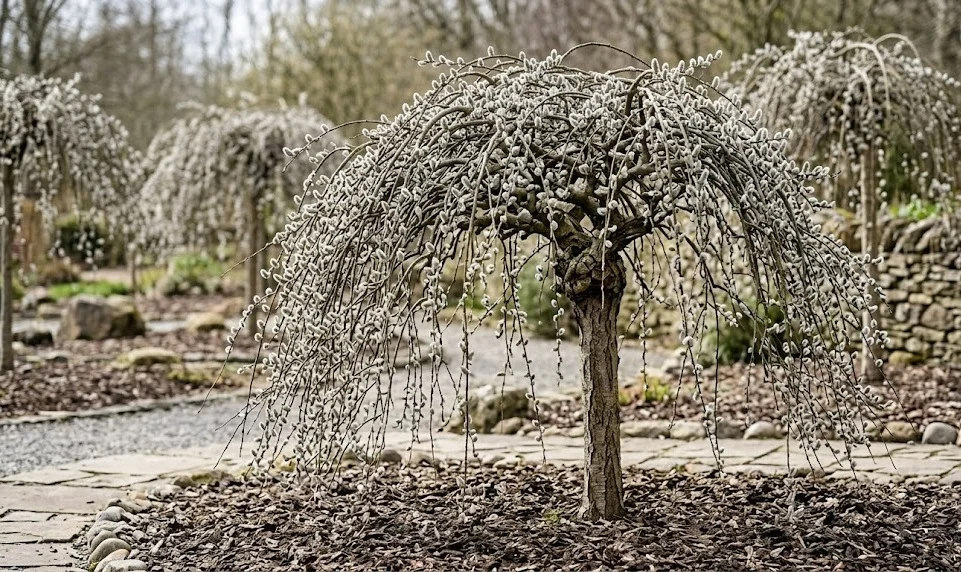
The main aim is to preserve the natural umbrella-like form. Branches should flow downward from the grafted head without forming a dense, tangled mass. Selective thinning opens the crown and improves airflow. This reduces disease risk and allows light to reach inner shoots.
Start by removing dead, broken, crossing, or inward-growing branches. These cuts immediately improve structure and make the remaining work clearer. Next, shorten overly long shoots to a healthy outward-facing bud or side branch. The finished crown should look lighter but not artificially clipped.
Avoid shearing the canopy into a blunt dome. Shearing destroys the natural texture and often creates dense outer growth with weak inner branches. A weeping pussy willow looks best when individual shoots retain movement and softness. Careful hand pruning gives a more professional result.
The length of the hanging branches can be adjusted according to the setting. In a lawn, longer branches may look graceful if they do not lie heavily on wet grass. Near paths or planting beds, shorter branches are more practical. The crown should be shaped to suit both the plant and the garden design.
More articles on this topic
Managing the graft and strong regrowth
The graft union is the structural heart of the tree. Any shoots that grow from below the graft should be removed as soon as they appear. These shoots belong to the rootstock and often grow upright or with a different leaf form. If left in place, they can steal energy from the ornamental crown.
Strong upright shoots may also appear within the weeping crown. Some can be useful if they arch later and fill gaps, but others disturb the shape. Assess their position before cutting, rather than removing every vigorous shoot automatically. Good pruning balances renewal with elegance.
After hard pruning, the plant may respond with many new shoots. This can be useful for rejuvenation, but it may also create congestion. Thin the new growth once it is clear which shoots are best placed. Keeping only well-positioned shoots prevents the crown from becoming crowded again.
Clean tools are essential when cutting willows. Secateurs and saws should be sharp enough to leave smooth wounds. If disease is present, tools should be cleaned between cuts to prevent spreading pathogens. Proper technique helps the plant heal quickly and continue growing strongly.