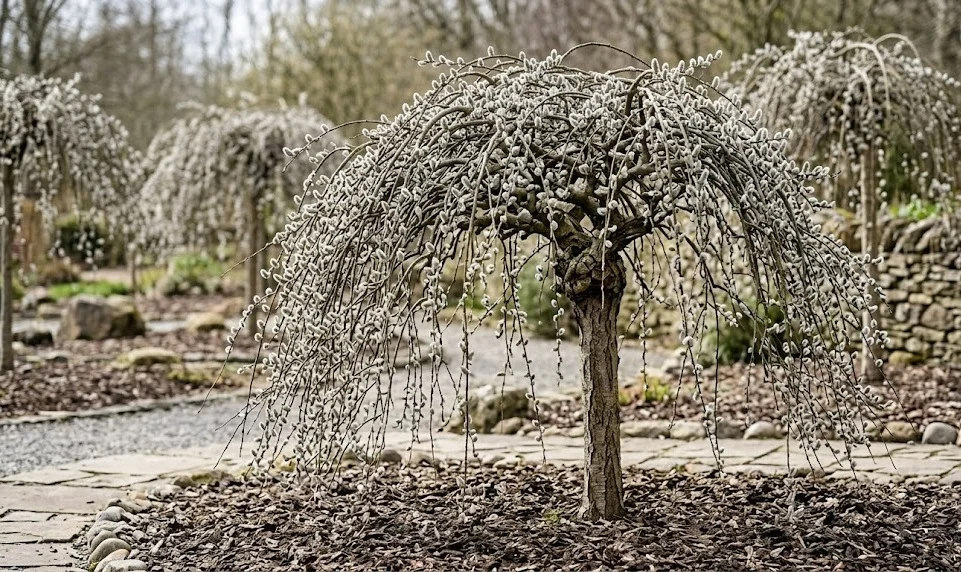

A weeping pussy willow needs bright conditions to develop a full, attractive crown and a reliable spring catkin display. It can tolerate some light shade, but too little sun leads to weak shoots, sparse foliage, and reduced ornamental value. The best position provides several hours of direct sunlight and open air movement. Understanding its light needs helps gardeners place the tree where it can remain compact, healthy, and expressive.
Full sun and flowering performance
Full sun is usually the best choice for a weeping pussy willow. In a sunny position, the plant produces stronger shoots, better foliage density, and more abundant catkins. The early spring display depends partly on the energy stored during the previous growing season. Good light allows the leaves to photosynthesize efficiently and build those reserves.
Morning and afternoon sun both have value, but a balanced exposure is ideal. Morning sun dries dew from the branches and foliage, reducing fungal pressure. Afternoon sun provides warmth and supports strong growth, though very hot sites may increase water demand. The plant performs best when sunlight is matched with consistently moist soil.
A sunny position also helps maintain the shape of the canopy. Shoots growing in good light tend to be sturdier and better distributed. In shade, branches may stretch awkwardly toward the brightest side, making the crown uneven. Over time, this can spoil the neat weeping form.
The catkins are most attractive when the tree has grown well during the previous season. Poor light often means fewer flowering buds and a less dramatic spring effect. If a tree flowers weakly for several years, shade should be considered as a possible cause. Improving light exposure may gradually restore better performance.
More articles on this topic
Partial shade and site limitations
A weeping pussy willow can grow in partial shade, especially where it receives direct sun for part of the day. Light shade from high, open trees may be acceptable if moisture and airflow remain good. The plant may still look attractive, though growth may be less dense than in full sun. Flowering may also be lighter but not necessarily absent.
Dense shade is unsuitable. A site under evergreen trees, between tall buildings, or beneath deep overhangs will usually produce poor results. The crown may become thin, and the lower shoots may die back over time. Damp shade also increases the likelihood of fungal leaf problems.
In small gardens, light often changes through the year. A position that is sunny in spring may become shaded once nearby trees leaf out. Observing the site across several seasons helps avoid planting mistakes. The best location is one that offers dependable light during the main growing period.
Reflected heat and light should also be considered. A pale wall may increase brightness, while a dark paved corner may become hot and dry. The plant can handle brightness, but it should not be forced into drought stress. Light exposure and water availability must be planned together.
More articles on this topic
Adjusting care to light conditions
Plants in full sun usually need more careful watering. Bright light encourages active growth and increases moisture use through the leaves. During hot weather, the soil should be checked regularly to prevent drought stress. Mulching is especially valuable in sunny positions.
Plants in partial shade need less frequent watering but closer disease monitoring. Leaves may remain damp for longer after rain, particularly if airflow is limited. Pruning to open the crown becomes more important in these conditions. Avoid overhead watering where leaves already dry slowly.
Feeding should also be adjusted to light levels. A shaded plant should not be pushed with heavy fertilizer, because it may produce soft, weak growth. Moderate feeding and improved growing conditions are safer than trying to force performance. Light is a basic requirement that fertilizer cannot replace.
If a tree is clearly struggling because of shade, relocation may be the best option while it is still young. Moving should be done during dormancy and with careful attention to the root ball. Older established trees are harder to transplant successfully. Choosing the correct light exposure at planting is always easier than correcting the problem later.