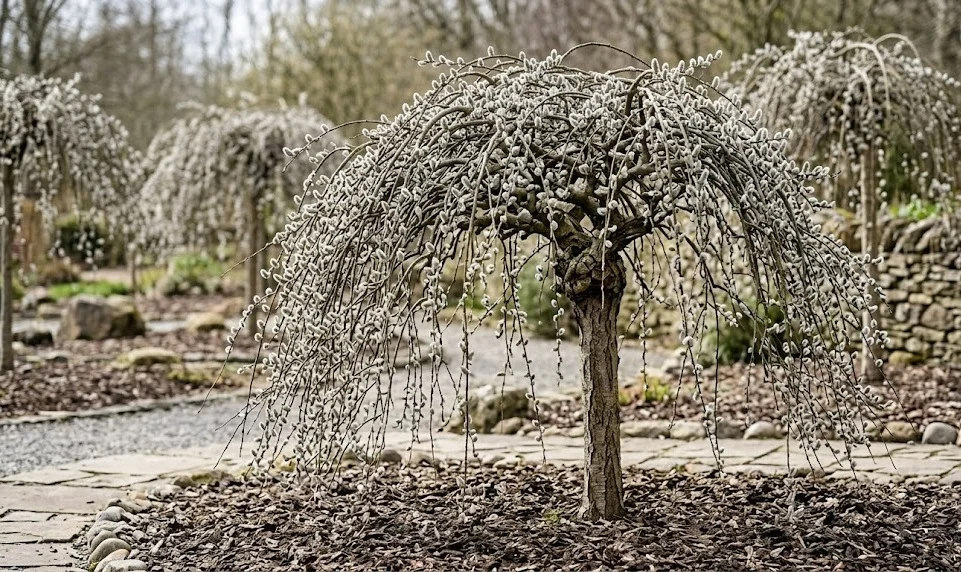

A weeping pussy willow brings a soft, sculptural character to the garden, especially in early spring when its silky catkins appear before the foliage fully wakes. Its compact grafted form makes it suitable for small gardens, front yards, courtyards, and large containers. Although it looks delicate, it is a resilient ornamental tree when its soil, moisture, light, and pruning needs are understood. Good care focuses on steady water, thoughtful pruning, healthy soil, and regular observation through the seasons.
Choosing the right position in the garden
A weeping pussy willow performs best in a position where it receives generous light and enough space for its cascading crown to develop naturally. The plant is usually grafted onto a straight stem, so the height does not increase much beyond the graft point, but the canopy widens and thickens over time. A site with open air movement helps the leaves dry after rain, reducing the likelihood of fungal problems. It should not be squeezed tightly between dense shrubs, walls, or fences, because poor airflow weakens the plant’s overall condition.
The soil should be moisture-retentive but not permanently waterlogged. Willows generally enjoy more moisture than many ornamental trees, yet their roots still need oxygen. Heavy clay can be improved with compost and coarse organic matter before planting, while very sandy soil benefits from humus-rich amendments that help hold water. A balanced soil structure encourages strong root development and reduces stress during hot or windy periods.
It is wise to consider the visual role of the tree before planting. A weeping pussy willow looks especially effective near a lawn edge, beside a pond, in a mixed border, or as a small focal point close to a terrace. Its pendant branches create movement and softness, so it pairs well with spring bulbs, low perennials, and ground-covering plants. The planting area should allow the hanging shoots to be seen clearly rather than hidden by taller companions.
Avoid planting too close to underground pipes, drains, or fragile paved areas. Although this ornamental form is much smaller than large willow species, willows naturally seek moisture and can be vigorous in favorable conditions. In a small garden, sensible placement prevents future conflicts with structures and utilities. When in doubt, choose an open planting pocket with dependable soil moisture and enough room for maintenance access.
More articles on this topic
Soil care and mulching
Soil quality has a direct influence on the health and appearance of a weeping pussy willow. The plant responds well to fertile, humus-rich soil that remains evenly moist without becoming stagnant. Compost, leaf mold, and well-rotted manure can improve both nutrient availability and soil texture. These materials also support beneficial soil life, which helps roots absorb water and minerals more efficiently.
Mulching is one of the simplest and most useful care practices for this tree. A layer of bark mulch, composted wood chips, leaf mold, or garden compost helps retain moisture and moderate soil temperature. The mulch should be spread around the root zone but kept a few centimeters away from the trunk. If mulch is piled directly against the bark, it can hold excess moisture and encourage rot or pest problems.
The mulch layer should usually be renewed once or twice a year. In spring, fresh organic material supports the plant as new shoots, leaves, and catkins develop. In autumn, mulch helps protect the root zone from sharp temperature changes and improves soil structure as it breaks down. A consistent mulching routine is especially valuable in exposed gardens, dry summers, or container plantings.
Soil compaction should be avoided around the tree. Repeated walking, heavy garden equipment, or dense planting too close to the trunk can reduce oxygen in the soil. Compacted soil drains poorly and makes it harder for fine roots to spread. Keeping the area gently cultivated, mulched, and free of unnecessary disturbance supports long-term vitality.
More articles on this topic
Watering through the growing season
A weeping pussy willow needs reliable moisture, particularly during its first few years after planting. Newly planted specimens have limited root systems and cannot draw water from a wide area. Deep watering is more useful than frequent shallow sprinkling, because it encourages roots to grow downward. The aim is to moisten the full root zone rather than only wetting the soil surface.
Established plants tolerate short dry spells better, but they still benefit from watering during prolonged heat or drought. Wilting leaves, premature yellowing, and dry shoot tips often signal water stress. Stress is especially likely when the tree grows in a container, raised bed, or sandy soil. Regular observation helps prevent damage before the canopy loses vigor.
Watering should be adjusted to the weather, soil type, and season. In cool spring conditions, the soil may remain moist for longer, while midsummer heat can dry it quickly. After heavy rain, additional watering is unnecessary and can even be harmful if drainage is poor. A simple check with a finger or hand trowel near the root zone gives a more accurate guide than watering by calendar alone.
Container-grown weeping pussy willows require particular attention. Pots dry out faster than open ground, especially when placed on sunny patios or exposed balconies. The container must have drainage holes, and excess water should be able to leave freely. During warm weather, the plant may need watering several times a week, while in cooler seasons the frequency should be reduced.
Feeding for balanced growth
Feeding should support steady, healthy growth rather than forcing excessive shoot production. A weeping pussy willow does not usually need heavy fertilization if it grows in good garden soil. In spring, a modest application of slow-release balanced fertilizer or organic plant food can help new growth develop strongly. Overfeeding, especially with nitrogen-rich fertilizer, may produce long, soft shoots that are more vulnerable to pests and breakage.
Organic amendments are often the best foundation for nutrition. Compost, mature manure, and plant-based soil conditioners release nutrients gradually while improving the soil itself. This approach suits ornamental willows because it encourages resilience rather than sudden growth spurts. A healthy root environment is more valuable than repeated strong feeding.
Poor foliage color, weak shoot growth, or reduced catkin production may indicate that the plant needs nutritional support. However, these symptoms can also result from drought, waterlogging, shade, root damage, or disease. It is important to assess the growing conditions before applying fertilizer. Feeding a stressed plant without correcting the underlying problem rarely gives lasting improvement.
Late-season fertilization should be avoided in most gardens. Feeding too late in summer can stimulate tender growth that may not harden before winter. This young tissue is more easily damaged by frost and cold wind. Spring and early summer are generally the safest periods for light, purposeful feeding.
Pruning and crown maintenance
Pruning is essential for maintaining the graceful shape of a weeping pussy willow. The tree produces arching, downward-growing shoots that can become tangled, crowded, or too long if left unmanaged. Pruning after flowering is usually preferred, because it preserves the spring catkin display and then encourages fresh growth for the following year. Removing old, damaged, crossing, or congested stems improves both form and plant health.
Because this plant is grafted, the graft union must be monitored carefully. Any shoots emerging from below the graft are not part of the ornamental weeping crown and should be removed promptly. These shoots often grow upright and more vigorously than the desired canopy. If allowed to remain, they can dominate the plant and spoil its characteristic shape.
The canopy should be opened gently rather than sheared into a stiff outline. Selective pruning keeps the natural weeping habit while preventing overcrowding inside the crown. Long stems that trail on the ground can be shortened to improve appearance and reduce disease risk. A clean, airy structure also allows light to reach the inner branches.
Always use sharp, clean pruning tools. Ragged cuts heal poorly and can create entry points for disease. Larger cuts should be made just above a healthy bud or branch junction, without leaving long stubs. A calm, methodical pruning session each year is better than severe correction after several seasons of neglect.
Seasonal monitoring and plant health
Regular inspection is an important part of expert care. In early spring, check the catkins, buds, and young shoots for signs of vitality. Healthy buds should swell evenly, and the canopy should produce fresh growth after flowering. Delayed bud break, dieback, or patchy growth may point to winter damage, drought stress, or root problems.
During the growing season, the leaves reveal much about the tree’s condition. Fresh green foliage, flexible shoots, and steady extension growth suggest that the plant is comfortable. Yellowing leaves, black spots, powdery patches, sticky residue, or curled growth should be examined closely. Early detection makes pest and disease management far easier.
Autumn is the right time to assess structure and prepare the tree for winter. Fallen leaves should be cleared from around the base if disease was present during the season. The mulch layer can be renewed, and container plants can be moved to a more sheltered position if necessary. This seasonal routine reduces pressure on the plant during cold, wet months.
Winter care is mostly about protection from extremes. The tree is generally hardy, but young plants, potted specimens, and recently planted trees are more vulnerable. Cold wind, frozen containers, and alternating thaw-freeze cycles can stress roots and branches. A sheltered position, good drainage, and moderate soil moisture help the plant enter spring in strong condition.
Long-term care and ornamental value
A well-cared-for weeping pussy willow becomes more characterful with age. Its trunk thickens, the crown develops a fuller curtain of shoots, and the spring catkin display becomes more reliable. The tree works beautifully as a seasonal highlight, especially when underplanted with early bulbs or low perennials. Its structure also provides winter interest after the leaves have fallen.
Long-term success depends on consistency rather than complicated techniques. Proper watering, annual pruning, mulching, and observation solve most problems before they become serious. The plant should not be treated as a large woodland willow, but as a grafted ornamental tree with specific structural needs. Understanding this distinction prevents many common mistakes.
In small gardens, proportion matters. The canopy should be allowed to look natural, but it should not be permitted to drag heavily across paths, lawns, or neighboring plants. Light annual adjustment keeps the shape elegant and practical. When maintained well, the tree remains compact, expressive, and easy to integrate into designed spaces.
A weeping pussy willow rewards attentive gardeners with early-season beauty and a distinctive architectural form. It is one of the most appealing small trees for bringing softness and movement into a planting scheme. Its care is straightforward when moisture, light, pruning, and soil health are kept in balance. With thoughtful maintenance, it can remain a charming focal point for many years.