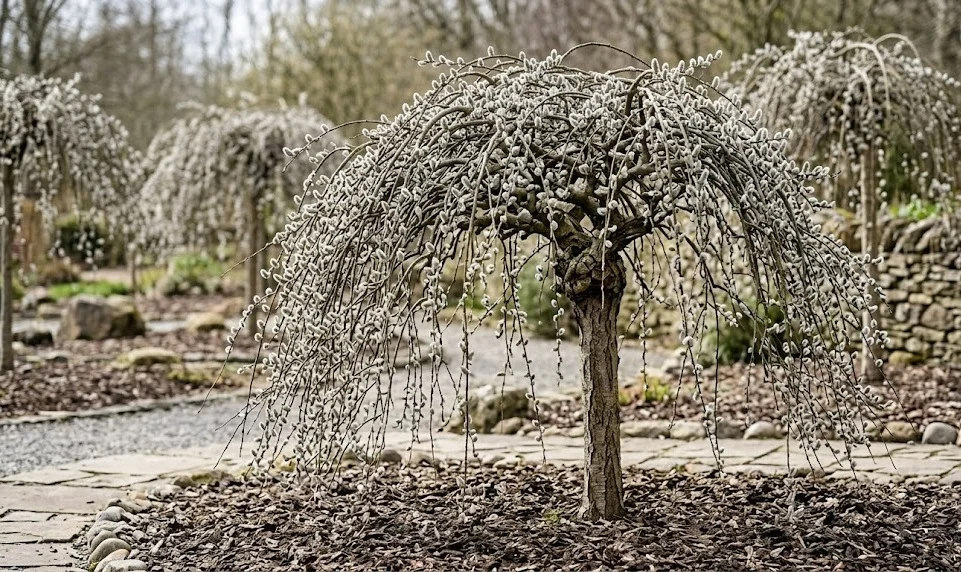

Planting a weeping pussy willow well is the foundation for a healthy, long-lived ornamental tree. Because this plant is usually sold as a grafted standard, correct depth, support, soil preparation, and early watering matter from the first day. Propagation is more complex than it may first appear, since cuttings do not always reproduce the same grafted form. A professional approach considers both practical planting technique and the biological limits of multiplying this distinctive weeping tree.
Preparing the planting site
The best planting site is bright, open, and moist without being swampy. A weeping pussy willow prefers soil that holds water evenly, but the planting hole should not become a stagnant pocket after rain. Before planting, loosen the soil over a broad area rather than digging only a narrow hole. This encourages new roots to move outward into the surrounding ground.
The planting hole should be wider than the root ball but not much deeper. Planting too deeply can bury the graft union or trunk base, leading to bark problems and weak establishment. The top of the root ball should sit level with the surrounding soil surface. If the soil settles after watering, a small adjustment can be made before mulching.
Organic matter can be incorporated into poor soil, but it should not create a sharp contrast between the planting hole and the surrounding ground. If the hole is filled with overly rich compost while the native soil remains dense, roots may circle in the improved pocket. Mixing compost evenly with the existing soil gives a better transition. The goal is a broad, root-friendly zone rather than a small container-like planting pit.
Before placing the tree, inspect the roots and crown carefully. Damaged or circling roots can be loosened gently if the plant is pot-grown. The graft point should be visible above the stem and must remain above soil level. Any broken or diseased shoots can be removed with clean secateurs before planting.
More articles on this topic
Planting technique and early support
Place the tree upright in the hole and check its position from several angles. The straight stem should stand vertical, because a leaning standard is difficult to correct later. Backfill gradually with the prepared soil, firming gently by hand to remove large air pockets. Avoid stamping heavily, as excessive compaction limits root oxygen.
Water thoroughly immediately after planting. This first watering settles the soil around the roots and reveals whether more soil is needed. The water should soak slowly into the root zone rather than run away from the surface. If the soil drains too quickly, a shallow watering basin can be formed around the planting area.
Young grafted standards often benefit from a stake during establishment. The stake should support the stem without rubbing against the bark or restricting natural movement completely. A flexible tree tie allows the trunk to strengthen while preventing wind rock. The support can usually be removed once the roots have anchored firmly.
Mulch should be applied after planting to conserve moisture and reduce weed competition. A broad ring of organic mulch is more useful than a narrow collar. Keep the mulch away from direct contact with the trunk and graft area. This small detail prevents hidden dampness and reduces the risk of bark decay.
More articles on this topic
Planting in containers
A weeping pussy willow can be grown in a large container, provided the pot is stable and moisture management is reliable. The container should be wide, deep, and heavy enough to support the top-heavy weeping crown. Drainage holes are essential, because waterlogged compost can damage roots even in a moisture-loving plant. A high-quality loam-based potting mix usually performs better than a very light peat-based medium.
Container planting requires careful positioning of the root ball. The plant should sit at the same depth as it did in the nursery pot. The graft union must stay clearly above the compost surface. After planting, the compost should be firmed gently and watered until moisture runs from the drainage holes.
Potted plants dry out faster than those grown in the ground. During warm, sunny, or windy weather, moisture can disappear quickly from the compost. Regular checking is more reliable than a fixed watering schedule. The compost should remain evenly damp but not sour, stagnant, or constantly saturated.
Feeding is also more important in containers because nutrients wash out over time. A slow-release fertilizer in spring can support steady growth through the season. Liquid feeding may be useful during active growth, but it should be moderate. Excessive feeding in a pot can produce weak, lush shoots and increase the need for pruning.
Propagation and realistic expectations
Willows are generally easy to root from cuttings, but a weeping pussy willow sold as a standard is a special case. The familiar garden form is normally created by grafting a weeping variety onto a straight rootstock. A cutting taken from the weeping crown may root, but it will not automatically grow into the same upright standard shape. Instead, it may develop as a low, spreading, weeping shrub unless trained or grafted.
Hardwood cuttings can be taken during dormancy from healthy mature shoots. Sections with several buds may root in moist soil or a propagation medium. They should be inserted deeply enough to remain stable and kept consistently damp. However, success in rooting does not guarantee a commercially shaped tree.
Grafting is the professional method used to produce the classic standard form. A compatible rootstock provides the upright stem, and the weeping material is grafted at the desired height. This requires skill, clean technique, correct timing, and suitable plant material. For most gardeners, buying a well-grown grafted specimen is more reliable than trying to create one from scratch.
Propagation should also be approached responsibly. Material should be taken only from healthy plants and never from protected or privately owned specimens without permission. Tools must be clean to prevent the spread of disease. If the goal is a uniform ornamental tree for a designed garden, a nursery-grown plant is usually the best choice.