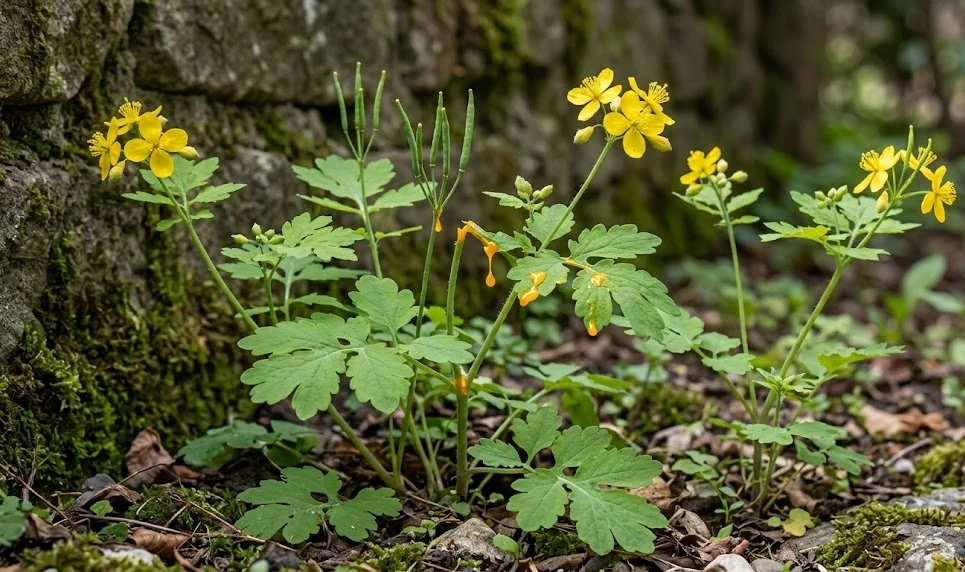

Planting greater celandine is usually straightforward because the species establishes readily in ordinary garden soil. Its success depends less on intensive preparation and more on choosing a suitable semi-shaded position where natural spread can be monitored. Propagation is equally simple, since the plant produces viable seed freely and can also be divided when mature clumps need renewal. For professional results, the main task is not making the plant grow, but guiding where and how strongly it grows.
Selecting planting material
Greater celandine can be started from nursery plants, divisions, or seed. Young container-grown plants establish quickly when planted during cool, moist periods. Divisions are useful when an existing clump has become too large or when a uniform planting is desired. Seeds are the most natural method, but they require more patience and careful thinning.
Healthy planting material should have firm stems, fresh foliage, and no signs of rot at the crown. Plants with pale, stretched growth may have been kept in too much shade or crowded conditions. Slight wilting after transport is not unusual, but the root ball should still be moist and alive. Avoid plants that already carry mature seed capsules unless self-seeding is desired immediately.
When collecting divisions from an established clump, handle the plant with gloves because of the colored sap. Lift the clump gently with a fork and separate sections that have both roots and visible growth points. Small divisions recover better when kept moist and replanted quickly. Large, damaged pieces may take longer to settle and can look untidy during the first season.
Seed collection should be timed before capsules split and release their contents. The seed pods mature quickly, so regular checking is necessary. Collected seeds should be dried briefly in a ventilated place and stored in a labeled paper packet. Because germination can vary, sowing fresh seed often gives better results than keeping it for long periods.
More articles on this topic
Preparing the planting site
The planting site should be cleared of aggressive perennial weeds before greater celandine is introduced. Although the plant is vigorous, young specimens can still be outcompeted by dense grasses, bindweed, or established groundcovers. Loosening the soil helps roots enter the surrounding ground more quickly. A simple preparation is usually more effective than deep, unnecessary digging.
Add mature compost if the soil is very poor, dry, or compacted. This improves structure and helps maintain an even supply of moisture. Heavy feeding is unnecessary and may encourage excessive leafy growth. The best soil preparation creates a balanced environment rather than a highly enriched bed.
For planting beneath shrubs or trees, work carefully to avoid damaging established woody roots. A narrow planting pocket can be opened between roots and improved with leaf mold or compost. Watering after planting is especially important in these positions because tree and shrub roots compete for moisture. Greater celandine can cope with such competition once established, but young plants need support.
Spacing depends on the intended effect. For a naturalistic patch, plants may be set about 30 to 40 centimeters apart. In a controlled border, wider spacing allows easier access for deadheading and seedling removal. Dense planting is rarely needed because the plant fills space readily over time.
More articles on this topic
Planting technique and aftercare
Plant greater celandine at the same depth it was growing in its pot or previous location. The crown should not be buried deeply, because soft basal tissue can rot if covered with wet soil. Firm the soil gently around the roots to remove large air pockets. Water thoroughly after planting to settle the soil and encourage root contact.
Spring and autumn are the most reliable planting seasons in temperate climates. Spring planting gives the plant a full growing season to establish before winter. Autumn planting works well where winters are not excessively wet and the soil remains workable. Summer planting is possible, but it requires more careful watering and shade protection during hot spells.
After planting, keep the soil lightly moist until new growth confirms establishment. Mulch can be added to reduce evaporation, but it should be kept slightly away from the stems. Remove any flowers from stressed young plants if seed production would weaken establishment. This redirects energy into root growth and helps the plant settle faster.
Watch the plant during its first flowering season and decide how much spread is acceptable. If seed capsules form and mature unnoticed, seedlings may appear widely the following year. Deadheading early gives better control than trying to remove hundreds of seedlings later. Planting aftercare is therefore both horticultural and managerial.
Propagation by seed and division
Seed propagation is the easiest way to produce many plants. Seeds may be sown in trays, pots, or directly into prepared soil. A fine, well-drained seed compost is suitable for controlled sowing, while outdoor sowing works best in weed-free ground. The seed should be covered lightly, because very deep sowing can reduce emergence.
Natural temperature fluctuations often improve germination. Outdoor sowing in autumn allows winter conditions to prepare the seed for spring emergence. Spring sowing can also succeed, especially if fresh seed is used and the compost remains evenly moist. Seedlings should be thinned early so they do not become weak and crowded.
Division is faster when mature plants are already available. It is best done in spring as growth begins or in early autumn when heat stress has passed. Each division should include roots, crown tissue, and at least one healthy shoot or bud. Replant divisions promptly and water them well.
Propagation should always be planned with future control in mind. Producing many plants is easy, but finding suitable places for them may be harder. In small gardens, a few divisions are often more practical than seed batches. In larger wildlife or woodland-style plantings, seed propagation can create a softer and more natural distribution.