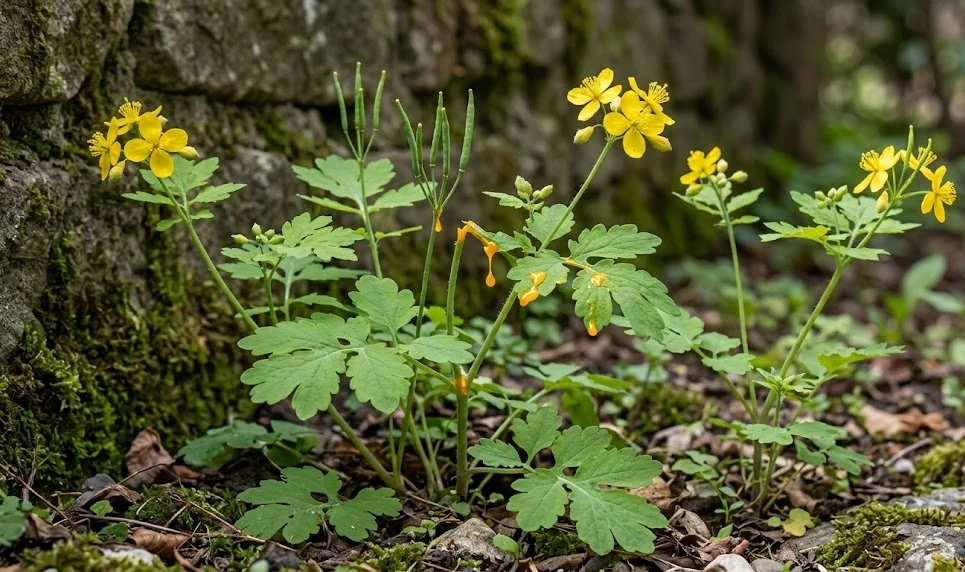

Greater celandine performs best in partial shade, where it receives enough light for flowering but not so much exposure that its foliage becomes stressed. It is especially well suited to woodland edges, shrub borders, old walls, hedgerows, and informal corners with filtered sun. Although it can tolerate a range of light conditions, the quality of growth changes noticeably from deep shade to full sun. Understanding that response helps place the plant where it looks healthy, flowers reliably, and remains manageable.
Partial shade as the ideal condition
Partial shade gives greater celandine the balance it needs for strong foliage and regular flowering. Morning sun followed by afternoon shade is often excellent. Filtered light beneath deciduous trees can also work well, especially before the canopy becomes dense. These conditions reflect the plant’s natural preference for edges and lightly disturbed woodland-like habitats.
In partial shade, leaves usually remain fresher and less prone to scorching. Soil moisture also lasts longer, which reduces summer stress. The plant can maintain a more attractive shape because it is not constantly struggling against heat and dryness. This makes partial shade the most reliable choice for ornamental use.
Flowering remains good when shade is not too deep. Bright but indirect light is usually enough to support repeated yellow blooms. If the plant receives only a few weak rays each day, flowering may decline. The aim is shade that softens exposure, not shade that excludes light almost completely.
Partial shade also helps manage the plant’s vigor. In very rich, sunny conditions, it may grow strongly and seed heavily. In moderate shade, growth is often more balanced and easier to control. This makes site selection an important part of long-term maintenance.
More articles on this topic
Full sun and deep shade responses
Greater celandine can grow in full sun where the climate is cool and the soil remains evenly moist. In these conditions, flowering may be abundant and growth can be compact. However, full sun becomes stressful when paired with dry soil or intense summer heat. Leaves may yellow, wilt, or become coarse earlier in the season.
In hot gardens, afternoon sun is usually more damaging than morning sun. A plant that thrives on an east-facing edge may struggle on a south-facing slope. Mulch and watering can help, but they may not fully compensate for unsuitable exposure. Relocating the plant to brighter shade is often the better solution.
Deep shade produces a different set of problems. Stems may stretch toward light, become thin, and fall over. Flowering is usually reduced, and the plant may look more weedy than ornamental. In very dark positions, it may survive without contributing much beauty or structure.
The best light level is therefore moderate rather than extreme. Greater celandine is tolerant, but tolerance does not mean every position gives equal results. Observing leaf color, stem strength, and flowering tells the gardener whether light is suitable. If growth is weak or scorched, the site should be adjusted.
More articles on this topic
Managing light through the seasons
Seasonal changes strongly influence light availability. In spring, greater celandine may receive plenty of light before trees and shrubs fully leaf out. This early brightness supports rapid growth and flowering. Later, summer shade can protect the plant from heat and moisture loss.
This seasonal rhythm makes deciduous plantings especially useful companions. The plant benefits from spring light and summer shelter. It can occupy the ground layer beneath shrubs without demanding prime border space. This is one reason it succeeds in semi-wild and woodland-edge gardens.
Garden maintenance can also modify light conditions. Pruning overhanging shrubs may improve flowering if shade has become too heavy. Conversely, allowing nearby plants to cast light shade can protect greater celandine in hot, exposed sites. Light management is often more flexible than moving the plant immediately.
Containers allow even more control over exposure. A potted plant can be shifted from brighter spring light into summer shade. This is useful for botanical collections or small gardens where conditions change sharply. Even in containers, however, the plant should not be left in harsh sun with dry compost.