
Successful basil cultivation begins with a professional approach to the initial planting phase and the various methods of propagation. Whether starting from seeds or utilizing vegetative cuttings, the goal is to establish a robust root system and vigorous early growth. This herb is exceptionally responsive to its environment, making the first few weeks of its life cycle the most critical for long-term productivity. Understanding the biological requirements for germination and root initiation allows for a more reliable and abundant harvest throughout the year.
Germination and seedling development
Starting basil from seed is the most cost-effective way to produce a large volume of plants for the garden or commercial use. The seeds are small and require a fine-textured, sterile starting mix that provides consistent contact without burying them too deeply. A planting depth of approximately three millimeters is sufficient to allow the emerging hypocotyl to reach the surface easily. Keeping the medium consistently moist but not saturated is essential for triggering the biochemical processes of germination.
Temperature control is perhaps the most significant factor in achieving a high germination rate with basil seeds. The ideal range for most varieties is between 24 and 29 degrees Celsius, which often requires the use of supplemental heat mats in cooler climates. Under these optimal conditions, sprouts typically appear within five to seven days, showcasing two distinct heart-shaped cotyledons. If the environment is too cold, germination may be delayed or the seeds may rot before they have a chance to sprout.
Once the seedlings have emerged, they require immediate access to high-intensity light to prevent them from becoming leggy or weak. If growing indoors, placing the trays under full-spectrum LED or fluorescent lights for fourteen to sixteen hours a day is recommended. The lights should be positioned close to the plants to encourage a compact growth habit and strong stem development. Proper air circulation at this stage is also vital to prevent damping-off, a common fungal disease that affects young seedlings.
Thinning is a necessary step that many amateur gardeners overlook, but it is crucial for professional-quality results. If multiple seeds were sown in a single cell or pot, the weakest individuals should be removed to allow the strongest one to thrive. This reduces competition for light and nutrients and ensures that the remaining plant has adequate space for its root system to expand. Seedlings are generally ready for their first transplant when they have developed at least two pairs of true leaves.
More articles on this topic
Transplanting into the permanent location
Moving basil seedlings from their controlled nursery environment to their permanent home requires a careful hardening-off process. This involves gradually exposing the young plants to outdoor conditions, such as direct sunlight and wind, over a period of seven to ten days. Sudden exposure to the elements can cause leaf scorch or transplant shock, which can set the plant’s growth back by several weeks. Starting with just an hour of morning sun and slowly increasing the duration is the safest method for acclimation.
The timing of the final transplant is dictated by both the weather and the physiological maturity of the plant. Gardeners must wait until all danger of frost has passed and the soil temperature has reached at least 15 degrees Celsius. Planting too early into cold soil can result in purple-tinted leaves, a sign of phosphorus lock-up and general metabolic stress. Checking the long-term weather forecast for stable nighttime temperatures is a hallmark of professional garden management.
When planting in the ground or in large containers, the hole should be twice as wide as the root ball and just as deep. It is beneficial to incorporate a small amount of balanced organic fertilizer into the bottom of the hole to provide an immediate nutrient source. The plant should be placed at the same depth it was growing in its original container to avoid stem rot. Firming the soil gently around the roots ensures good contact and eliminates air pockets that could cause the roots to dry out.
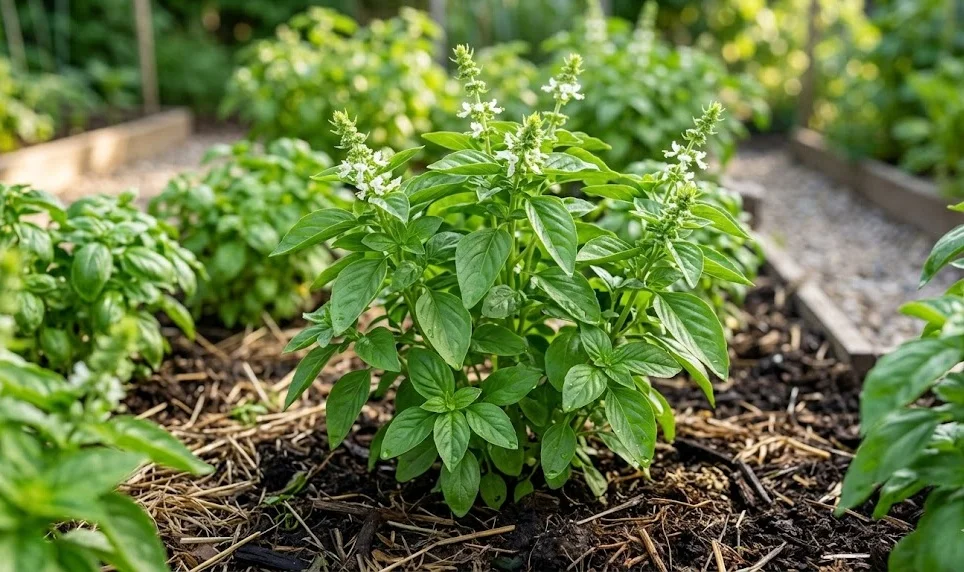
A thorough watering immediately after transplanting is essential to settle the soil and reduce the stress on the plant. Some growers also apply a diluted seaweed solution at this stage, which contains natural hormones that encourage rapid root establishment. Mulching around the base of the plant with organic material like straw or shredded bark can help maintain consistent soil moisture and suppress weeds. Monitoring the transplants closely for the first week ensures they are adapting well to their new environment.
More articles on this topic
Vegetative propagation from cuttings
Propagating basil from cuttings is a professional technique that allows for the rapid production of new plants that are genetically identical to the parent. This method is particularly useful for multiplying high-performing individuals or rare varieties that may not produce seeds reliably. A healthy stem cutting of about ten centimeters, taken from the soft, vegetative growth of the plant, is the ideal starting point. The cut should be made just below a node using a sterile, sharp knife to minimize tissue damage.
Preparing the cutting involves removing the lower leaves to expose at least two nodes, which is where the new roots will eventually emerge. Any flower buds present on the cutting should also be pinched off so the plant can focus its energy entirely on root production. The cutting can then be placed in a clean container of filtered water, ensuring that no leaves are submerged to prevent rot. Many professionals prefer this water method because it allows for easy monitoring of root development.
Changing the water every two days is critical to maintain oxygen levels and prevent the growth of bacteria or algae. The container should be placed in a bright location but away from direct sunlight, which can overheat the water and stress the cutting. Within seven to ten days, small white roots should begin to appear from the submerged nodes. Once the roots are approximately two centimeters long, the cutting is ready to be transitioned into a potting medium.
Transitioning water-rooted cuttings to soil requires a delicate touch, as the roots are fragile and adapted to a liquid environment. Use a light, well-draining potting mix and keep it very moist for the first few days to help the roots adjust. Placing a clear plastic dome or bag over the plant can maintain high humidity and prevent the cutting from wilting during this transition. After a week, the plant should be well-established and can be treated like a regular seedling.
Root division and alternative methods
While less common than seeds or cuttings, certain perennial-like varieties of basil can be propagated through the division of the root mass. This is typically done with older, established plants that have developed multiple stems and a dense root system. The process involves carefully lifting the entire plant from the soil and using a sharp spade to split the root ball into two or more sections. Each section must have a healthy portion of both roots and foliage to ensure its survival after being replanted.
Layering is another propagation technique that can be used directly in the garden without removing pieces of the plant. A flexible, low-growing stem is bent down to the ground, and a small section is covered with soil while the tip remains exposed. The buried section will eventually produce roots, at which point it can be severed from the parent plant and moved elsewhere. This method is slow but highly successful because the new plant remains supported by the parent during the rooting process.
Professional greenhouse operations often use specialized rooting hormones to speed up the propagation process and increase success rates. While basil roots easily on its own, a quick dip in an auxin-based powder or liquid can produce a more robust and uniform root system. This is especially helpful when working with woody or older stem tissue that might otherwise be slow to respond. Understanding these advanced techniques allows for more flexibility in how a collection is managed and expanded.
Regardless of the method chosen, the success of basil propagation depends on the health of the source material. Only take cuttings or seeds from plants that are free of pests, diseases, and nutritional stresses. Maintaining a “mother plant” under ideal conditions specifically for propagation purposes is a common professional practice. By starting with the best possible genetic material, the gardener ensures that the next generation of basil will be just as productive and flavorful.