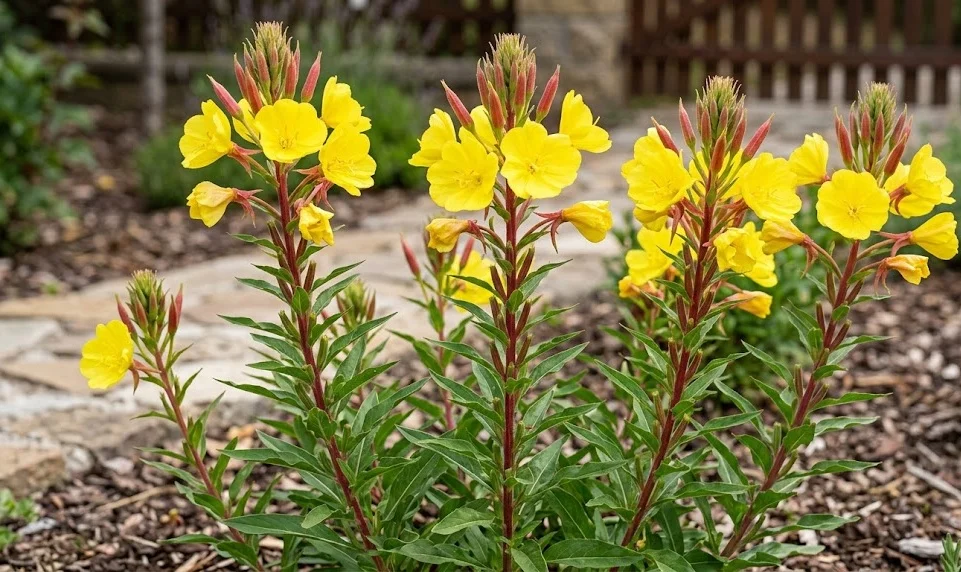

Planting red-sepal evening primrose is most successful when its need for sun, drainage, and minimal root disturbance is respected from the beginning. The plant can be established from seed, young nursery specimens, or carefully moved seedlings, although direct sowing often produces the strongest plants. Its natural tendency to reproduce abundantly makes propagation straightforward once a few healthy individuals are established. Careful spacing and early site preparation prevent competition and help each plant develop a sturdy flowering stem.
Preparing the planting site
Choose an open area that receives direct sunlight for most of the day. Remove perennial weeds thoroughly because they can be difficult to extract once evening primrose roots occupy the same ground. Loosen compacted soil to improve drainage and root penetration. The finished surface should be firm enough to support seedlings but not compressed into a hard crust.
Heavy soils benefit from the addition of coarse organic matter or fine horticultural grit. These materials should be distributed through a broad area rather than concentrated directly beneath the plant. A sharply different planting pocket can collect water and create poor winter conditions. Improving the entire bed provides more consistent drainage.
Very poor sandy soil may be amended with a modest amount of mature compost. The aim is to improve moisture retention without making the ground excessively rich. Red-sepal evening primrose generally develops stronger stems in moderately fertile conditions than in heavily manured soil. Fresh manure should not be used around young plants.
Allow enough space for the basal rosette and future flowering stem. A distance of approximately forty to sixty centimetres between plants is usually practical, depending on local fertility and the surrounding planting. Closer spacing creates competition and reduces airflow. Wider spacing allows each specimen to express its natural form.
More articles on this topic
Planting young specimens
Container-grown plants can be planted in spring or early autumn when the soil is workable. Spring planting is often safer in cold or wet regions because roots have a full growing season to establish before winter. Autumn planting works well in mild climates with free-draining ground. Avoid planting during extreme heat, frost, or prolonged saturation.
Water the container before removing the plant so the root ball remains intact. Handle the roots carefully because evening primroses can resent severe disturbance. Place the plant at the same depth at which it was growing in the pot. Burying the crown too deeply increases the risk of decay.
Backfill with the excavated soil and firm it gently around the root ball. Water thoroughly to settle the ground and remove large air pockets. Do not repeatedly press wet clay soil, as this destroys its structure. A loose mineral mulch can be applied without covering the central crown.
Recently planted specimens need regular checking during their first several weeks. Water when the upper layer begins to dry, but avoid maintaining constant saturation. Protect the young rosette from slugs and aggressive weeds. Once active new growth appears, the plant is usually beginning to establish successfully.
More articles on this topic
Growing from seed
Seed can be sown directly outdoors in spring or autumn. Direct sowing avoids root disturbance and allows seedlings to adapt immediately to local conditions. Scatter the seeds thinly over prepared soil and press them lightly into the surface. They should not be buried deeply because light can assist germination.
Keep the seedbed gently moist until germination occurs. A fine spray is preferable to a heavy stream that may wash seeds into clusters. Germination timing varies with temperature and moisture, so patience is often necessary. Marking the area prevents accidental cultivation before seedlings emerge.
When seedlings develop several true leaves, thin them to reduce competition. Keep the strongest, best-positioned plants and remove weak or crowded individuals. Thinning is easier after light rain because the soil releases roots with less resistance. Unwanted seedlings can occasionally be moved, but direct-rooted plants usually establish more reliably.
Autumn-sown seedlings may form rosettes before winter and flower during the following growing season. Spring-sown plants often spend their first year developing leaves and roots before flowering later. Local climate and sowing date influence this pattern. The plant’s biennial habit should therefore be considered when planning the border.
Propagating through self-sown seedlings
Self-sown seedlings are often the simplest source of new plants. They commonly emerge around mature seed-bearing stems or in nearby areas of open soil. Inspect the garden in spring and autumn for small rosettes. Early identification allows you to retain useful plants before routine weeding begins.
Seedlings that are already growing in suitable positions can simply be left undisturbed. Remove nearby competitors and provide water during prolonged dry periods. These naturally placed plants often outperform transplanted specimens because their roots have never been disturbed. Their growth also reveals which parts of the garden provide the best conditions.
When relocation is necessary, lift seedlings while they are still small. Use a narrow trowel to remove a generous plug of soil around the roots. Transfer the seedling immediately to its prepared position and water thoroughly. Delays between lifting and replanting can dry the fine roots quickly.
Mature flowering plants are not ideal candidates for division. Their growth habit and root structure make them less responsive to the division techniques used for clump-forming perennials. Seed propagation is faster, easier, and more consistent. Maintaining a sequence of young plants through controlled self-sowing ensures reliable continuity.