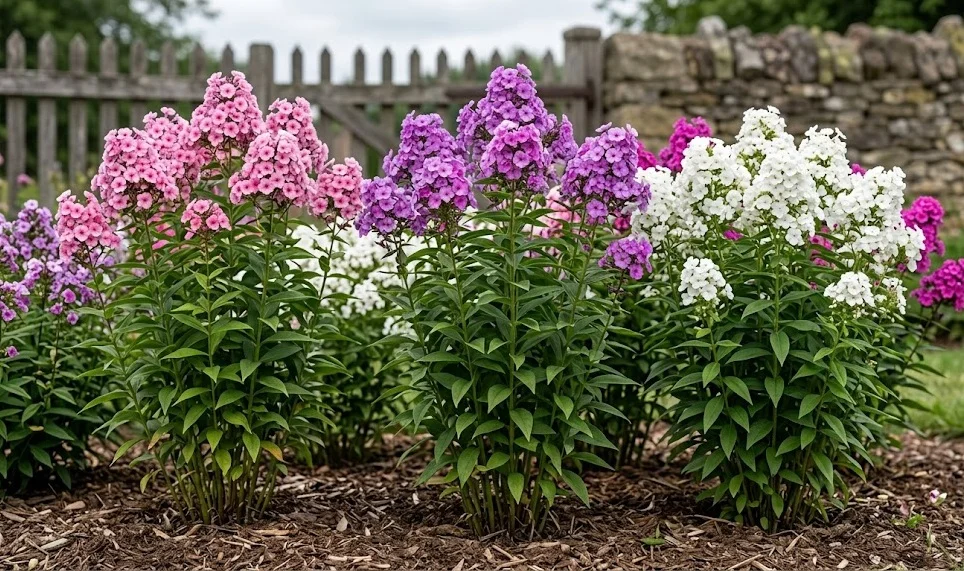

Garden phlox establishes best when planting is treated as the foundation of the plant’s future health, not as a quick decorative job. Strong roots, correct depth, generous spacing, and careful aftercare all influence how well the plant flowers in later seasons. Propagation is also straightforward when mature clumps are divided at the right time and handled gently. With good technique, one healthy plant can become several vigorous new clumps without losing the character of the original cultivar.
Selecting plants and timing the planting
The best garden phlox plants for planting have firm crowns, healthy shoots, and roots that are neither dry nor rotting. When buying container-grown plants, avoid specimens with yellowing lower leaves, badly tangled roots, or signs of mildew. A compact, well-rooted plant usually establishes better than an overgrown one that has been held too long in a pot. Healthy starting material reduces problems from the first season onward.
Spring and early autumn are the most reliable planting times in many temperate gardens. Spring planting gives the plant a full growing season to establish before winter. Autumn planting works well when soil is still warm and rainfall is more regular. Very late planting should be avoided because roots may not settle before hard cold arrives.
Summer planting is possible, but it requires more careful watering. Plants moved or installed during hot weather can suffer quickly if their roots dry out. If planting cannot be delayed, choose a cooler, cloudy day and water thoroughly before and after planting. Temporary light shading may help newly planted phlox recover from heat stress.
Bare-root plants should be planted while dormant or just beginning to grow. Their roots need to be kept moist before planting, but not submerged for long periods. Soaking briefly before planting can rehydrate dry roots and make them easier to spread. Once planted, they should be watered well so soil settles closely around the root system.
More articles on this topic
Preparing the planting hole and spacing
A generous planting hole helps garden phlox establish quickly. The hole should be wider than the root ball so surrounding soil can be loosened and improved. Depth should be judged carefully, because planting too deeply can encourage crown rot. The crown should sit at roughly the same level it occupied in the pot or nursery bed.
Compost can be mixed into the backfill, but the planting hole should not become a soft pocket in otherwise compacted soil. Roots need to move outward into the surrounding ground, not remain confined in an enriched bowl. Loosening a wider area is often better than heavily amending only the hole itself. This creates a more even root environment.
Spacing should allow for mature size, not just the size of the young plant. Many garden phlox cultivars need enough room for air to move freely between clumps. Crowded planting may look full in the first year but often causes disease and weak flowering later. Good spacing is especially important in humid regions.
After planting, firm the soil gently with your hands to remove large air pockets. Water deeply so the soil settles around the roots. A thin mulch can then be added to conserve moisture and reduce weed pressure. Keep the mulch away from the crown so the base of the plant remains open and healthy.
More articles on this topic
Dividing mature clumps
Division is the most dependable way to propagate garden phlox while preserving cultivar traits. It is especially useful when a mature clump becomes congested, flowers less heavily, or develops a tired center. Spring is often the preferred time because new shoots show where the healthy growth points are. Early autumn division is also possible if there is enough time for roots to re-establish before winter.
To divide a clump, lift it with as much root as possible. A garden fork is usually better than a narrow spade because it loosens the root mass with less cutting. Shake or wash away some soil so the natural divisions are easier to see. Healthy outer sections with several shoots and good roots make the strongest new plants.
Old, woody centers should usually be discarded. These sections often have fewer active buds and may not regrow with vigor. The best divisions come from younger, vigorous parts of the clump. Each division should have enough root to support the shoots it carries.
Replant divisions promptly so the roots do not dry out. If there is a delay, keep them shaded and wrapped in damp material. Water thoroughly after replanting and maintain even soil moisture during establishment. Divided plants may flower lightly in the first season, but they often perform strongly once settled.
Other propagation methods and aftercare
Garden phlox can also be propagated from basal cuttings in spring. Young shoots taken close to the crown may root well when handled carefully. Cuttings need a clean growing medium, steady moisture, and bright indirect light. This method is useful when only a small amount of material is available.
Stem cuttings can be taken from non-flowering shoots during active growth. The lower leaves should be removed, and the cutting should be inserted into a free-draining propagation mix. Humidity helps prevent wilting, but excessive wetness can cause rot. Once rooted, young plants should be hardened off gradually before planting outside.
Seed propagation is possible, but it does not reliably reproduce named cultivars. Seedlings may vary in height, color, disease resistance, and flowering quality. This can be interesting for breeding or naturalistic gardens, but it is less suitable when a specific variety must be preserved. For consistent results, division and cuttings are better methods.
Newly propagated plants need careful aftercare during their first season. Keep the soil evenly moist, remove weeds, and protect young plants from severe competition. Avoid heavy feeding until roots are established, because tender growth can become weak. The goal is to build a strong crown and root system before expecting a full flowering display.