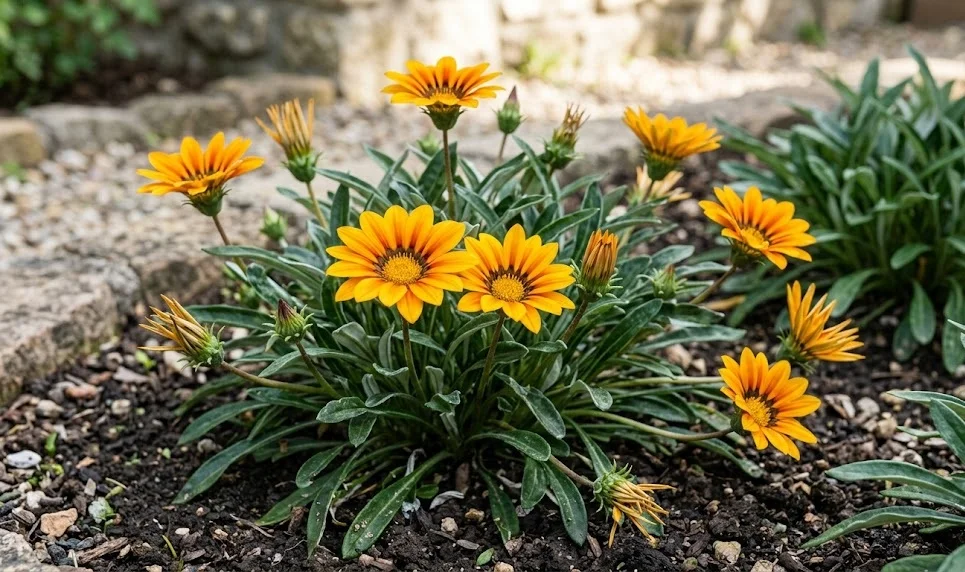

Gazanias, often called treasure flowers, reward careful gardeners with vivid, daisy-like blooms from late spring until cold weather arrives. Their silvery or deep green foliage tolerates heat, wind, and dry conditions better than many traditional bedding plants. Although they are naturally resilient, reliable flowering depends on strong sunlight, sharply drained soil, and restrained watering. Understanding these basic preferences makes gazanias remarkably easy to maintain in beds, borders, containers, and rock gardens.
Understanding the natural growth habit
Gazanias originate from warm regions where sunlight is intense and rainfall may be irregular. Their growth habit reflects these conditions, with low rosettes of leaves and flower stems that rise above the foliage. Many cultivars spread gradually to form broad, colourful clumps without becoming aggressively invasive. This compact structure makes them useful along path edges, at the front of borders, and in exposed coastal gardens.
The leaves are often narrow, slightly leathery, and covered with pale hairs on their undersides. These features reduce moisture loss and protect the plant from strong sun and drying winds. Some varieties have distinctly silver foliage, while others display glossy green upper surfaces. Healthy leaves should remain firm and evenly coloured rather than soft, yellow, or water-soaked.
Gazania flowers usually open fully when direct sunlight reaches them. They may close during cloudy weather, in the evening, or when planted in excessive shade. This response is normal and does not indicate poor health. However, plants that rarely open their flowers are usually receiving less light than they need.
In climates with mild winters, gazanias may behave as short-lived perennials and expand from year to year. In colder regions, they are commonly grown as annual bedding plants or overwintered under protection. Their exact lifespan depends on temperature, winter moisture, drainage, and cultivar. Even perennial plants benefit from periodic renewal because older clumps may become sparse in the centre.
More articles on this topic
Choosing the best growing position
A successful gazania planting begins with the sunniest available location. The plants perform best where they receive at least six to eight hours of direct sunlight each day. South-facing slopes, open patios, raised beds, and unobstructed borders are generally ideal. Heat reflected from paving, gravel, or light-coloured walls is usually tolerated well.
Shelter from persistent cold wind can improve flowering in cooler districts. However, the site should not be enclosed so tightly that air becomes stagnant around the foliage. Gentle air movement helps leaves dry quickly after rain and reduces the risk of fungal problems. A warm, open position with good circulation provides the best balance.
Low-lying areas where water collects after storms are unsuitable for gazanias. Their roots tolerate temporary dryness far better than prolonged saturation. Where garden soil drains slowly, planting on a slight mound can keep the crown above excess moisture. Raised beds and sloping ground are particularly useful in regions with frequent summer rain.
Containers offer greater control when natural garden conditions are unsuitable. Pots can be positioned in full sun and moved under cover during extended wet weather. Dark containers may become extremely hot, so the root zone should be monitored during heatwaves. Every container must have unrestricted drainage holes and a free-draining growing medium.
More articles on this topic
Preparing suitable soil
Gazanias grow best in light soil that releases surplus water quickly. Sandy loam, gravelly soil, and moderately poor ground are often more suitable than rich, moisture-retentive beds. Heavy clay can be improved by creating raised planting areas rather than simply mixing sand into a deep hole. A uniformly well-drained root zone is safer than an isolated pocket surrounded by compacted soil.
The ideal soil reaction is generally neutral to slightly acidic, although gazanias tolerate a reasonably broad range. Extremely acidic or strongly alkaline conditions can restrict nutrient availability. A soil test is useful when plants show persistent discolouration despite otherwise suitable care. Amendments should be based on measured results rather than guesswork.
Large quantities of compost or manure are rarely necessary. Excessively fertile soil encourages lush leaves at the expense of flowers and may produce soft growth that is vulnerable to pests. A modest amount of mature compost can improve structure in very poor soil without making it excessively rich. Fresh manure should be avoided because it may scorch roots and stimulate weak growth.
Before planting, loosen the soil across a broad area to prevent root restriction. Remove perennial weeds because gazania foliage can make later weeding awkward. Break up compacted surface layers so irrigation can penetrate evenly rather than running away. The finished bed should feel crumbly and should not remain sticky or waterlogged after watering.
Managing routine watering
Newly planted gazanias need regular moisture while their roots spread into the surrounding soil. Water deeply enough to moisten the entire root zone, then allow the upper soil to begin drying. Frequent surface sprinkling encourages shallow roots and leaves plants less resilient during hot weather. Deep, spaced watering supports stronger establishment.
Once established, gazanias are moderately drought tolerant. They should still receive water during extended dry periods, especially when flowering heavily. The correct interval depends on soil type, temperature, wind, and plant size rather than a fixed calendar. Checking the soil beneath the surface is more reliable than judging by appearance alone.
Container-grown plants dry more quickly than those in open ground. During hot, windy weather, small pots may require daily inspection even though gazanias dislike constantly damp soil. Water should be applied until a little drains from the base, after which the saucer should be emptied. Leaving pots standing in water can rapidly damage fine roots.
Morning is generally the best time to irrigate. Early watering supplies moisture before daytime heat while allowing wet foliage to dry promptly. Water directed at the soil is preferable to repeated overhead spraying. Keeping leaves and flowers dry reduces staining and limits conditions favourable to disease.
Encouraging abundant flowering
Strong light is the most important factor in gazania flower production. Even healthy plants may remain leafy and reluctant to bloom when shaded by buildings, shrubs, or taller perennials. Moving containers or thinning nearby vegetation can produce a noticeable improvement. Fertiliser cannot compensate for insufficient sunlight.
Removing faded flowers helps maintain a tidy appearance and redirects energy away from seed production. Cut the flower stem near its base without damaging the central crown. Regular deadheading is especially useful for cultivars that set seed readily. Sterile or self-cleaning varieties may require less frequent attention.
Moderate feeding can support flowering in containers or very poor soil. A balanced or bloom-formulated fertiliser applied at low strength is usually sufficient. Excess nitrogen should be avoided because it promotes leaves rather than buds. Plants in fertile garden soil may need little or no additional feeding.
Heat usually improves gazania performance, provided the roots are not completely dry. Flowering may pause temporarily during prolonged cool, wet spells. Once brighter and warmer conditions return, healthy plants often resume blooming without special treatment. Good drainage is particularly important during these weather changes.
Seasonal maintenance through summer
Inspect gazanias regularly for damaged leaves, spent flowers, and signs of crowding. Small problems are easier to correct before they affect the whole clump. Remove dead material promptly because it can trap moisture around the crown. Clean growth also makes pest inspection more effective.
A thin mineral mulch can suit gazanias better than a thick layer of moist organic material. Fine gravel or grit keeps flowers clean, reduces soil splash, and warms quickly in sunlight. Mulch should not be piled directly against the crown. Dense bark or undecomposed grass clippings may retain too much moisture.
Weeds compete for water and can shade the low-growing foliage. Pull them carefully while they are young to avoid disturbing gazania roots. Hand weeding is usually safer than deep cultivation around established clumps. Maintaining open space around each plant also improves air circulation.
During exceptionally hot periods, plants may wilt briefly in the afternoon even when soil moisture is adequate. Check the root zone before adding water, because heat stress and overwatering can produce similar symptoms. If the soil remains moist, allow the plant to recover as temperatures fall. Unnecessary irrigation during heat can create root problems later.
Recognising and correcting poor growth
Yellow leaves frequently indicate excessive moisture, poor drainage, or root stress. Examine the soil before assuming that fertiliser is required. If it remains wet for long periods, reduce irrigation and improve drainage immediately. Severely affected container plants may need repotting into a drier, more porous mixture.
Long, weak stems and sparse flowering are typical signs of insufficient light. Moving the plant to a sunnier location usually provides a better solution than pruning alone. New growth should become shorter and sturdier after light conditions improve. Existing stretched growth will not return to its previous form.
Brown leaf edges can result from prolonged drought, root congestion, salt accumulation, or harsh drying wind. Water container plants thoroughly to flush excess fertiliser salts when buildup is suspected. Root-bound plants may need a slightly larger pot or division. Consistent care is more effective than sudden heavy watering or feeding.
A clump that declines from the centre may simply be ageing. Healthy outer sections can be divided and replanted in fresh soil. This renewal produces more vigorous plants and restores a compact shape. It also provides an opportunity to discard any soft, dark, or diseased tissue.