
Watering Matilija poppy well means understanding that its needs change dramatically as the plant matures. Young plants require dependable moisture while establishing their roots, whereas mature specimens are naturally adapted to long dry periods and usually resent constantly wet soil. Feeding follows a similar principle: enough nutrients are necessary for healthy growth, but excessive fertility can weaken stems and reduce the plant’s naturally robust character. The most successful regime is therefore moderate, seasonal and closely matched to soil conditions rather than based on routine weekly applications.
The plant’s native ecology provides an excellent guide to irrigation. Seasonal rainfall supports growth during cooler periods, while summers may become very dry. Established plants respond to this rhythm by developing deep and extensive roots capable of exploiting moisture stored well below the surface. Garden irrigation should encourage rather than suppress this adaptation.
Constant shallow watering is generally undesirable. It keeps the upper soil moist but may discourage roots from exploring deeper layers. It can also increase the risk of crown and root disorders in poorly ventilated soils. Deep irrigation at wider intervals is usually much more suitable once the plant has begun to establish.
Soil texture should always influence watering decisions. Sandy ground drains rapidly and may require somewhat more frequent irrigation, while loam retains moisture longer. Heavy clay can remain wet far below the surface even when the top appears dry. Checking actual root-zone moisture is therefore more reliable than following a fixed calendar.
Watering during establishment
Immediately after planting, water thoroughly to settle the soil around the roots. For the following weeks, prevent the root ball from drying completely while still allowing some aeration between irrigations. Newly planted specimens cannot yet access the same volume of soil as mature colonies. A plant that will eventually tolerate drought can therefore still suffer serious dehydration during its first season.
More articles on this topic
The frequency of irrigation should gradually decrease as roots spread into surrounding soil. Instead of giving small amounts every day, apply a deeper watering and then wait until the soil begins to dry. This encourages a more resilient root architecture. By the end of the first growing season, well-established plants should usually tolerate longer dry intervals than they did immediately after planting.
Hot weather may require temporary adjustments. A recently planted specimen exposed to strong sun and drying winds can lose water faster than its limited root system can replace it. Wilting during the hottest part of the afternoon does not always indicate severe drought, but persistent wilting into the evening deserves attention. Water deeply if the root zone is genuinely dry rather than simply wetting the foliage.
Autumn-planted specimens also require monitoring. Cooler weather reduces evaporation, but newly disturbed roots still need moisture to establish. The danger at this time is often overwatering rather than drought, particularly in heavy soils. Irrigate only when necessary and allow rainfall to perform most of the work where conditions are naturally moist.
Watering established plants
Once the root system is mature, Matilija poppy is capable of remarkable drought tolerance. In climates that resemble its native environment, established specimens may need little supplementary irrigation after spring growth is complete. This does not mean they must never be watered. An occasional deep soaking during prolonged exceptional drought can preserve foliage and support overall plant health.
More articles on this topic
Spring irrigation can be particularly useful if rainfall is unusually low while new stems and flower buds are developing. At this stage the plant is actively producing substantial biomass. Severe water shortage may restrict stem length or reduce flowering. A few well-timed deep irrigations can be more effective than frequent light watering.
After flowering, irrigation can usually be reduced. In hot climates the plant may naturally enter a period of partial summer dormancy, and foliage may decline. Trying to maintain lush spring-like growth with constant summer irrigation works against the species’ natural rhythm. The resulting combination of heat and wet soil may also increase root stress.
Winter watering should be especially conservative. Cool soil dries slowly, and dormant roots use relatively little water. In regions with regular winter rainfall, additional irrigation is often completely unnecessary. The primary objective is to prevent prolonged saturation, particularly around the crown.
Understanding nutrient requirements
Matilija poppy is not naturally dependent on highly fertile soil. It often grows successfully where nutrient levels would be considered modest for vegetables or intensely managed ornamental borders. This ability reflects its adaptation to open, dry habitats where organic matter may be limited. Gardeners should therefore resist assuming that more fertiliser automatically means more flowers.
Nitrogen deserves particular caution. High nitrogen availability stimulates vigorous leaf and stem growth, but these tissues may become soft and overly elongated. Such plants can be more prone to leaning and may allocate proportionally less energy to flowering. Moderate nutrition usually creates a stronger and more naturally balanced plant.
Phosphorus and potassium are also necessary, but routine supplementation is not always justified. Most garden soils contain adequate reserves unless testing indicates a deficiency. Applying nutrients simply because a plant is flowering heavily can result in unnecessary accumulation. Soil condition, leaf appearance and growth quality should guide feeding decisions.
Organic matter can provide slow nutrient release while improving soil biology, but large quantities of rich compost can also increase moisture retention. On a species that values drainage, this trade-off matters. A small amount of well-matured compost is usually sufficient where soil is genuinely poor. In naturally fertile loam, feeding may not be required at all.
Practical fertilising strategies
A restrained spring feeding is usually the most appropriate option when extra nutrients are needed. Apply a modest dose around the active root zone rather than concentrating fertiliser against the crown. Water afterwards if the product requires incorporation into moist soil. Avoid exceeding label rates in an attempt to accelerate growth.
Slow-release fertilisers can be useful because they provide nutrients gradually rather than producing a sudden surge. Choose a reasonably balanced formulation instead of one dominated by nitrogen. The purpose is to support steady growth, not to force exceptionally large leaves. A healthy established plant that is already growing strongly may be better left unfed.
Liquid feeding is rarely necessary for established plants in the ground. Frequent liquid fertilisation can produce exactly the lush, soft growth that should be avoided. It may have a place for young container-grown plants or severely depleted soils, but concentrations should remain moderate. Once plants are established outdoors, feeding should become less intensive.
Visible symptoms should be interpreted carefully before fertiliser is added. Yellow foliage can result from waterlogged roots, drought, natural seasonal decline or nutrient shortage. Feeding a plant whose roots are oxygen-starved will not solve the underlying problem. Soil moisture, drainage and seasonal timing should always be assessed first.
Coordinating water and nutrients
Water and fertiliser cannot be managed independently because nutrient availability depends on root activity and soil moisture. Extremely dry soil limits nutrient uptake even when minerals are present. Saturated soil, on the other hand, reduces root oxygen and can impair nutrient absorption despite apparently abundant moisture. Balanced soil conditions are therefore more important than simply adding more fertiliser.
A useful seasonal pattern is moderate moisture during active spring growth, followed by progressively drier conditions after flowering. If fertiliser is required, apply it early enough for nutrients to support new development. Late-season nitrogen applications can encourage soft growth when the plant should be slowing down. This can be particularly undesirable in climates with cold winters.
Mulch can alter both water and nutrient behaviour. Thick organic mulch conserves moisture and releases nutrients as it decomposes, which may be excessive on heavy soil. Gravel or other mineral mulch often better reflects the dry conditions preferred by Matilija poppy. Whatever material is chosen, avoid piling it directly against the crown.
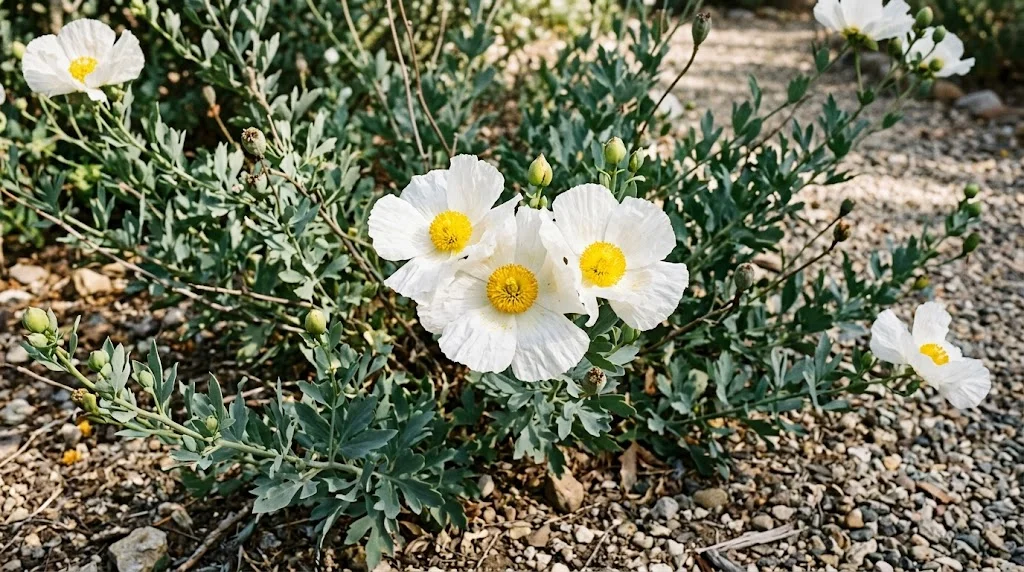
Observation remains the best management tool. A sturdy plant with healthy grey-green foliage, strong flower stems and regular seasonal growth is already receiving what it needs. If it performs well without supplemental feeding or irrigation, there is no horticultural benefit in adding them merely as routine. Matilija poppy often thrives when gardeners learn when not to intervene.