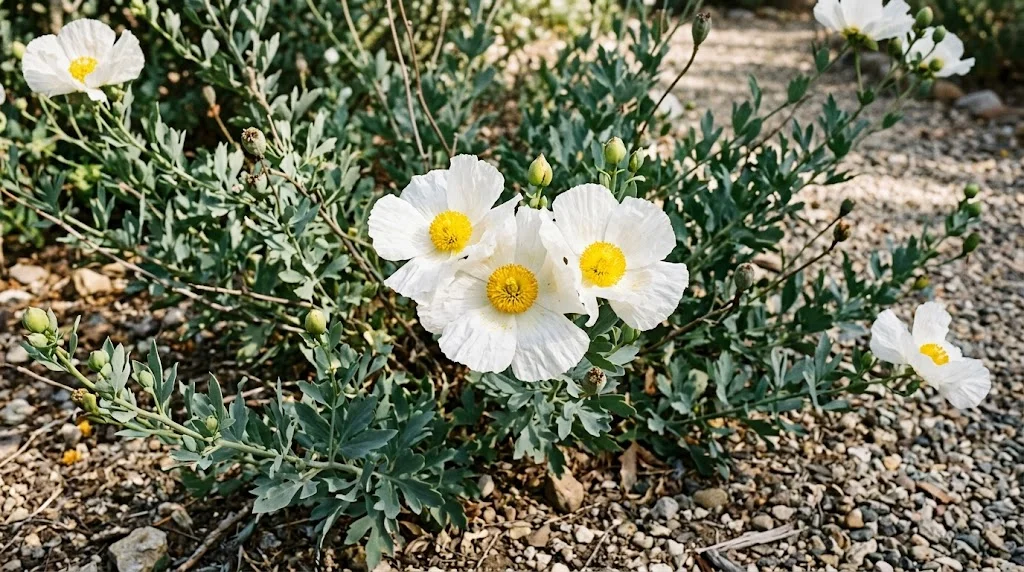

Pruning Matilija poppy is primarily a matter of managing renewal, size and seasonal dieback rather than trying to force the plant into a formal shape. Its natural habit is broad, vigorous and slightly wild, with tall flowering stems emerging from a spreading underground root system. Heavy trimming during active growth can reduce flowering, while well-timed cutting back can stimulate fresh shoots and keep older clumps manageable. Understanding when the plant naturally slows down is therefore more important than following a rigid pruning calendar.
The plant usually flowers on stems produced during the active growing season. Removing substantial growth too early can eliminate developing flower buds and reduce the display. Routine spring pruning should therefore focus mainly on dead or damaged material unless the plant clearly requires renovation. Healthy new stems should normally be allowed to develop freely.
After flowering, the appearance of the plant can become increasingly untidy, particularly in hot regions where summer dormancy develops. This is a natural part of its seasonal cycle. Gardeners may cut back declining stems once they have clearly finished functioning. There is little benefit in preserving completely dry top growth simply because it formed during the current year.
Always use clean, sharp pruning tools. Thick stems may require secateurs or loppers rather than light scissors. Clean cuts heal more predictably and reduce unnecessary tearing of the tissue. Sanitising tools is especially sensible if disease symptoms have been present.
Timing the main cutback
The ideal timing for major pruning depends on climate. In mild regions with dry summers, plants may be cut back after flowering and seasonal foliage decline. This tidies the planting and allows fresh growth to emerge when environmental conditions become favourable again. Avoid cutting back healthy green stems solely because flowering has recently ended.
More articles on this topic
In colder climates, major pruning is often delayed until late winter or early spring. Old stems can provide a modest amount of protection and make the dormant crown easier to locate. Once severe frost has passed and new growth is approaching, dead material can be removed. This timing also makes winter damage easier to assess accurately.
Where stems remain green through winter, there is no requirement to remove them automatically. Prune according to condition rather than date alone. Dead, broken or diseased stems can be removed whenever they are clearly identified. Healthy material may be retained until the plant naturally renews itself.
Cutting height can vary depending on the age and condition of the clump. During substantial renovation, old stems can be taken back close to the base without damaging the underground root system. Leave enough clearance to avoid cutting into emerging shoots or the crown itself. New stems will usually arise from the established roots when growth resumes.
Controlling spread and maintaining structure
Pruning the visible stems does not control underground spread. Matilija poppy can send up suckers beyond the original crown, and these need separate management. Remove unwanted shoots while they are young, ideally together with as much of their connecting root section as practical. Repeated removal may be necessary because established roots can regenerate.
More articles on this topic
If a broad colony is desired, selective thinning is better than trying to confine every shoot. Remove weak, crowded or badly positioned stems while retaining the strongest growth. This improves airflow and allows the remaining stems to develop more naturally. The result is a looser, healthier stand rather than a dense thicket.
Deadheading can be performed after individual flowers fade, although it is not essential for the plant’s survival. Removing spent blooms keeps the display tidy and limits seed production. If seed collection or naturalistic winter structure is desired, some flower heads can be left in place. Deadheading should not be confused with major stem pruning.
Avoid shearing Matilija poppy into a hedge-like shape. The plant looks best when its individual stems and large flowers are allowed to retain their natural architecture. Repeated superficial clipping can create dense, weak growth and remove developing flowers. Selective cuts made with a clear purpose are far more appropriate.