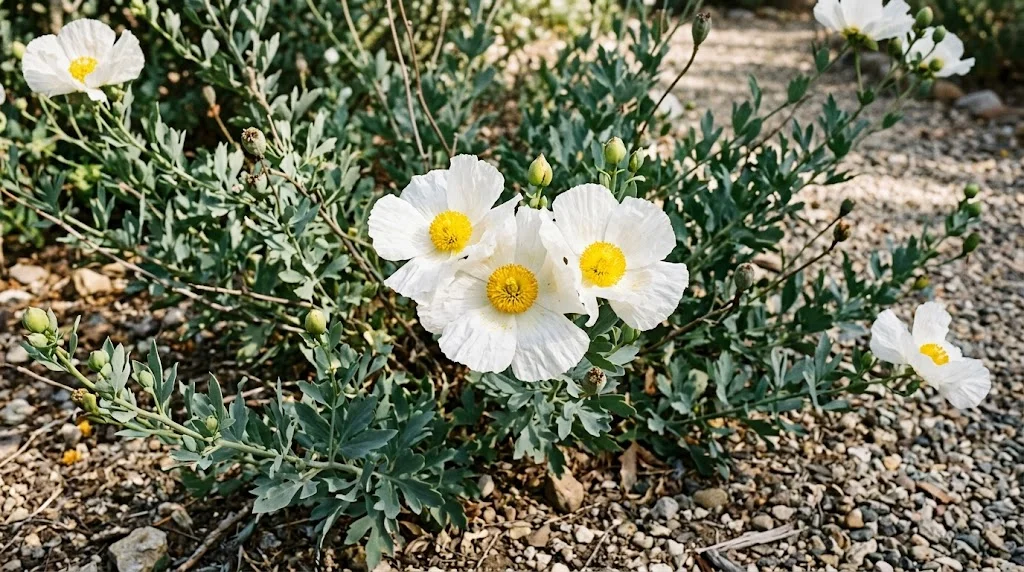

Matilija poppy is one of those plants that can make an established garden look almost wild and architectural at the same time. Its tall stems, deeply divided grey-green foliage and enormous white flowers with bright yellow centres give it a presence that few other perennial shrubs can match. Native to dry parts of California and northern Mexico, it is naturally adapted to strong sunlight, lean soils and pronounced seasonal changes in moisture. Successful cultivation therefore depends less on constant attention than on giving the plant the right conditions from the beginning and resisting the temptation to overmanage it.
The species forms a vigorous, spreading perennial with woody or semi-woody stems arising from an extensive underground root system. In favourable conditions, mature clumps can become well over 1.5 metres tall and spread considerably beyond their original planting position. This growth habit is part of the plant’s appeal, but it also means that location should be chosen carefully. A narrow border surrounded by delicate neighbouring plants is rarely the best place for it.
Matilija poppy performs most naturally in gardens that imitate the dry, open conditions of its native habitat. Mediterranean-style planting, gravel gardens, sunny banks and broad mixed borders can all suit it well. Once established, it usually becomes considerably more drought tolerant than many conventional herbaceous perennials. Young plants, however, require more consistent care while their root systems are becoming established.
One of the most important principles is to avoid treating Matilija poppy like a moisture-loving cottage-garden perennial. Constantly damp soil, excessive fertilisation and heavy organic mulches can encourage weak growth and root problems. The plant generally prefers conditions that might seem slightly austere to gardeners accustomed to rich cultivated soil. Strong sun, excellent drainage and moderate fertility usually produce sturdier plants and more reliable flowering.
Choosing the right site
A sunny, open position is fundamental to good performance. Ideally, Matilija poppy should receive direct sunlight for most of the day, especially in climates with relatively cool summers. Abundant light encourages compact, sturdy stems and helps the plant produce the energy required for its large flowers. Plants grown in too much shade often become taller, looser and noticeably less floriferous.
More articles on this topic
Good air circulation is also valuable, particularly where summers are humid or rainfall is frequent. Crowding the plant tightly between walls, dense evergreen shrubs or moisture-retaining groundcover can create a microclimate very different from its natural environment. An exposed site with free-moving air allows foliage and soil surfaces to dry quickly after rainfall. This reduces the likelihood of persistent fungal problems and soft, moisture-stressed growth.
Space should be considered almost as carefully as sunlight. Matilija poppy spreads through underground roots and can produce shoots some distance from the original crown. In a large garden this can create an impressive natural colony, but in a small border it may become intrusive. Providing a generous planting area from the start makes later management much easier.
It is also sensible to consider the visual scale of the mature plant. The foliage can form a substantial mass before flower stems rise above it, so it works particularly well toward the back of a sunny border or as part of a naturalistic planting. It can also stabilise dry slopes once established because of its extensive root system. Avoid positions where future suckering could interfere with paving, small rock-garden plants or carefully maintained formal beds.
Soil structure and drainage
Drainage is one of the most important factors in long-term success. Matilija poppy can cope with relatively poor soil, but it performs badly where water remains around the roots for prolonged periods. Sandy, gravelly or well-structured loam is generally ideal. Even heavier soil may be suitable if it drains freely and does not become waterlogged during winter.
More articles on this topic
In gardens with dense clay, improving the entire planting area is usually more effective than simply filling a small planting hole with loose compost. A heavily amended hole surrounded by impermeable clay can behave like a container buried in the ground and trap water around the roots. Instead, structural improvements should extend across a wider area where possible. Raised planting positions or sloping ground can also provide a useful advantage.
Soil fertility should remain moderate. Large quantities of nitrogen-rich manure or concentrated fertiliser can produce lush foliage at the expense of sturdier stems and balanced flowering. A modest amount of mature compost incorporated into poor soil before planting is generally sufficient. On naturally fertile ground, additional organic material may not be necessary at all.
Soil reaction is usually less critical than drainage, although neutral to mildly alkaline or mildly acidic conditions are generally acceptable. What matters most is that roots receive oxygen and that the soil does not remain saturated. Gravel incorporated into the upper planting zone may improve surface conditions, but it cannot correct fundamentally poor drainage below. Where winter waterlogging is unavoidable, another planting location is usually preferable.
Establishment during the first seasons
Newly planted Matilija poppies need more attentive watering than established specimens. Their roots initially occupy only the limited volume of soil surrounding the nursery root ball, making them vulnerable to drought even though mature plants are highly drought tolerant. Deep irrigation followed by a period of partial drying encourages roots to move outward and downward. Repeated shallow watering is less useful because it encourages roots to remain close to the soil surface.
During the first growing season, inspect soil moisture below the surface rather than judging only by appearance. The top few centimetres can dry quickly while deeper soil remains adequately moist. Water when the root zone is beginning to dry, but avoid maintaining permanently wet conditions. As the plant establishes, intervals between irrigations can gradually become longer.
Some initial transplant stress is not unusual. Leaves may wilt temporarily, especially if planting takes place during warm weather or if the roots have been disturbed. Maintaining moderate soil moisture and protecting the newly planted root zone from extreme drying usually allows recovery. Frequent feeding should not be used as a response to transplant stress because it can place additional pressure on damaged roots.
Growth can appear surprisingly modest at first because the plant invests considerable energy in underground establishment. Once the root system is well developed, new shoots may emerge strongly and sometimes at considerable distances from the original crown. Gardeners should therefore not assume that a quiet first season indicates permanent weakness. Patience during establishment often leads to much stronger performance in later years.
Managing mature growth
A mature Matilija poppy usually requires relatively little routine intervention. Its natural growth habit is informal, and excessive shaping tends to work against its character. Removing dead, damaged or obviously weak stems can keep the clump healthy and improve airflow. More substantial cutting back is generally best timed to coincide with the plant’s natural seasonal slowdown.
Spreading growth can be managed by removing unwanted suckers while they are still small. This is easier than allowing new shoots to develop into substantial stems and then trying to eliminate them later. Persistent unwanted shoots may need to be removed repeatedly because underground roots can continue to generate new growth. In locations where spreading is acceptable, this characteristic can instead be used to create broad colonies.
Tall stems are normally self-supporting when plants receive enough sunlight. Excessive fertility, shade or repeated irrigation can result in softer stems that lean or collapse more readily. Correcting the growing conditions is preferable to relying permanently on stakes. Where wind exposure is severe, discreet support may occasionally be useful during the flowering period.
Mulching should be handled carefully. A thin layer of gravel or another mineral mulch is often more appropriate than a deep layer of moisture-retentive organic material. If organic mulch is used, keep it away from the crown and avoid creating persistently damp conditions around the stems. The aim is to suppress severe surface drying and weeds without converting the root zone into a cool, wet environment.
Encouraging strong flowering
Flower production depends primarily on sunlight, plant maturity and appropriate seasonal growth. A well-established specimen in full sun normally flowers much more freely than one grown under trees or in a shaded courtyard. The plant should be allowed to build a substantial framework of healthy stems before heavy pruning or repeated division is considered. Young plants may need time before they reach their full flowering potential.
Overfeeding is one of the easiest ways to upset the balance between foliage and flowers. Nitrogen encourages vegetative growth, but excessive amounts can result in large, soft plants with relatively disappointing flowering. If soil is reasonably fertile, additional feeding may be unnecessary. Where growth is genuinely weak, a restrained application of balanced fertiliser in spring is usually preferable to frequent feeding.
Water availability can also influence bloom quality, particularly during periods of active spring growth. Although mature plants tolerate drought, severe water stress before flowering may reduce stem development or cause buds to abort. Occasional deep watering during unusually dry springs can therefore be helpful. Once flowering has finished and the plant moves toward seasonal dormancy, irrigation can usually be reduced significantly.
Removing faded flowers is optional rather than essential. Deadheading can improve appearance and may prevent unwanted seed production, but it is not always necessary for plant health. Seed heads can add structure to informal plantings and may be left where naturalistic effects are desired. The decision depends more on garden style and propagation goals than on any strict cultural requirement.
Seasonal care through the year
Spring is the main period of renewed growth. Fresh shoots emerge from the established root system, and this is the time to assess winter damage, remove dead material and check whether the plant is expanding into unwanted areas. Water may be necessary during exceptionally dry springs, especially on light soils. Heavy feeding is generally unnecessary if growth is already strong.
Early summer is usually the most dramatic period, when the large white flowers open above the foliage. Plants should be monitored for drought stress if the weather becomes unusually hot and dry before the roots have fully matured. Otherwise, intervention should remain limited. Allowing the plant to express its natural form generally produces the most attractive result.
After flowering, foliage may gradually look less fresh, particularly in regions with hot, dry summers. This seasonal decline is not necessarily a sign of disease or poor care. Matilija poppy is adapted to environments where summer drought can trigger a period of reduced activity. Trying to force lush summer growth through heavy irrigation can be counterproductive.
Late autumn and winter care depends on climate. In mild regions, some stems and foliage may persist for a considerable period, whereas colder conditions can cause more complete dieback. Dead top growth can be removed when appropriate, while the underground root system remains dormant. The greatest winter concern is generally prolonged wet soil rather than low nutrient availability.
Common cultivation mistakes
The most frequent mistake is planting Matilija poppy in soil that remains wet for too long. Gardeners sometimes assume that a vigorous flowering perennial will benefit from rich, moisture-retentive conditions, but this species has very different preferences. Roots deprived of air are more vulnerable to decline and decay. Improving drainage is far more important than adding extra fertiliser.
Another common problem is choosing a site that is too shaded. The plant may survive in partial shade, but survival is not the same as high-quality performance. Reduced light typically results in weaker stems, fewer flowers and less compact growth. Moving the plant later can be difficult because established roots dislike disturbance, so correct siting from the outset is valuable.
Excessive fertilisation can also create misleadingly impressive early growth. Large, soft leaves and rapidly extending stems may initially look healthy, yet such growth is often less resilient and may flower poorly. A leaner feeding regime usually produces a better-balanced plant. Matilija poppy is naturally equipped to perform in soils that would be considered relatively modest for many ornamental species.
Finally, gardeners often underestimate its eventual spread. A small nursery plant can give little indication of the underground network it may develop over several years. Before planting, consider not only the height of the mature stems but also the possibility of lateral expansion. In the right setting this vigour becomes one of the plant’s greatest strengths rather than a maintenance problem.