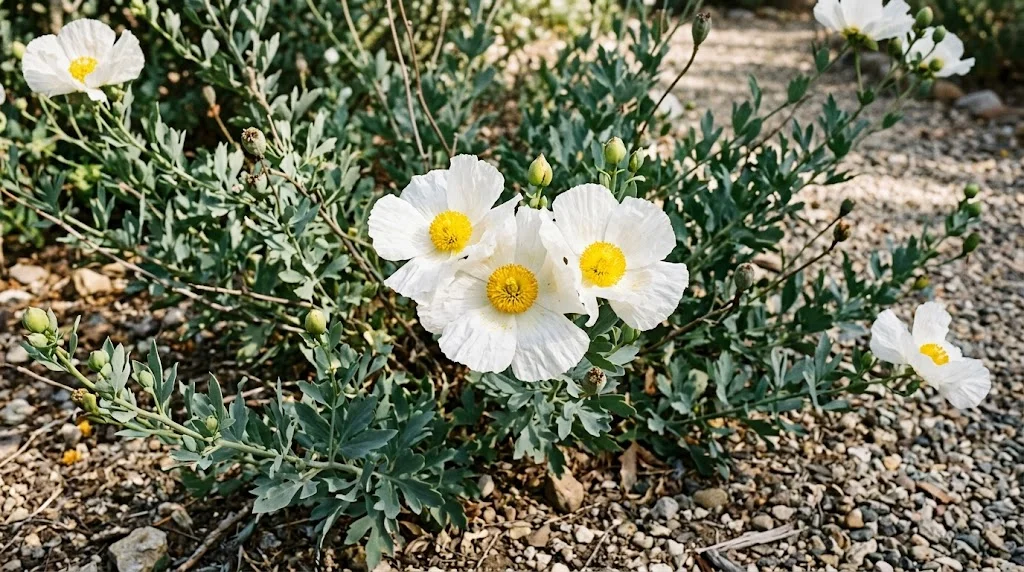

Matilija poppy is fundamentally a sun-loving plant, and light availability has a direct influence on its shape, vigour and flowering performance. In its native environment it commonly grows in open, bright situations where foliage receives intense sunlight for much of the day. Garden specimens respond best when this exposure is reproduced as closely as local climate allows. Although some partial shade can be tolerated, insufficient light usually produces weaker stems, reduced flowering and a less characteristic growth habit.
For the strongest performance, choose a position receiving at least several hours of direct sunlight and preferably close to full-day sun. Morning sun is useful, but prolonged afternoon light is especially valuable in cooler climates where summer temperatures are moderate. The plant’s pale foliage is well adapted to bright exposure. Healthy established specimens generally do not need shading from ordinary summer sun.
Light intensity also influences flower production because the plant requires substantial energy to support its exceptionally large blooms. A shaded specimen may continue producing foliage but generate fewer flowering stems. This can lead gardeners to add fertiliser unnecessarily when the true limitation is light. Improving exposure is usually more effective than increasing nutrition.
The angle of surrounding structures should be considered throughout the growing season. A location that appears sunny in early spring can become shaded later when trees leaf out or the sun’s seasonal path changes. Observe the site over several hours rather than judging it at one moment. This is particularly important because moving an established Matilija poppy can be difficult.
Full sun versus partial shade
Full sun generally produces shorter internodes and stronger, more self-supporting stems. Plants develop their characteristic upright structure and tend to flower more freely. The foliage also dries rapidly after rainfall, reducing the period during which fungal organisms can exploit wet surfaces. These combined effects make bright sites preferable for both appearance and plant health.
More articles on this topic
Partial shade may be acceptable where summers are extremely hot, particularly if the plant still receives strong morning or midday sunlight. Light shade during the hottest late-afternoon period is unlikely to be disastrous in such climates. However, the plant should not spend most of the day in deep shade. The objective is still to provide a high total amount of daily light.
Shade from buildings differs from filtered shade beneath open trees. A wall or dense structure can create a permanently dark zone with limited airflow, while high tree canopies may allow shifting light throughout the day. Root competition beneath trees adds another complication because established woody plants can compete strongly for water. A seemingly suitable patch of dappled shade may therefore be less favourable than expected.
Signs of inadequate light include elongated stems, wider spacing between leaves and a tendency for growth to lean toward the brightest direction. Flowering may become sparse or fail entirely. Correcting these symptoms through pruning alone will not solve the underlying cause. If possible, increase light by removing competing vegetation or relocate young plants before their root systems become extensive.
Managing light in different climates
In cool maritime climates, maximise sunlight aggressively. Matilija poppy benefits from south- or west-facing positions where temperatures and light levels are highest. Reflected warmth from walls, gravel and paving can create a favourable microclimate. These conditions can also help ripen growth before winter.
More articles on this topic
In hotter Mediterranean-type climates, strong sunlight remains appropriate because the species is naturally adapted to heat and brightness. Established plants can tolerate very intense exposure when their roots are healthy. The key is to provide sufficient moisture during establishment without maintaining permanently wet soil. Mature plants generally become considerably more resilient to hot, sunny conditions.
Newly propagated or nursery-grown specimens may need a short acclimatisation period before exposure to extreme sun. Plants raised under shade cloth or in protected structures can experience temporary scorch if moved abruptly into intense outdoor light. Increase exposure gradually over several days where necessary. Once acclimatised, healthy plants should be placed in their intended sunny position.
Light must always be considered together with soil moisture. A plant in full sun and rapidly draining soil may need occasional deep irrigation during establishment, while a shaded plant in heavy soil may remain wet for much longer. Reducing sunlight does not compensate for inadequate watering management, and increasing irrigation does not compensate for shade. The most successful cultivation combines strong light with free drainage and appropriately timed moisture.